
California is one of the largest sources of people moving into Utah, and Utah County gets a large share of them. They arrive for a job in Lehi's tech corridor, for a house they could not afford in the Bay Area, for family, or for a university. They arrive with a set of assumptions about taxes, weather and religion, and most of the assumptions are half right.
This is a practical guide to the half that is wrong. It does not argue for or against the move. It describes what changes in the first year, in the order you will encounter it: money, paperwork, schools, air, culture, and the things you will miss.
The income tax: better, but read the fine print
Utah has a flat income tax. Every dollar of taxable income is taxed at the same rate, and the Legislature has cut that rate repeatedly in recent years, most recently from 4.5 percent to 4.45 percent for tax year 2026 under Senate Bill 60 in the 2026 session. There is no city or county income tax anywhere in the state.
California's income tax is graduated, with rates that climb through the brackets to a top marginal rate above 13 percent for the highest earners. The comparison that matters is not the top rate against the flat rate; it is your effective rate in each state at your actual income. A household earning in California's middle brackets already pays an effective rate well below the headline, and the move to Utah's flat rate saves something, but not the twelve percentage points the headlines imply. A high earner saves a great deal. A retiree should look carefully: Utah taxes Social Security benefits for many filers, with a credit that phases out at moderate incomes, while California does not tax them at all.
Utah's tax also starts from federal adjusted gross income and replaces a standard deduction with a taxpayer tax credit that phases out as income rises, so two households with the same gross income can see different effective rates. Run both returns for the year you move; you will file part-year returns in both states, and the split is by date of residency.
Property tax and the exemption you must claim
Utah property tax is low by national standards and much lower than California's in one important way: it is not locked at purchase price. California's Proposition 13 means a longtime owner pays tax on a decades-old value while a new buyer pays on the current one. Utah reassesses every year at market value, which cuts both ways: your bill will not be frozen, but a neighbor who bought in 1995 is not paying a fraction of what you pay.
The single most important thing to know is the primary residential exemption. Utah reduces the taxable value of a primary residence by 45 percent, so you are taxed on 55 percent of market value, not 100 percent. That exemption is not automatic for a newly purchased home in every county; Utah County requires the owner to sign a declaration that the home is a primary residence. If you do not file it, you are taxed on the full value and the difference is large. Watch for the form from the county assessor after closing.
Effective rates in Utah County run well under one percent of market value for a primary residence. Compare that against California's roughly one percent plus local bonds and parcel taxes, on a purchase price that was probably higher.
Sales tax, gasoline and the small stuff
Utah's combined sales tax in Utah County runs in the low-to-mid seven percent range depending on the city, a shade lower than most California metros. Utah taxes groceries at a reduced state rate, which California does not tax at all, so your grocery receipt will show tax and your restaurant receipt will look familiar. Gasoline is cheaper, both because Utah's fuel tax is lower and because the state does not require California's reformulated blend.
Car registration is a flat fee plus an age-based uniform fee rather than California's value-based vehicle license fee, and it is usually cheaper. Utilities are generally lower; natural gas heating in winter is a new line item for many Californians and electricity is cheap by Western standards.
The DMV clock: sixty days
Utah requires a new resident to register each vehicle within 60 days of establishing residency, and you should get a Utah driver license in the same window. Plan on in-person visits for both.
For the license: Utah's Driver License Division is a separate agency from the DMV that handles vehicles. Bring proof of identity, your Social Security number and proof of Utah residency, and check the division's current list of documents and tests before you go. Appointments are strongly recommended, because local offices book out.
For the vehicle: the Division of Motor Vehicles, under the State Tax Commission, handles titles and registration. An out-of-state vehicle needs a VIN inspection, which can be done at the DMV, at a police department or by a licensed inspection station. Utah County is one of five Utah counties that require emissions testing. Gasoline vehicles in their first few model years are exempt; newer vehicles are tested every other year on a model-year parity schedule, and vehicles roughly six years and older are tested annually. Diesel vehicles from 1998 onward also require a test in Utah County. Utah has eliminated its passenger vehicle safety inspection, so there is no safety check, which surprises people from states that have one.
Your California smog certificate does not transfer. Bring the title, or arrange for the lienholder to send it, and expect a bill for the uniform fee and registration.
Voting, taxes and the residency paper trail
Register to vote when you get your license; Utah votes almost entirely by mail and the county clerk sends a ballot to every active registered voter. Update your address with the IRS, your employer and your bank promptly, because California's Franchise Tax Board takes an interest in people who move out mid-year and keep California ties, and a clean paper trail with a date on it settles the part-year residency question.
If you own a home in California and rent it out, California will tax that rental income regardless of where you live. If you keep a California business, the same applies. None of this is unusual, but people who expect to stop dealing with California on the day the moving truck leaves are surprised.
Schools: districts, calendars and the charter question
Utah County has three public school districts today, and will have five from July 2027. Alpine School District, a very large district by enrollment, historically covered the north half of the county from Orem to Eagle Mountain; voters in 2024 approved splitting it into three new districts, and that reorganization is underway on a multi-year timeline, so the district name on your address may change. Provo City School District serves Provo. Nebo School District covers Springville south to Santaquin. Charter schools are numerous and free, with lottery admission, and a meaningful share of families use them.
The calendar is traditional in most schools: classes start in mid-to-late August and end in late May, with a shorter summer than California's June-to-August pattern. A minority of elementary schools in the larger districts run year-round track schedules with staggered breaks; if that matters to you, ask before choosing a house.
Class sizes are larger than in much of California; Utah has long ranked at or near the bottom nationally in per-pupil spending and near the top in students per teacher. The schools compensate with strong community involvement and, in most neighborhoods, stable families. Advanced programs, dual-language immersion and concurrent enrollment with UVU and BYU are widely available. Special education services exist but families accustomed to California's district resources should meet the school early.
Public universities are cheap for residents. Establishing Utah residency for tuition purposes generally takes a year and has specific rules; a family with a college-bound child should read them before the move.
Housing: what the money buys
The house is why most Californians come, and the arithmetic still works: a detached home with a yard in Utah County costs a fraction of its coastal California equivalent. But the gap has narrowed sharply since 2020, when remote work and in-migration pushed Utah County prices up quickly. A three-bedroom in Lehi, Saratoga Springs or Eagle Mountain is no longer cheap; it is cheaper than San Jose.
Two structural differences matter. Utah is a non-disclosure state: sale prices are not public record, so the price history you are used to seeing on listing sites is estimated rather than recorded. And most Utah County homes have basements, often unfinished, which means square footage numbers include space that may or may not be livable. Ask what is finished.
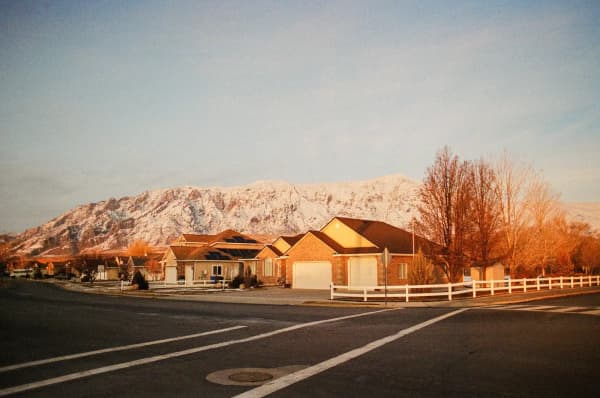
Homeowners' associations are common in newer subdivisions and rare in older Provo and Orem neighborhoods. Water is billed separately from the city, often through an irrigation company for outdoor use in older areas, and secondary water is a concept you will learn.
The air: inversions and smoke
Utah Valley sits in a bowl. In winter, when cold air settles under a lid of warm air, the bowl fills with everything the valley emits and does not empty until a storm pushes through. These inversions can produce very poor air quality for a few days at a time, mostly in December and January, and they are visible from the bench as a brown layer over the lake. The state issues air-quality action days, schools keep children in at recess, and people with asthma or heart conditions stay inside.
The rest of the year the air is clean, with one exception: late-summer wildfire smoke, which drifts in from Idaho, Oregon and California itself for days or weeks. A Californian who has lived through fire seasons will recognize it.
The altitude is its own adjustment. The valley floor is about 4,500 feet, the bench closer to 5,000. Expect a few weeks of tiring more easily, drink more water than you think you need, and use more sunscreen; the sun at altitude is stronger than it feels.
Water, lawns and the desert you moved to
Utah is one of the driest states, and the valley's green lawns are irrigated with mountain water through a system of canals and pipelines built over 150 years. The state and the cities are pushing conservation hard: rebates for removing turf, watering restrictions in dry years, and, increasingly, metered secondary water. A Californian from a drought-conscious county will feel at home; one from a coastal area with greener defaults may be surprised at how seriously a yard is treated as a water decision.
Utah Lake, the large shallow lake at the valley's center, is not a swimming lake in the California sense; it has summer algal bloom advisories in many years and its shoreline is mostly wetland and marina. The recreational water is in the mountains: Deer Creek and Jordanelle reservoirs in the next valley east, and the rivers.
The church next door
The Church of Jesus Christ of Latter-day Saints is not simply the majority faith in Utah County; it is the organizing structure of much of the county's social life, and a Californian will feel that in the first week. Neighbors will bring something to the door. Someone will ask which ward you are in, assuming you are a member. The meetinghouse a few blocks away will be full on Sunday morning and the streets will be empty. Many businesses close on Sunday. Coffee is available and bars exist, but the default social calendar runs through congregations, and if you are not in one you will build a social life through work, schools, sports and the growing number of non-member community groups.
Almost nobody will pressure you. Saying that you are not a member is, in nearly every interaction, the end of the subject. What newcomers report is not pressure but a quieter difference: the absence of the bar-and-restaurant evening culture that is the default in California cities, the earlier hours, and the sense that everyone else has a built-in community that you must assemble by hand. Provo in particular has a large and visible non-member and ex-member population and a growing number of institutions built for them.
Alcohol, cannabis and the rules that surprise
Beer is sold in grocery stores, capped at five percent alcohol by volume. Wine and spirits are sold only in state liquor stores, which close on Sundays and holidays. Restaurants serve alcohol under a system of licenses that requires food with your drink in most cases. Bars exist and are fine; there are simply fewer of them, and none of them are in the neighborhood by default.
Recreational cannabis is illegal. Utah has a medical cannabis program with a state card and licensed pharmacies, not dispensaries, and possession without a card is a crime. A Californian used to walking into a dispensary should understand that the same act here is a misdemeanor at best.
Fireworks are legal in specific summer windows around the Fourth and Pioneer Day, July 24, and illegal the rest of the year and in restricted zones near the mountains.
Driving here
The roads are wide and gridded on a numbered system radiating from a city's center; 800 North is eight blocks north of Center Street, and the addresses tell you where you are. Freeway driving is faster and looser than California's, and the left lane is used as a travel lane more than it should be. Snow tires or a good all-season set matter for perhaps a dozen days a year; the plows are excellent on the freeways and slower in the neighborhoods.
The daily commute, if you work in Salt Lake County, is the Point of the Mountain: a single freeway choke point between the two valleys that turns forty miles into an hour or more at rush hour. FrontRunner commuter rail is the alternative and many people use it.
The seasons you will get
Californians tend to overestimate the cold and underestimate the snow. Winters in the valley are cold but usually dry and sunny between storms; it is the inversions, not the temperature, that people struggle with. Snow falls, melts and falls again; the mountains hold it, the valley floor does not. Spring is short and windy. Summer is hot, dry and long, with afternoon highs in the nineties and cool nights, and it is the season most Californians find easiest. Fall is brief and spectacular.
The mountains are the compensation. Skiing at Sundance is twenty minutes from Provo; the big Cottonwood Canyons resorts are an hour. Hiking starts at the end of most east-bench streets. Five national parks are a day's drive. This is the part of the bargain that Californians say, after a year, they did not fully understand before they came.
What you will miss
The ocean, without qualification. Produce, particularly in winter, and the depth of Mexican, Asian and Middle Eastern grocery and restaurant options, which exist in Utah County and are improving but are not Los Angeles. Late hours. Anonymity. A certain kind of civic messiness that Utah County's orderliness replaces. Friends, obviously.
And what you will stop missing, in roughly this order: the commute, the price of the house, the price of gas, and the feeling that every public system is at capacity.
A first-ninety-days checklist
Register the cars inside sixty days and get the driver license in the same window. File the primary residence declaration with the county assessor. Register to vote. Find the neighborhood school and check its calendar. Set up utilities and ask about secondary water. Learn the grid addresses. Buy a decent snow shovel and a set of tires before November. Find your nearest canyon trailhead. And when the neighbor comes to the door with something on a plate, take it; it is a greeting, not a recruitment.
Related Guides
- Moving to Provo: The Complete Relocation Guide (2026)
- Cost of Living in Provo, Utah (2026)
- The Provo DMV, Decoded: Two Agencies, Two Buildings
- How LDS Wards Work: A Guide for People Moving to Utah Valley
- Moving to Provo When You're Not LDS: The Honest Guide
- Secondary Water and Water Shares: The Second Pipe Utah Valley Runs On
- Health Insurance in Utah, Explained: The Marketplace, Medicaid Expansion, What Happened to PCN, and the Student Plans — Who Qualifies for What Before Open Enrollment (2026)
- Is Gambling Legal in Utah? What the Law Says, and What President Christofferson Asked
Frequently Asked Questions
How much lower is Utah income tax than California's?
Is the cost of living in Utah Valley really lower?
How long do I have to get a Utah driver license and register my car?
Do Utah schools run year-round?
Is the air really that bad in winter?
Will I be pressured about religion?
Can I keep my California vehicle registration if I keep a California address?
What do people from California miss most?
Sources
The facts in this guide were checked against these sources. Hours, fees and rules change, so confirm anything time-sensitive with the source before you go. How we make Provo.com.
- Utah Code 59-10-104 Tax basis -- Tax rate, Utah Legislature. Checked October 12, 2026.
- Utah Code 59-2-103 Rate of assessment -- Residential property, Utah Legislature. Checked October 12, 2026.
- Utah Code 41-1a-202 Definitions -- Vehicles exempt from registration, Utah Legislature. Checked October 12, 2026.
- Utah Code 41-6a-1642 Emissions inspection, Utah Legislature. Checked October 12, 2026.
- S.B. 60 Income Tax Rate Amendments (2026, enrolled), Utah Legislature. Checked October 12, 2026.