
Yoga sits in an unusual regulatory position in Utah, and the two halves of it point in opposite directions.
Nobody licenses your teacher. There is no state credential, no examination, no minimum training, no complaint route to a licensing board. Anyone in Utah may teach yoga tomorrow.
And since May 2026 the studio is outside Utah's fitness center law too. The statute that requires gyms to register, post security for prepaid memberships and honor a three-business-day cancellation right now expressly excludes businesses whose primary operation is yoga or Pilates.
Regulated business, unregulated profession. It is worth understanding which protections you have here, because they are not the ones people assume.
The part that surprises people: there is no license
Utah licenses a great many things. Massage therapists are licensed. Electricians are licensed. Cosmetologists, contractors, tattoo artists' facilities, childcare centers — all regulated, all with a state record you can look up.
Yoga teachers are not on that list.
What exists instead is a private registry. The 200-hour and 500-hour designations you see on studio websites come from an international non-profit that maintains standards for training schools and lists teachers who complete them. It is a genuine and useful credential. It is also entirely voluntary, self-selected, and administered by a private body with no enforcement power beyond removing someone from its own list.
None of this means Provo's teachers are untrained. The opposite is closer to true — this is a market with a lot of experienced instructors and a fairly demanding clientele. But it changes what "checking" means:
- There is no state disciplinary record to search.
- There is no scope-of-practice rule stopping a teacher from offering advice they are not qualified to give.
- There is no continuing-education requirement anyone verifies.
- A teacher removed from a private registry can keep teaching.
So the verification burden is yours, and it is done by watching rather than by looking anything up. More on that below.
The finding: the gym law now leaves yoga studios out
Here is where a statute nobody associates with yoga used to matter, and why it mostly no longer does.
Utah's consumer law for gyms was long called the Health Spa Services Protection Act. In 2026 the Legislature renamed it the Fitness Center Services Protection Act and renumbered it within Title 13, Chapter 23 (effective May 6, 2026). It defines a fitness center, in substance, as a business providing access to a facility for a fee for the development or preservation of physical fitness or well-being through exercise, weight control or athletics. Read on its own, that definition would reach a yoga studio.
But the Act lists exclusions, and the current list names yoga directly. Among the businesses that are not fitness centers:
- A business enterprise whose primary operation is to teach or allow an individual to practice yoga or Pilates.
- A business whose primary operation is to teach self-defense or a martial art.
- Public or private schools, colleges and universities, and the state or a political subdivision — which takes campus and municipal recreation programs out.
- A person offering instruction who uses no employee or independent contractor and grants no use of a facility containing exercise equipment.
- An individual providing professional services within the scope of a license with the Division of Professional Licensing.
The practical upshot: a studio whose main business is yoga is outside the Act, whatever its size or membership model. The protections below apply to the gym down the road that sells yoga classes as part of a general fitness membership, not to the yoga studio itself.
The lesson generalizes: check whether a consumer statute covers your particular business before relying on it, and check again after each legislative session. Being wrong about protection you do not have is worse than not knowing.
What the Act gives a gym member, for comparison
Where a business is a fitness center, the obligations are concrete, and they are worth knowing because they show what a yoga membership does not carry.
Registration. A fitness center may not operate a facility in Utah without registering it with the Division of Consumer Protection.
Security for prepaid money. Unless exempt, the business must maintain security such as a bond or certificate of deposit covering prepaid contracts.
A capped contract term. No contract longer than 36 months, and no lifetime memberships.
A written contract with specified contents, including the fitness center's rules, cancellation and refund policies, and an email and mailing address for rescission.
A three-business-day rescission right. You may rescind by email or mail before midnight of the third business day after signing (or after your location opens, if it was not yet operating).
For a yoga studio, none of this is required by that statute. Pay per class or monthly until you trust a studio, keep prepayment small, and pay by credit card, which gives you a dispute route if a business closes with your money.
What is available in Provo
The valley supports a reasonable spread of styles, and the practical question is usually which kind of room you want rather than which brand.
Vinyasa and power dominate the studio market here — flowing, athletic, usually with music, usually the default when a schedule just says "yoga."
Hot and heated classes are widely available, and see the climate note below.
Hatha and slow flow are the gentler, more instruction-heavy end, and are the better starting point for anyone who has not done this before, whatever the internet says about jumping straight in.
Yin and restorative are long-hold, low-intensity, prop-heavy classes aimed at connective tissue and recovery rather than exertion. They are also the most useful complement to a heavy lifting or running routine.
Prenatal is offered intermittently rather than universally, and availability changes; call rather than relying on a schedule page.
Campus and community options are a genuine part of the picture in a student town. University recreation programs and city recreation centers both run classes, both are excluded from the Health Spa Act, and both are usually the cheapest way to try the practice at all. For the wider fitness picture, see our guide to gyms in Provo — many of them include yoga in a general membership, which is a different value proposition from a dedicated studio and a different contract.
The altitude and the air
Two local conditions change how yoga feels here, and both catch people who have moved from lower and wetter places.
Provo sits at roughly 4,550 feet. Anyone arriving from near sea level should expect to be more breathless than their fitness justifies for the first couple of weeks, and heated classes amplify that considerably. This is not a fitness problem and it resolves, but pushing through it in a hot room is how people end up sitting on the floor.
The air is dry. Utah Valley humidity is low most of the year, and fluid loss in a heated class is faster than the same class would produce in a humid climate. Hydrate before rather than during — a large volume of water drunk in class is uncomfortable and largely too late.
Winter inversions matter for anyone with respiratory sensitivity. During a bad inversion the valley's air quality can be poor for days at a time, and a heated indoor class is not a refuge from it unless the studio filters. If you are asthmatic, this is a reasonable thing to ask about.
The money, without quoting numbers
Rates move too fast for a guide to track honestly, so what follows is the ordering rather than the prices — and the ordering is durable.
Drop-in is the most expensive per class and the cheapest way to be wrong. You pay a premium for committing to nothing. For a first visit anywhere, that premium is worth it.
Class packs sit in the middle and usually carry an expiry date. The expiry is the thing to read. A pack of twenty classes expiring in three months is a different product from the same pack expiring in a year, and studios price them as though they are the same.
Memberships are cheapest per class and only if you go. The arithmetic that makes a membership sensible assumes an attendance rate most people do not sustain past the first six weeks. Work out how many classes a month you would need to attend for the membership to beat a pack, then ask yourself whether you attended anything that often last year.
Introductory offers are the best value in the market and are designed to convert you. Use them across several studios before choosing one.
Community, donation and campus classes are the floor, and in a university town there are more of them than most people realize.
One structural note: every money-protection question raised in this guide attaches to prepayment, and a yoga studio carries none of the statutory gym protections. Pay per class and none of them can hurt you. That is not an argument against memberships, which are cheaper for regular attenders. It is an argument for earning your way into one rather than starting there.
Your first class, practically
Arrive early enough to speak to the teacher. Ten minutes. Tell them it is your first time and mention anything relevant — a knee, a back, a pregnancy, a recent surgery. This is the highest-value ninety seconds of the whole experience.
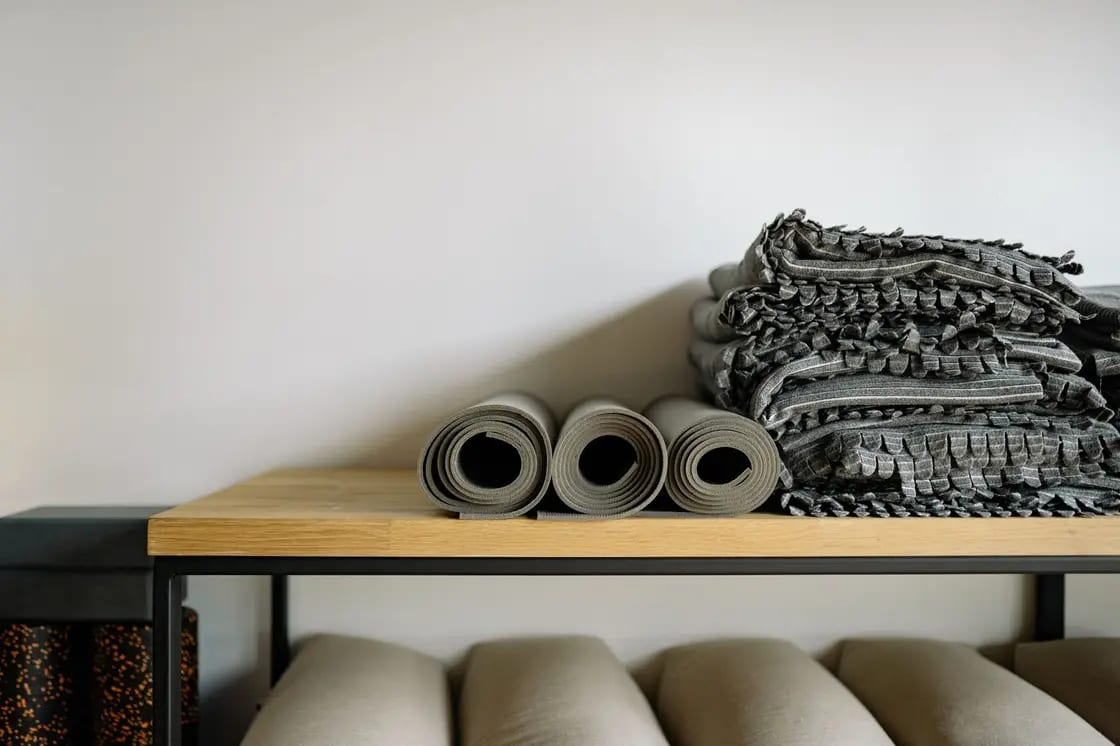
Ask whether mats are provided. Most studios rent or lend them; heated studios will usually also rent a towel, and in a hot class you will want one.
Bring water, and less of it than you think you need in class. Drink beforehand.
Do not eat immediately before. Two hours is the usual advice and it is sound, particularly for anything involving inversions or twists.
Take the modification. Every competent teacher will offer an easier version of most shapes. Taking it is not failing at the class; the class has no score.
Rest whenever you want. Sitting down or lying down in the middle of a class is normal and unremarkable in a well-run room. If a teacher makes you feel otherwise, that is information about the teacher.
Skip the phone. Almost every studio asks for phones out of the room, and the ones that do not still expect them silent.
Choosing a teacher when the state will not help you
Since there is no license to check, substitute observation. These are the things that distinguish a well-run room, and none of them require you to know anything about yoga.
Do they ask about injuries before class? A teacher who takes thirty seconds to ask the room, and who then adjusts what they offer, is doing the single most protective thing available.
Do they offer options rather than one shape? "If that does not feel good, do this instead" is the mark of someone teaching bodies rather than a sequence.
Do they ask before touching you? Consent for hands-on adjustment should be sought — a card, a show of hands at the start, or asking in the moment. Adjustment without consent is a genuine problem and it is not a matter of taste.
Do they avoid medical claims? A teacher who tells you yoga will fix your herniated disc, cure a condition, or replace treatment is outside anything they are qualified to say — and with no licensing board, there is nothing stopping them but their own judgment.
Is the room the right size for the level? A packed beginner class with one teacher and no assistant means nobody is watching you.
Try before you commit. Nearly every studio runs an introductory offer. Use it to sample several studios rather than to get a discount at the first one you walk into, and do not buy a year of anything until you have proved to yourself that you will turn up in February.
Where the absence of a license costs money
The section above makes the point that Utah does not license yoga teachers. For a student paying for drop-in classes, that is mostly an abstraction — a bad class costs you an hour. The place the absence bites is teacher training, because that is where the sums stop being small.
A 200-hour teacher training is the largest single purchase most people make in this corner of the industry, and it is sold to a predictable audience: someone two or three years into a practice, mid-career or between careers, who has started to think of the studio as the best room they spend time in. That is not a naive buyer. It is an emotionally invested one, which is a different thing and a more expensive one.
Yoga Alliance is a registry, not a regulator, and the difference is the whole point. A school listed as an RYS has represented that its curriculum meets a published standard. Nobody from the state inspects it, nobody audits the hours, and the credential a graduate receives is a private certification rather than a license to practice anything. That is not an accusation — plenty of registered schools are excellent. It means the letters after a training's name are a claim by the school about itself, and they should be weighted accordingly.
So the diligence has to be done by you, and it is the same diligence the choosing-a-teacher section above describes, applied to a purchase two orders of magnitude larger:
- Ask who teaches which hours. Trainings are frequently marketed under the name of a senior teacher and delivered largely by others. That can be fine. It should not be a surprise.
- Ask what the refund terms are before the first weekend, in writing. Trainings run for months; life events inside a six-month window are normal rather than exotic, and the policy is the thing that decides whether an interruption costs you the balance.
- Ask what graduates are doing. Not how many graduated — how many teach, where, and how the studio helped them get there. A training that places its graduates has an answer ready.
- Ask whether the studio hires its own graduates, and if not, why not. It is a fair question and the answer is informative in either direction.
- Sit in on a session if you can. A studio confident in its training will find a way to let you.
The insurance point that catches new teachers. Teaching yoga is one of the activities where liability coverage is normal practice and is generally arranged by the teacher rather than supplied by a license. Studios commonly require proof of it before putting anyone on a schedule. It is worth knowing that this cost exists before the training rather than after it, because it belongs in the arithmetic of whether a training pays for itself.
None of this is a reason not to train. It is a reason to treat a training like the several-thousand dollar unregulated purchase it is, rather than like a deeper version of a class pass. The studios in this valley that run good trainings will answer every question above without flinching. That willingness is the signal the state is not providing.
Related Guides
- Best Gyms in Provo
- Massage Therapy in Provo
- Healthcare in Provo
- Student Health & Wellness
- Chiropractic vs. Physical Therapy in Utah Valley
- Vets in Utah Valley: The Midnight Gap Nobody Tells You About Until 1 a.m.
- Dog Grooming in Provo: There Is No License to Check, So Here Is What to Ask Instead
- Adopting a Pet in Utah County: Two Shelters, No Humane Society, and Nobody Open on Saturday
- The Fault Under Utah Valley: What the Forecast Actually Says, and What It Leaves Out
- Getting a Passport in Utah County: Two Payments, One Building, and the Check Nobody Brings
- Power Outages in Provo: The City Would Rather You Didn't Call — Except When It Really Wants You To
- CrossFit, Pilates and Barre in Utah Valley
Last updated: October 2026. The fitness center discussion is drawn from Utah Code Title 13, Chapter 23 (the Fitness Center Services Protection Act, renamed and amended by Chapter 95 of the 2026 General Session, effective May 6, 2026). Whether the Act applies to any particular business depends on that business's specific structure and offerings, which we have not assessed individually — this is general information, not legal advice, and the Division is the authority on registration status. Class schedules, styles and pricing change constantly; verify with studios directly.
Frequently Asked Questions
Does Utah license yoga teachers?
So is a yoga studio regulated at all?
Which yoga businesses fall outside Utah's fitness center law?
What contract rights do I have when I buy a membership?
Should a yoga studio be registered with the state?
Is my prepaid yoga membership protected if the studio closes?
Is hot yoga safe in Utah's climate?
What is a fair way to try studios without overcommitting?
Does a yoga teacher in Utah need a state license?
What should I ask before paying for a 200-hour teacher training?
Sources
The facts in this guide were checked against these sources. Hours, fees and rules change, so confirm anything time-sensitive with the source before you go. How we make Provo.com.
- Utah Code Title 13 Chapter 23 Fitness Center Services Protection Act, Utah Legislature. Checked October 12, 2026.