
Ask a family that has just moved to Utah County from Ohio or New Jersey where the Little League field is and you will get a confused pause. There is not one, or not really: Little League International, the organization that runs the tournament everyone watches in August, charters only a handful of leagues in Utah, and almost none of them are in this county. Youth baseball here is organized the way most youth sports are organized here — by the cities' parks and recreation departments, city by city, with a couple of independent volunteer leagues and a growing private travel-ball tier layered on top. The sport is enormous and cheap at the bottom and expensive and scattered at the top, and it runs on a registration calendar that closes in late winter, months before the first pitch.
This guide explains how the valley's youth baseball and softball are organized: the ladder from t-ball to the draft leagues, what the cities charge and when they close registration, what Orem Youth Baseball is and why it exists apart from the city, where girls' fastpitch splits off, what fall ball and travel ball add, and how to read a season for a child who is six, nine or thirteen. Our youth sports overview covers every sport in one place; this page is the one for the diamond. Fees and dates are from the cities' and leagues' published 2026 pages and are hedged accordingly; every program republishes them each winter.
Who Actually Runs the Sport
Three kinds of organization, and a family usually deals with only one of them per child per season.
The city recreation departments are the base. Provo, Lehi, American Fork, Pleasant Grove, Spanish Fork, Springville, Payson, Saratoga Springs, Eagle Mountain and most of the smaller cities each run their own baseball and softball program: t-ball for the youngest, coach-pitch or machine-pitch for first and second grade, and drafted "minor" and "major" leagues from third grade up into junior high. The city owns the fields, hires the umpires, buys the shirts, and registers the children; parents coach. Provo's program runs out of the Recreation Center with games at Fort Utah Park for the younger draft leagues and Sunset View Park for the older ones; other cities use their own park complexes.
The independent volunteer leagues fill the gaps the cities leave. The largest is Orem Youth Baseball, a decades-old nonprofit that has run baseball for the valley's second-largest city out of the City Center Ballpark near Center Street, separate from Orem's own recreation department, with its own registration (opening around February 1), its own draft, its own umpires and its own concession stand. A family in Orem looking for city-run baseball will find that the city points them to OYB. Some of the smaller cities have similar arrangements, and a few neighboring cities share a league.
The private travel organizations sit on top. These are the accelerated, comp and club teams — the baseball equivalent of the competition soccer clubs in our youth soccer guide — formed by tryout, coached by paid or semi-professional coaches, and playing tournaments most weekends from April into July. They are the pipeline to the high-school programs and, for a very few, beyond. They cost what club soccer costs and take what club soccer takes.
The absence in that list is Little League. Little League International charters leagues by fixed geographic boundary, and its Utah footprint is thin; the leagues that exist are mostly along the northern Wasatch Front. A family that wants the Little League experience specifically — the all-star tournament, the district and state brackets, the August broadcast — should check Little League's own league finder for its address, but should expect to find that the sport here runs on other rails. It is not a deficiency; the cities' draft leagues and the travel tier do the same jobs. It is simply a different map.
The Ladder, Rung by Rung
The names vary by city, but the structure is the same everywhere in the valley, and it tracks school grade rather than birth year (the opposite of soccer).
Parent-and-child (ages three to five). A few cities, Provo among them, run a short parent-participation program in May: a few weeks, twice a week, at the rec center, a parent on the field with the child. It is a class more than a league, and it is the right first exposure for a three-year-old.
T-ball (kindergarten; some cities take preschool). The ball sits on a tee, every child bats every inning, nobody keeps score, and the outfield is a lesson in entropy. Provo's t-ball runs in late spring for a modest fee. One practice and one game a week, usually a weeknight. The jersey or t-shirt is included or a few dollars extra.
Coach-pitch and machine-pitch (first and second grade). A coach pitches to their own team's batters — or, in the cities that have switched, a pitching machine does, which removes the coach's arm from the equation and gives every batter the same pitch. Provo runs these with boys and girls separate, in late spring. This is the rung where children start to hit the ball with some regularity and where the game first looks like baseball.
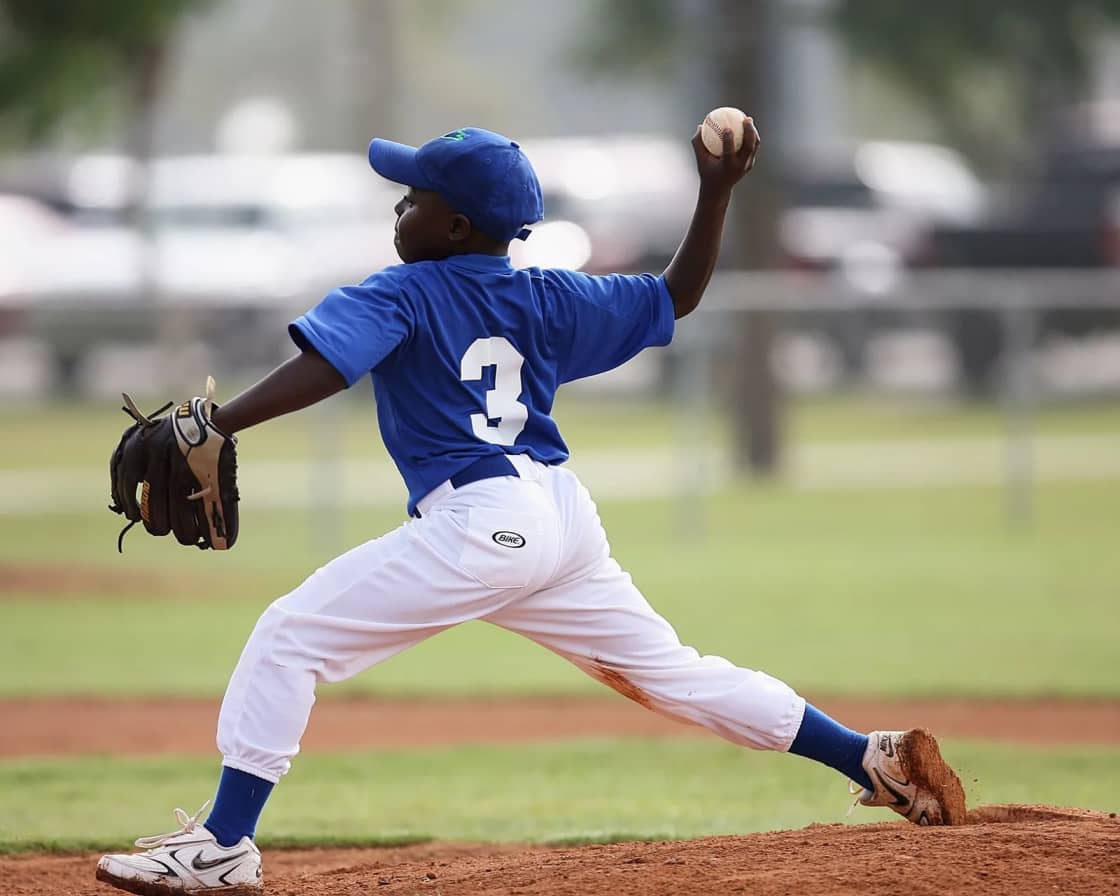
The draft leagues (third grade up to eighth or ninth). Children pitch. Umpires call the game. Standings are kept. And the teams are formed by a draft: an evaluation day in April where each registered child throws, fields and hits in front of the volunteer coaches, followed by a draft that distributes ability across the teams. Provo's draft leagues run from late spring into summer, with separate boys' baseball and girls' softball divisions; American Fork drafted its third-through-eighth-grade teams in early March after a January-to-February registration window. This is the rung where the sport gets serious, where the season is longest, and where a child who is clearly better than the field will start to hear about travel ball.
Fall ball. A shorter, lighter season in August and September, offered by some cities (Provo has published a fall draft league for third through sixth grade, boys and girls combined, with July registration and an August season) and by most travel organizations. Fewer games, more instruction, less pressure on the standings. It is the best-value baseball of the year.
Girls' fastpitch. In most cities boys and girls play together through coach-pitch and split at the draft-league age, with the girls moving to fastpitch softball under the same recreation department. Above rec, girls' fastpitch has a competition ecosystem of its own — accelerated and travel teams that play tournaments across the Wasatch Front all summer — feeding the high-school programs, which are strong in the valley. A girl who prefers to stay in baseball can, in most rec leagues, through the draft-league ages; it is unusual but not prohibited.
What It Costs, and What the Fee Does Not Cover
The city fees are small, rising from the youngest rungs to the draft leagues, and the cities publish them each winter. Orem Youth Baseball's fees are in the same range and cover its umpires and equipment.
What the fee does not cover is the gear, and the gear is where new families get surprised. A glove ($30 to $80 for a child; more as they grow), cleats (soccer cleats work until the draft leagues; baseball cleats from then on), a batting helmet (many leagues supply a shared set, but a child's own is better and required in some draft leagues), and a bat. The bat is the expensive item and the one with a rule attached: youth baseball in the United States runs on bat standards — USA Baseball for most rec leagues, USSSA for many travel leagues, BBCOR for high school — and a bat legal in one is illegal in another. Ask the league which standard it enforces before buying anything; a compliant youth bat runs from about $40 to well over $300, and the expensive ones are not necessary below the draft leagues. Softball has its own standards.
Travel ball is a different order of money: from several hundred dollars for a modest local organization to a few thousand a year for one that travels out of state, plus hotels and gas for tournament weekends, plus the private lessons that travel-ball culture treats as normal. A family should ask any travel organization for last year's total per-player cost including tournament entry and travel, exactly as with club soccer.
The Calendar: The Trap Is February
Baseball's registration calendar is the earliest of any youth sport in the valley, because the draft has to happen before the fields thaw.
- January: the cities post their spring baseball and softball pages and open registration. Check each city's page and Orem Youth Baseball's site for the exact opening date.
- Late February to mid-April: registration closes. American Fork closed February 25; Provo closed April 19 for its main leagues. A child who registers after the close is placed only if a roster has room, and in the popular age groups it does not.
- March–April: evaluation days and drafts. Parent meetings, increasingly streamed. Coach meetings. Provo's draft leagues began play in late April.
- May–July: the season. T-ball and coach-pitch are the shortest (six weeks in May and June); the draft leagues run into mid-July, ending before the Fourth-of-July weekend disrupts everything.
- July: fall-ball registration.
- August–September: fall ball.
- Year-round for travel: tryouts in late summer or fall for the following year; winter indoor training at the private facilities; a spring-to-July tournament season.
The trap is the one soccer families do not have: the season most families think of as "summer baseball" has a registration deadline in late winter, and a family that starts looking in April will find the t-ball league open and the draft leagues full.
Umpires, Coaches and the Parent Meeting
Three practical notes on how a rec season runs, because they are the parts that surprise first-year families.
The coaches are parents, drafted alongside the children. A city recruits its draft-league coaches from the parents who check the box at registration, and the coach meeting — Provo held its 2026 meeting the evening after the parent meeting, with equipment check-in the same night — is where they get the bag of balls, the bases, the roster and a rule sheet. A family that has a parent willing to coach should say so at registration; the leagues are always short, and a coached team practices more.
The umpires are teenagers, paid by the city, trained in a clinic in April. They call the draft leagues; the younger rungs have none. A parent who yells at a fifteen-year-old umpire from the bleachers will find that the leagues have a policy, and in this valley the policy is enforced, because the umpires are somebody's kid and the city knows their mother.
The parent meeting is mandatory in name and streamed in practice. Provo ran its 2026 meetings on a Monday evening on YouTube Live, one for the younger leagues and one for the draft leagues, and posted the recording. It covers the schedule, the bat rule, the rainout procedure, the sunscreen and water expectations, and the code of conduct. Watch it; the bat rule alone is worth the half hour.
And rainouts: the valley's spring is wet in fits, and the cities text or app-notify a cancellation by mid-afternoon. Make-up games land on Saturdays, which is the one day the schedule otherwise leaves free, and which is why a draft-league family should not book anything on a Saturday in May until the season is over.
Where the Games Are
Rec games are on city park diamonds, which in this valley means the big multi-field complexes each city has built: Fort Utah Park and Sunset View Park in Provo; City Center Ballpark in Orem; the sports complexes in Lehi, American Fork, Spanish Fork and Saratoga Springs. Most are a few minutes from home, and the evening games — t-ball at 5:30, draft leagues at 6 and 7:30 — are the summer rhythm of half the families in the valley.
Travel tournaments use the same complexes and the larger ones: the county's showpiece Epic Sports Park in west Provo has diamonds alongside its soccer pitches, and the Spanish Fork and Lehi complexes host weekend brackets all spring. A travel family should expect to spend Saturdays at one of them from April through July.
Watching the sport played well is easy here, too. UVU's baseball program plays at UCCU Ballpark in Orem, with a berm that makes it the valley's best cheap family afternoon in April, and BYU's program plays at Larry H. Miller Field on campus; a nine-year-old who has just been drafted onto his first real team should be taken to one game at each.
How to Read a Season for a Particular Child
Five or six: t-ball at the city. One season. The goal is that the child wants to come back.
Seven or eight: coach-pitch or machine-pitch. Two seasons. Buy a glove that fits and a helmet; borrow a bat. If the child asks for more, fall ball.
Nine to eleven, in a draft league: this is where most children find their level. A child who is drafted high and dominates the league will be approached about travel ball by the end of the season — often by a parent-coach forming a team. A child who is drafted in the middle and enjoys it should stay in rec, add fall ball, and revisit at twelve. A child who is drafted low and struggles should be asked, privately, whether they want to keep playing; the answer is often yes, and rec is built for that.
Twelve to fourteen: the rec draft leagues thin out as the strong players leave for travel and the rest leave for other things. A child who wants to play in high school needs, realistically, to be in a travel program by thirteen; the high-school coaches recruit from it. A child who wants to play for fun has the city's junior-high divisions and, in some cities, an adult-style rec league at fifteen.
Any age, the family cannot do weekends: rec plus fall ball is a full, good baseball childhood. Travel ball is a choice, not a requirement, and the valley's high-school rosters have players who never did it.
The Three Mistakes New Families Make
They look for Little League and, not finding it, conclude the valley has no baseball. It has more than most places; it is filed under the city.
They start looking in April. The draft leagues closed in February or March. T-ball is still open; the rest is not.
They buy the bat first. Ask the league which bat standard it uses, then buy the cheapest compliant bat that the child can swing, then upgrade in the draft leagues if the child stays.
And a fourth, the expensive one: they say yes to the first travel team that asks, in the glow of a good draft-league season, without asking what it costs or how many weekends it takes. Ask both. The answer to the second question is usually "all of them."
The Short Version
Utah Valley's youth baseball and softball run through the city recreation departments, an independent volunteer league in Orem, and a private travel tier on top — not through Little League. The rungs are t-ball, coach- or machine-pitch, and the draft leagues, tracked by school grade. City fees are modest; the gear, especially the bat, is the real cost, and the bat has a rule. Registration opens in January and closes in late winter for a spring draft, which is the trap. Fall ball in August is the best-value season. And travel ball, when it comes calling, is a choice about weekends first and money second.
Related Guides
- Youth Sports in Utah Valley: City Rec, Club Teams & What It Costs
- Youth Soccer in Utah Valley: Rec, Club, Academy
- Jr. Jazz in Utah Valley
- The Complete Guide to Epic Sports Park
- Summer Camps in Utah Valley
- The UVU Wolverines Game-Day Guide
- The Provo Recreation Center
- Sports Medicine in Utah Valley
- Gymnastics, tumbling and cheer gyms — the other big youth track in the valley
- Youth Sports Registration Calendar — every sign-up window we can verify, by sport, city and age
Frequently Asked Questions
Is there Little League in Utah Valley?
What does a season of city rec baseball cost?
When does registration close?
What is the difference between coach-pitch, machine-pitch and the draft leagues?
What is Orem Youth Baseball, and how is it different from the city program?
Where do girls play softball, and at what age does it split from baseball?
What is travel ball, and when does a family need to think about it?
What about fall baseball?
Sources
The facts in this guide were checked against these sources. Hours, fees and rules change, so confirm anything time-sensitive with the source before you go. How we make Provo.com.
- Baseball / Softball, Provo City Parks and Recreation. Checked October 12, 2026.
- Provo City Parks and Recreation: Sports, Provo City Parks and Recreation. Checked October 12, 2026.