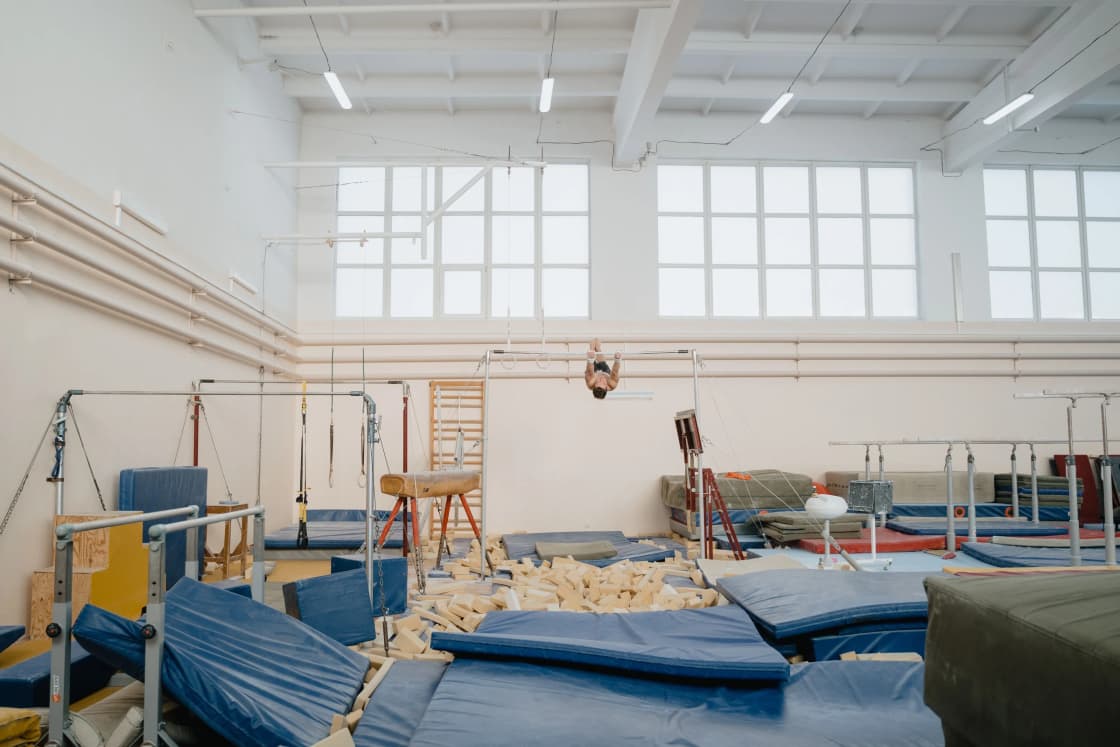

Drive any commercial strip in Utah Valley and you will pass a gymnastics gym. Then another one. The density is unusual, and it means a family shopping for one has real choice — and no obvious way to compare.
This covers the difference between the tracks on offer, what each costs in money and hours, how to evaluate a gym you are standing in, and how to avoid the specific mistakes families make in this sport. Prices, schedules and program offerings change constantly; confirm everything current with the gym directly.
Why there are so many
Utah County has one of the youngest population profiles in the country and a deep culture of organized children's activity. That alone would support a lot of gyms.
Layered on top is the state's gymnastics and cheer tradition, which runs through the university programs and into a large recreational base. Competitive cheer in particular has a strong following here.
The result is a market with more suppliers than most places its size, which is good for families. Competition keeps prices honest and gives you the ability to walk away from a gym that is not working.
The four things a gym might be selling
Understanding this taxonomy will save you a lot of confusion, because gyms use the words loosely.
Recreational gymnastics is a weekly class. Your child learns skills on floor, beam, bars and vault at a pace suited to a class group. No travel, no qualification, no selection. This is what most children should be doing.
Competitive artistic gymnastics is a team program with levels, multiple practices per week, meets, and a roster chosen by coaches. It is a substantial commitment for the whole family.
Tumbling is floor skills only — the running passes, flips and connected series used in cheer and dance. No apparatus. Many children take tumbling as a support activity for another sport.
All-Star cheer is competitive cheerleading run by private gyms, with its own level structure, season and national competitions. It is separate from school cheer and it is expensive.
A single gym may offer all four. Read the class description rather than the gym's name.
Recreational is the right answer for most children
The default assumption in a competitive sport is that the goal is to advance. In gymnastics, that assumption costs families a great deal of money and a great deal of family time, and it is not what most children need.
Recreational gymnastics is excellent for children. It builds strength, body awareness, balance and confidence in a way few activities match, and it transfers to every other sport. A child can do recreational classes for years, get real benefit, and never compete.
If your child loves it and is clearly gifted at it, the competitive path will find you — coaches recruit from recreational classes. You do not need to push toward it.
What competitive asks of you
Before joining a team program, get the full picture in writing.
The time commitment is several practices a week, often three hours or more each, plus meets on weekends during the season. For a family, that is most of your discretionary evening time.
The financial commitment is monthly tuition several times higher than recreational, plus meet entry fees, plus competition leotards or uniforms, plus travel to meets — which in this sport frequently means out of state — plus a share of coaches' travel expenses.
The scheduling commitment is the one families underestimate. A team schedule does not flex around a family vacation, a sibling's activity, or a work trip. Ask directly what the attendance expectations are and what happens when they are not met.
None of this is an argument against competitive gymnastics. It is an argument for knowing the number before you say yes.
How to evaluate a gym you are standing in
Go watch a class in the age group and level your child would join. Any gym that will not let you observe is telling you something.
Watch the ratio. How many children per coach, actually, in that class? Count them. A number on a website and the number in the gym are different things.
Watch the spotting. Is a coach physically present at the skill being learned, or supervising from across the floor? At the levels where children are learning inversions, this matters.
Watch the waiting. How much of the hour is a child standing in a line? Some queueing is inevitable with rotations. A class where children spend most of the time waiting is a class that is too big.
Watch the equipment. Mats in good condition, no gaps at seams, pits maintained, chalk and grips available. Wear is fine. Damage is not.
Watch the tone. How do coaches talk to children who are struggling or frightened? This is the single most informative thing you will observe, and it takes about five minutes to read.
The questions to ask at the desk
What certifications do coaches hold, and who is certified in the class my child would be in?
What background checks are run on coaches and on anyone else who has contact with children?
What is the make-up policy for missed classes, and does tuition run continuously or by session?
What is the notice period to withdraw, and is there an annual registration fee that is charged regardless?
How are children moved up a level, who decides, and how often does that happen?
Ask all of these before signing anything. A well-run gym answers them without hesitation because it is asked them constantly.
Body talk, and a line worth holding
Gymnastics and cheer are sports where bodies are visible, judged and discussed, and where the culture historically has not always handled that well.
Pay attention to how a gym talks about children's bodies. Coaching about strength, control and technique is the job. Commentary about a child's weight or shape is not, and it should not be happening in a recreational class at any age.
If you hear it, that is enough information to leave. There are plenty of gyms in this valley and you are not obliged to keep your child in one that talks that way.
Injuries, and what to expect
Gymnastics has a real injury profile. Wrists, ankles, backs and elbows carry load, and overuse injuries are more common than dramatic ones, particularly in children training many hours a week.
A gym with a sensible approach will manage volume, build strength before skills, and take complaints of pain seriously rather than coaching through them. Ask what happens when a child says something hurts.
For a child in a high-volume program, having a relationship with a physical therapist or sports medicine provider before you need one is sensible. Our guide to chiropractic versus physical therapy in Utah Valley covers which is which.
Cheer, and the school-versus-All-Star split
School cheer runs through junior highs and high schools, tries out annually, and is tied to the school calendar and to supporting school athletics.
All-Star cheer runs through private gyms, has its own competitive season and level structure, and travels to national competitions. Children frequently do both, which compounds cost and time.
Tumbling classes are the connective tissue — most children on either track take tumbling year-round to build and maintain skills, and for many Utah Valley gyms this is their largest enrollment.
If your child's goal is to make a school squad, ask gyms directly which of their classes are designed for that, because it is a different skill emphasis than artistic gymnastics.
Toddlers and preschool classes
Almost every gym runs parent-and-child classes for walking toddlers and independent preschool classes from around three.
These are good and they are also not necessary. A toddler who spends a lot of time at parks and playgrounds is developing the same capacities. If a class fits your week and budget, it is a pleasant thing to do together. If it does not, your child is not falling behind.
For families weighing options at this age, our guides to things to do with toddlers in Utah Valley and destination playgrounds beyond Provo and Orem cover the free alternatives.
Open gym, which is underused
Most gyms run open-gym sessions where children can use the equipment with supervision but without a class structure, usually for a drop-in fee.
This is the best value in the sport. It is cheaper than a class, it requires no enrollment commitment, and it is a good way to find out whether your child enjoys the environment before you sign up for months of it.
It is also a good option for a child who likes gymnastics but does not want a class, and for snow days and school breaks when you need somewhere for a child to burn energy.
Cost management, honestly
Ask about sibling discounts, which most gyms offer and few advertise clearly.
Ask whether tuition is monthly or per session, and what happens over school holidays — some gyms charge continuously regardless of how many weeks fall in a month.
Buy competition gear secondhand where the program allows it. Leotards in particular hold up well and there is an active resale market among gym families.
And revisit the decision annually rather than drifting. Enrollment tends to renew by default, and families frequently continue paying for a class their child stopped enjoying a year ago.
Boys' gymnastics, which is harder to find
Men's artistic gymnastics uses a different apparatus set — rings, pommel horse, parallel bars, high bar — and requires equipment and coaching that not every gym maintains.
In practice this means a Utah Valley family looking for a full boys' program has fewer options than a family looking for a girls' program, and may need to drive further. Some gyms run boys' recreational classes without a competitive men's track, which is fine for most children.
Call ahead and ask specifically what apparatus the boys' class uses and whether there is a path beyond recreational. The answer varies more than you would expect between gyms that look similar from the parking lot.
Tumbling classes, by contrast, are widely available to boys and are often where boys who like the sport end up, particularly if they are also doing another sport that benefits from the skills.
What good progress looks like
Parents frequently expect visible skill advancement every few weeks and worry when it does not appear. That expectation is wrong for this sport.
Gymnastics progresses in long plateaus punctuated by sudden jumps. A child can work on the same skill for months, appear to be getting nowhere, and then acquire it in a single session. Strength and body awareness are being built the whole time even when nothing new is visible.
What should be visible over a season is better body control, better landings, more confidence going upside down, and more comfort in the gym. If those are improving, the class is working, regardless of whether a named skill has been ticked off.
If a year passes with no change in any of those, that is worth a conversation with the coach before it becomes a reason to leave.
When to leave a gym
If your child dreads going, that is information. Children who love a sport occasionally do not want to go; children in the wrong environment stop wanting to go consistently.
If the class has grown too big and the gym will not move your child, if coaches turn over constantly, if you cannot get a straight answer about billing, or if you hear the body talk described above — leave. Switching gyms in this valley is easy because there are so many, and gym loyalty is not something your child owes anyone.
The competitive levels, briefly
Artistic gymnastics uses a numbered level system that runs from entry compulsory levels through optional levels, with skill requirements at each stage and qualification scores needed to advance. All-Star cheer uses its own separate level structure.
You do not need to understand this system to enroll a child in a recreational class, and gyms will explain it if your child moves toward team. What is worth knowing early is that the levels are national frameworks rather than gym-specific inventions, so a level means broadly the same thing if you move gyms or move states.
Be cautious of any gym that describes its own internal class names as though they were national levels. Ask directly whether a "level" they are quoting is the recognized competitive level or an in-house label for a recreational class. Both are legitimate; conflating them is not.
Scheduling around the rest of your life
Gym schedules are built around the gym's floor time, not around your family. Popular class slots — immediately after school, early evening — fill first and stay full.
If you have several children in activities, book the gymnastics slot first if it is the least flexible, then build around it. Gyms with multiple locations in the valley sometimes have availability at one site and none at another, and it is worth asking rather than joining a waitlist at the nearest one.
Also ask how the gym handles the summer, because schedules frequently change entirely and some programs pause. Families who assume continuity through August are regularly caught out.
Trial classes and how to use them
Most gyms offer a trial class or will let a child join mid-session on a prorated basis. Use this.
Do two trials at two different gyms in the same week if you can. The comparison is far more informative than either visit alone, because you have nothing to calibrate against until you have seen two.
Watch your child rather than the class. A child who is engaged, attempting things, and looking to the coach for feedback is in the right room. A child who is disengaged or anxious in one gym and not the other has told you something that no amount of program comparison would have.
And ask your child afterward what they thought, before offering your own view. Their answer at seven is worth taking at face value more often than parents assume.
A note on parties and drop-in events
Many Utah Valley gyms run birthday parties and holiday camps alongside their classes, and these are popular — an open gym full of equipment is close to an ideal party venue for this age group.
If you are only curious about gymnastics, a party or a camp day is a low-commitment way in. Our guide to kids' birthday party places in Utah Valley covers how gym parties compare with the other options on price and hassle.
Camps during school breaks serve a similar purpose and tend to book early, particularly in the summer. Our summer camps guide covers the registration clock across the valley, which runs earlier than most families expect.
Where this fits
Gymnastics sits alongside the other youth tracks in the valley, and our overview of youth sports in Utah Valley covers how rec, club and school programs relate and what each costs. Families comparing options at the same age will also find youth soccer, youth baseball and softball and youth football useful, and the city rec centers run lower-cost introductory classes in several of these.
Frequently Asked Questions
Why does Utah Valley have so many gymnastics gyms?
What is the difference between recreational and competitive gymnastics?
At what age should a child start?
What does it cost?
Is tumbling the same as gymnastics?
How do I know whether a gym is safe?
What is All-Star cheer?
Can boys do gymnastics here?