
Type "ATV rental Provo" into a search bar and the results look encouraging: several operations, good reviews, professional sites, Provo right there in the page titles.
Read the addresses and they are all in Heber City or Kamas.
This is not a bait-and-switch, and it is not a hole in the Provo market waiting for somebody to fill. It is a straightforward consequence of where the riding is. A rental shop exists to put you on a machine near a trail, and the trail systems that justify a fleet of side-by-sides are on the other side of the mountains. A Provo-based shop would spend the first forty minutes of every rental towing you somewhere else.
Understanding that reframes the whole question. You are not looking for a Provo rental. You are choosing which trail system you want, and renting where it starts.
The geography, which is the actual answer
Three clusters matter.
Heber City sits about 30 minutes from Provo over the top of Provo Canyon, and it is the closest genuine rental hub. It is surrounded by trails in every direction, sits between the Uinta National Forest and Wasatch Mountain State Park, and the fleets there are large and current.
Kamas, another twenty minutes on, is the gateway to the Mirror Lake Highway and the high Uintas proper. It is further, and the terrain it opens is better — alpine lakes, waterfalls, genuinely remote country.
Utah County itself has riding, but it is dispersed and mostly used by people with their own machines: the Nebo Loop and Payson Canyon country in the south, the Diamond Fork drainage east of Spanish Fork, and Five Mile Pass on the far west side. Rental fleets have not clustered around these, which tells you something about the demand pattern.
The upshot: if you want a rental, plan on Heber. If you own a machine and want somewhere to use it without leaving the county, read the trails section further down.
Who actually rents, and what distinguishes them
Two operations turn up consistently in the Provo-facing market, and a third sits further out.
Lofty Peaks Adventures has been operating out of Heber Valley since 1994, which in this industry is a long time. They run a four-season fleet — side-by-sides and ATVs in summer, snowmobiles in winter, plus kayaks — and list Provo among the areas they serve alongside Park City, Midway, Sandy and Salt Lake City. They also offer guided UTV experiences rather than rentals alone, and they operate a sister watersports business at Jordanelle. Their stated pricing philosophy is that you pay for ride time.
Uinta Recreation is at 2210 South Highway 40 in Heber City and positions itself precisely by drive time: 25 minutes from Park City, 30 from Provo and Orem, 45 from Salt Lake. They run a Can-Am side-by-side fleet in two-hour, three-hour and full-day blocks, and — usefully — you can ride directly from their own private trailhead rather than towing anywhere. They are a permitted outfitter for guiding in the Uinta National Forest, which is a real credential rather than a marketing line. Multi-day rentals and off-site towing are available, with a trailer provided at no additional charge, but those have to be arranged by phone rather than booked online.
Uinta Adventure operates out of Kamas, deeper toward the Mirror Lake country, offering rentals and guided tours. Their published insurance and deposit terms are unusually explicit, which is worth reading closely for reasons covered below.
There are other names in circulation on directory sites, some of them from listings that have not been touched in years. This guide names only what could be checked against the operator's own current site — a habit that matters more in the rental business than most, because it is a sector with real turnover.
The OHV education requirement, which trips people up at the counter
This is the operational detail most likely to cost you money, and almost nobody reads about it in advance.
Utah has an off-highway vehicle education requirement, and rental operators enforce it. Uinta Recreation states flatly that it is required by Utah state law for all OHV operators, that you should complete it before you arrive, and that if you have not finished it by check-in it will reduce your allotted ride time — with no extensions given.
Read that last clause again. You booked three hours. You show up without the certificate, you sit in the office doing an online course, and you still get off the lot at the same time you would have — minus however long the course took. The clock does not stop for you.
The course is online, it does not take long, and it is free or nearly so. Do it at home the night before.
One caution on the legal framing. The specific requirement in Utah varies with the operator's age and with residency, and off-highway vehicle rules get revised periodically. This page reports what rental operators require, which is a checkable claim about those businesses. For what the law itself demands of you personally, check the current guidance from Utah State Parks, which administers the OHV program. Do not rely on a summary — including this one — for a legal question.
Insurance, and the assumption that costs people thousands
Your car insurance does not cover a rented UTV.
This is stated explicitly by at least one operator in the region, whose site notes that driver liability is offered precisely because auto insurance does not apply to UTV rentals, and who includes accident medical coverage per rider.
The exposure is not theoretical. Deposits in this business are substantial — the same operator publishes a maximum out-of-pocket figure of $1,500 for a UTV and $500 for a snowmobile. Roll a machine on a rocky trail and you are looking at real money, and the coverage you assumed you had does not exist.
What to do:
- Ask what is included in the rental, by name, rather than assuming the deposit is the whole story
- Ask what the deposit hold is and whether it is a hold or a charge
- Check whether your credit card's rental coverage extends to OHVs — most explicitly exclude them, but check rather than guess
- Take the offered coverage unless you have specifically confirmed you are covered elsewhere
This is one of the few situations where the upsell at the counter is usually the correct purchase.
Choosing a machine
The category has split, and the two halves suit different people.
An ATV is the straddle-style quad. Lighter, more agile on tight single track, more physical to ride, and more exposed. One rider, sometimes two.
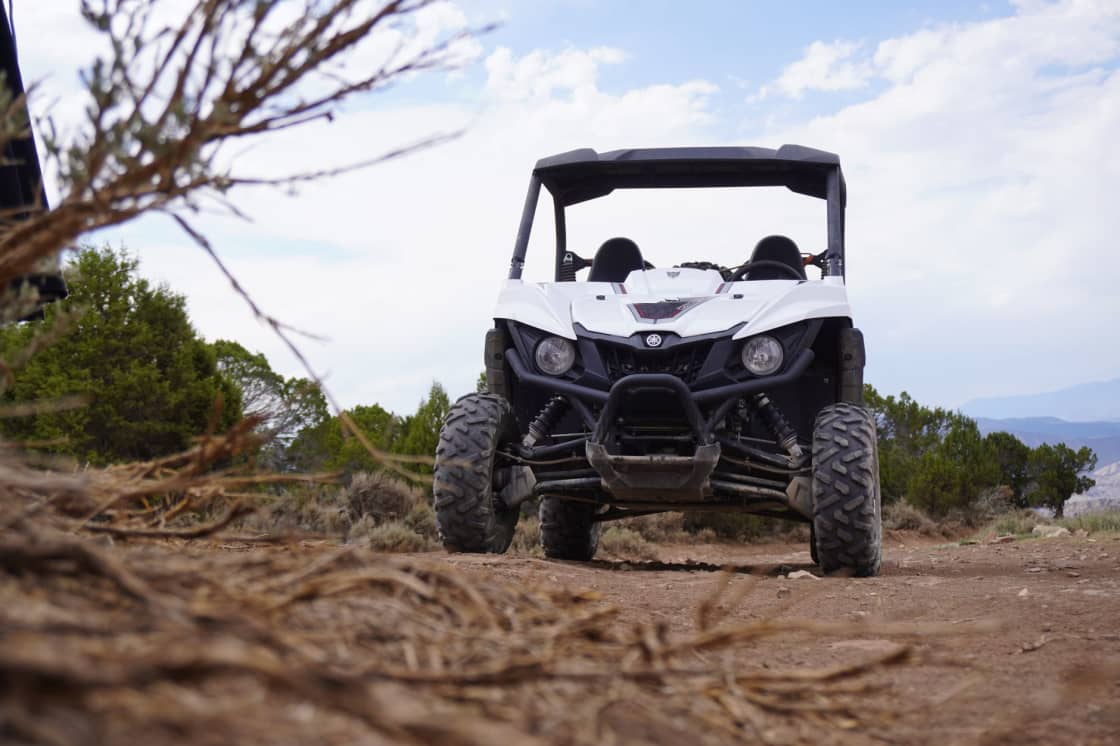
A UTV or side-by-side has bucket seats, a steering wheel, seat belts and a roll cage. Automatic transmission, car-like controls, room for two to six people, and a cargo bed. For a family, a group of friends, or anyone who has never done this, it is the obvious choice, and it is where the industry has gone.
Within side-by-sides, the meaningful decision is trail machine versus sport machine. A Can-Am Defender or Commander style vehicle is comfortable, capable and calm. A Maverick X3 Turbo is a genuinely fast performance vehicle. Both are available; only one of them is a sensible first rental. Operators will tell you this if you call, and one of them explicitly invites the call — if you are uncertain which model fits your skill level, phone rather than clicking.
Seat count matters more than people expect. A four-seat machine with two adults and two children is comfortable; the same machine with four adults and a cooler is not.
What a rental day actually costs in time
The rental block is not the day.
Provo to Heber is around 30 to 40 minutes each way depending on traffic through the canyon, which on a summer Saturday afternoon is not nothing. Check-in, paperwork, the machine walkthrough and gearing up take a solid half hour at the front. Fuel and return checks take some at the back.
So a three-hour rental is a five to six hour day. A full-day rental is the whole day and then some. Book accordingly, and if you are trying to fit a ride around something else, the two-hour option exists for a reason but is genuinely short once you subtract the trailhead approach.
The operators who let you ride from their own lot save you the towing time, which on a short rental is a substantial fraction of the value.
Where to ride around Utah County, with your own machine
If you own a machine, the county has more than the rental map suggests.
Five Mile Pass, out west past Cedar Fort toward Eureka, is the long-established open riding area for the region — high desert, wide open, and busy on weekends. It is the closest thing to a dedicated OHV playground in the county.
Payson Canyon and the Nebo Loop country in the south end offers forest roads and connecting routes with genuinely spectacular scenery, particularly in autumn.
Diamond Fork, east of Spanish Fork, carries routes through the drainage that also holds the hot springs, which means it shares the corridor with a great deal of hiking traffic.
The Uinta National Forest east of the valley is the large system, and is where the rental fleets point.
Three standing cautions, all of which have caught people out.
Not every dirt road is open to OHVs. Legality is route by route and determined by the managing agency's motor vehicle use map, not by whether the surface looks like a trail. Registration and street-legal requirements differ again for connecting road sections.
Seasonal closures are real. Many routes are gated for spring mud and for wildlife wintering, and the dates move with conditions.
Fire restrictions bite hard. In a dry Utah summer, OHV use gets restricted or closed outright in specific districts, sometimes at short notice, and a spark arrestor requirement applies broadly.
Winter is the second season
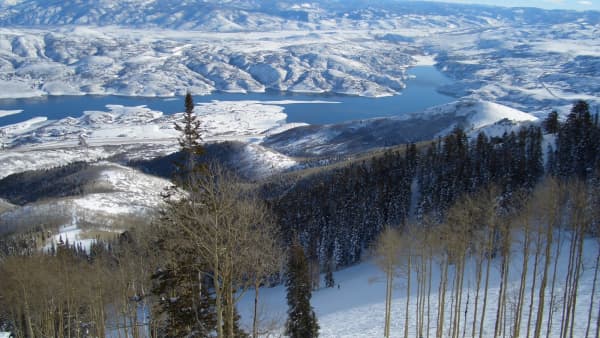
The same fleets run snowmobiles from roughly December through March on the same terrain, typically in five-hour and eight-hour blocks with multi-day options. Helmets, goggles and handlebar warmers are commonly included, and at least one operator supplies GPS units with location sharing.
The Uintas in winter are a serious destination rather than a consolation prize, and the guided options are worth considering. Backcountry avalanche terrain is not a place to learn by exploring, and some operators in this region also run avalanche education alongside the rentals — which tells you how seriously they take the distinction.
Booking notes
- Reserve early for summer weekends and holidays. These fleets sell out.
- Complete the OHV course before arrival. Non-negotiable, and it costs you ride time otherwise.
- Call about group pricing if you need more than one machine; it is commonly available and rarely posted.
- Ask about the trailhead model — riding from the lot versus towing changes your day substantially.
- Bring sun protection, layers and eye protection. Open cockpits at elevation are dustier, colder and sunnier than they look from the parking lot.
- Expect to be filthy. Dress for it and put a towel on the car seat.
Guided tour or self-guided rental
Most operators sell both, and the choice is less obvious than it looks.
Self-guided is cheaper, more flexible, and lets you stop where you like for as long as you like. It also means navigation is your problem, mechanical trouble is your problem, and the interesting places are the ones you happen to find.
Guided costs more and buys three things that are hard to value until you need them. A guide knows which routes are actually open this week, which matters more in a landscape governed by seasonal gates and fire orders than any map suggests. A guide takes you to the alpine lakes and overlooks that are not obvious from a trailhead kiosk. And a guide is the difference between a mechanical failure being an inconvenience and being a long walk out of somewhere with no signal.
The honest recommendation: first time in unfamiliar mountains, go guided. Once you know the drainage, rent and go alone. Groups with mixed experience levels also do better guided, because a guide sets a pace that keeps the nervous rider comfortable without the confident one deciding to demonstrate something.
Riding with children
The rules here are not uniform and they are worth pinning down before booking.
Passenger age minimums vary by operator and by machine, and they are usually driven by whether a child can sit properly restrained with feet supported — a seat belt across a child too small for the seat is not restraint. Some operators set a firm minimum age for passengers; some set a height requirement instead; almost all set a higher bar for anyone operating.
Helmets are standard for everyone and required for minors. Ask whether children's sizes are stocked, because "helmets provided" often means adult sizes.
Two practical points that decide whether a family ride is fun. Dust is relentless on a dry summer trail, and a child in an open cockpit behind another machine will be coated and miserable within twenty minutes — buy or borrow goggles and a buff rather than relying on sunglasses. And duration should be shorter than you think: a two-hour ride with young children is usually the right call, and the three-hour version is where the mood turns.
What to bring
- Closed-toe shoes. Not sandals, whatever the weather is doing.
- Long sleeves or good sunscreen. An open cockpit at 8,000 feet burns you without feeling hot.
- Eye protection. Goggles beat sunglasses in dust.
- A layer. Mountain temperatures drop fast in the late afternoon and faster if a storm builds.
- Water, more than you planned. Altitude and dust dehydrate quickly.
- A phone mount or secure pocket. Loose items leave the vehicle on rough ground.
- Cash for a tip if you go guided.
Leave behind anything you would mind scratching, and assume everything you bring comes back dusty.
The short version
There is no meaningful ATV rental market inside Provo, and looking for one is the wrong search. Drive to Heber City, where the fleets are current, the trails start at the lot, and the shops are 30 minutes from Provo — closer than most Provo residents' actual commute.
Do the OHV education course before you go. Buy the insurance. Take the calm machine, not the turbo. And if you own a quad already, the county's own riding is at Five Mile Pass and up the Nebo Loop, subject to a motor vehicle use map you should read before you unload.
For the surrounding country, see our guides to Payson Canyon and the Nebo Loop drive, American Fork Canyon and camping near Provo.
Related Guides
- Hiking Mount Nebo: The Highest Peak in the Wasatch, and Nobody Agrees How High
- Horseback Riding in Utah Valley: Where to Ride, What It's Actually Like, and Who Takes Beginners
- Shooting Ranges in Utah Valley: Where the Public Can Actually Shoot, and What to Bring
- Disc Golf in Utah Valley: Every Course, Ranked Honestly
- Golf in Utah Valley: The Complete Guide to Every Course Worth Playing
- Waterfalls in Utah Valley: Every One Worth the Drive, Ranked by Effort
- Steamboats, Carp and the June Sucker: Utah Lake's Strange History
- Jolley's Ranch: Camping in Hobble Creek Canyon, Twenty Minutes from Provo
- Skate Parks in Utah Valley: Fort Utah, Orem, and Where Else to Actually Skate
- Fly Fishing the Provo River: Three Rivers Wearing One Name
- Hunting Near Provo: How Utah's System Works Before You Worry About Where
- Five Mile Pass: Utah County's OHV Playground
Frequently Asked Questions
Can you rent an ATV in Provo, Utah?
Do you need a license or certificate to ride an OHV in Utah?
How much does a UTV rental cost near Provo?
Does my car insurance cover a rented UTV?
Where can you ride an ATV near Provo?
Do you need a trailer to rent a side-by-side?
Can you rent a snowmobile near Provo in winter?
Is a UTV rental suitable for beginners?