
Utah Valley has one famous waterfall and several better ones. Bridal Veil Falls gets the postcards, the parking lot, and roughly the entire tourist volume of the county. The others ask for anywhere from twenty minutes to a half day of your time, and most people who live here have visited exactly one of them.
This is a sorting guide rather than a ranking. The useful question is not which fall is prettiest — that argument goes nowhere — but how much effort each one costs and what you get in return. Sorted that way, the county's waterfalls fall into three clear tiers.
The one thing that determines everything: when you go
Every waterfall in this guide is fed by snowmelt. That single fact governs the experience more than trail quality, more than crowd levels, more than which one you pick.
Peak flow arrives with peak melt, generally somewhere in May and June depending on the year's snowpack and how fast spring warms up. That is when the smaller cascades are impressive and when the big ones are loud enough to make conversation difficult at the base.
By August the picture has changed. Bridal Veil still runs — it drains a large enough basin to keep going — but the smaller falls thin out noticeably, and in a dry year some become more of a wet rock face than a waterfall. Nobody tells first-time visitors this, which is why there is a steady trickle of disappointed August arrivals who saw a June photograph.
The practical implication: if you are choosing between waterfalls in late summer, weight toward the larger ones. If you are choosing in June, the small ones are punching well above their usual weight and are worth prioritizing precisely because they will not look like that in two months.
Tier one: no hike required
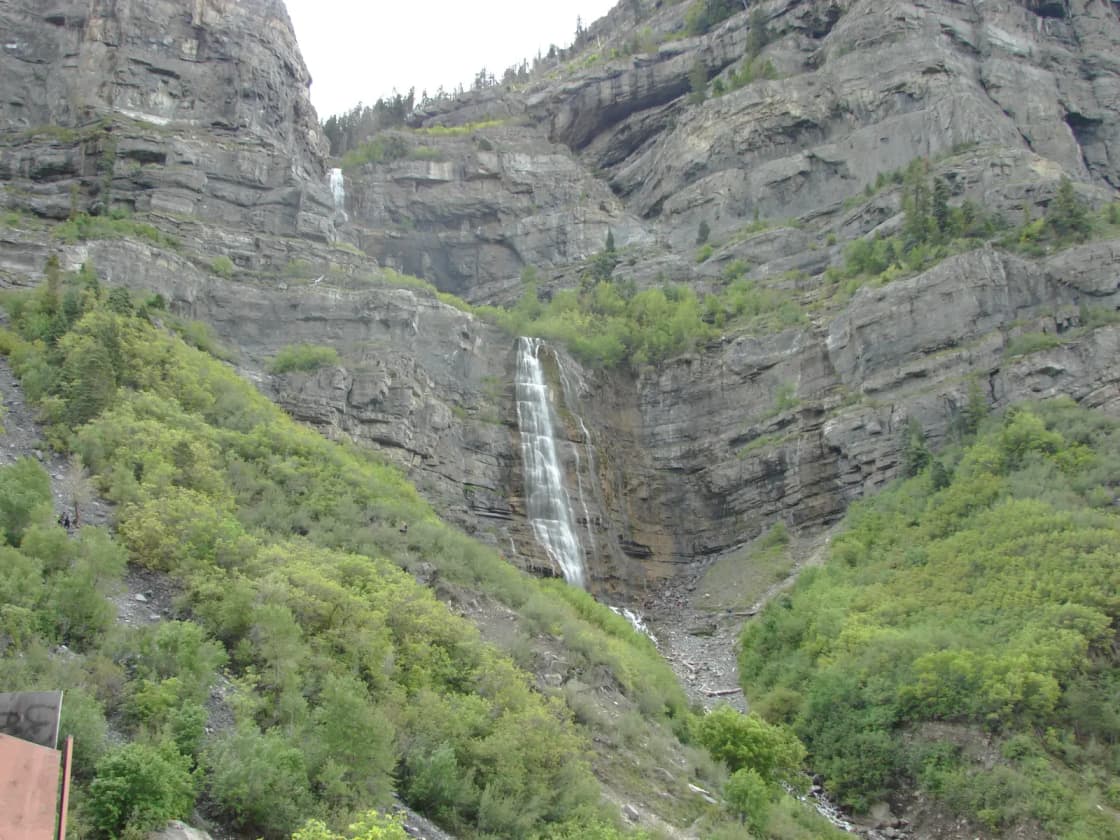
Bridal Veil Falls is the county's landmark and the only fall here that a person with mobility limitations can reliably reach. The double cascade drops roughly 607 feet down the canyon wall, and the viewing area sits a short paved distance from parking off the Provo Canyon road. Through Utah County's reconstruction, which runs into fall 2027, the trail at the base is closed, so expect to view it from the road and the Parkway.
It is worth understanding what you are looking at. The falls have a complicated recent history — including a period when the land around them was privately held and the public's continued access was uncertain — and the pool at the base is not the purely natural feature most visitors assume. Our full Bridal Veil Falls guide covers both stories properly.
The site's weakness is its popularity. On a Saturday afternoon in July the parking is a competitive sport and the viewing area holds a crowd. Early morning on a weekday is a completely different place, and the light is better for photographs anyway.
Upper Falls sits further up the canyon and is the fall most locals drive past without registering. It is smaller, less dramatic, and correspondingly empty. If Bridal Veil's parking situation has defeated you, this is the fallback that costs you nothing but a few more minutes of driving.
Tier two: a real walk, but a short one
Battle Creek Falls in Pleasant Grove is the honest recommendation for most people most of the time. The trail runs about half a mile to the falls, roughly 1.2 to 1.4 miles round trip, with something in the range of 450 feet of climbing, on a path wide and well-trodden enough that you will pass strollers and dog walkers on it.
What makes it work is the ratio. You get a genuine canyon hike, an actual waterfall at the end, and a trail that keeps climbing past the falls if you decide you want more — all within a distance that a moderately fit person covers before their enthusiasm runs out. Our Battle Creek Falls hike guide goes into the trail conditions and the question of whether you should stand underneath it, which people do and probably should not.
The trailhead is in Pleasant Grove proper, which means no canyon fee and no long approach drive. For a family with young children this is usually the right answer.
Tier three: worth a morning
Stewart Falls is the one that rewards the effort. Roughly four miles round trip from the Aspen Grove trailhead on the back side of Mount Timpanogos; the Forest Service puts it at 1.9 miles each way. The setting does most of the work here — the fall itself is fine, but the approach through aspen with Timpanogos overhead is the reason people come back.
The catch is access. Aspen Grove sits on the Alpine Loop, which closes for the winter and reopens on the Forest Service's schedule rather than the calendar's, and the corridor is a fee area. Budget for a pass and check that the road is open before committing to the drive. Our Stewart Falls guide has the trailhead specifics.
Scout Falls, off the Timpooneke trail, is the lesser-known sibling, shorter than the full Timpanogos summit slog but sharing its trailhead and its fee area. From July through October that trailhead also needs a Recreation.gov timed-entry ticket on Saturday, Sunday and holiday mornings. It runs hard in early season and considerably less so later.
Grotto Falls in Payson Canyon is the outlier: a short, easy walk to a fall that pours over an overhang into a small amphitheater of rock, well south of the rest of these and reached off the Nebo Loop. It is covered in our roundup of lesser-known hikes near Provo, which is the right home for it because the walk is barely a hike at all.
The fee question, which trips people up constantly
Utah Valley's waterfalls sit under at least three different land managers, and the rules do not harmonize.
Bridal Veil and Battle Creek cost nothing. Anything reached through American Fork Canyon or from the Alpine Loop — Stewart Falls and Scout Falls both qualify — sits inside a fee area, and enforcement is real. A day pass works; an America the Beautiful pass works; hoping nobody checks does not.
This catches visitors more than residents, because the free ones happen to be the famous ones. Someone who has only ever been to Bridal Veil reasonably assumes canyon access here is free, then drives an hour to Aspen Grove without a pass.
What to wear on your feet
The falls trails are short enough that people treat them casually, and the injuries here are almost entirely footwear-related.
The problem is not the trail; it is the last thirty feet. Wet rock near the base of any of these falls is slick, coated in spray and often in algae, and it looks no different from dry rock from a distance. Sandals and smooth-soled shoes are how people end up in the water.
For Bridal Veil, ordinary shoes are fine as long as you stay on pavement. For Battle Creek, Stewart or Scout, wear something with a tread. This is not a mountaineering recommendation — it is a request to not wear flip-flops on a wet granite slab.
Photographing them without the usual problems
Waterfall photographs fail in two predictable ways here, and both are fixable.
The first is midday sun. A canyon wall in direct light at noon produces blown-out white water against a black rock face, and no amount of editing recovers it. Overcast days are better. Early morning is better. Late afternoon in a west-facing canyon is better.
The second is scale. Bridal Veil at 607 feet photographs as an abstract white streak unless something in the frame establishes size — a person, a tree, the road. Photographers who know the site place something human in the shot on purpose.
Our guide to photography spots around Provo covers the broader question of where to shoot in the valley, including the canyon locations that are not waterfalls.
Combining them into a day
The geography cooperates better than you would expect. Bridal Veil and Upper Falls are both in Provo Canyon, minutes apart. Stewart Falls sits at the top of the same canyon system via the Alpine Loop. Battle Creek is a separate errand in Pleasant Grove.
A reasonable full day: Battle Creek in the morning while it is cool, lunch in Pleasant Grove, then up Provo Canyon in the afternoon for Bridal Veil when the light has moved off the worst of the glare. That covers the two most accessible falls without rushing either.
An ambitious day swaps Bridal Veil for Stewart Falls and accepts that you are spending the whole day on it, with a fee pass and a check that the Loop is open.
If you are building a broader itinerary, our summer activities guide and things to do in Provo both cover what fits around a canyon morning.
Camping near the falls
Several of these pair naturally with an overnight. The Provo Canyon and American Fork Canyon corridors both hold developed campgrounds, and the Alpine Loop's campgrounds put Stewart Falls within easy reach of breakfast.
The practical constraint is that canyon campgrounds here book out well ahead in summer, and the first-come sites fill on Friday afternoon rather than Friday evening. Our camping near Provo guide has the specifics on which corridors take reservations and which do not.
Parking, and the part everyone underestimates
Waterfall parking in this county is a story about three very different problems.
Bridal Veil has a lot, and on a summer Saturday that lot is full by mid-morning. The overflow behavior — people parking along the canyon road shoulder — is both discouraged and periodically enforced, and the shoulder there is narrower than it looks when you are the one standing on it. If the lot is full, the honest move is to continue up the canyon and come back rather than to invent a space.
Battle Creek's trailhead parking is a neighborhood problem rather than a tourist one. The lot is modest and sits at the edge of a residential street in Pleasant Grove, which means the overflow lands in front of people's houses. Arriving before nine on a weekend morning solves this entirely.
Aspen Grove is the easiest of the three, because the fee gate rations demand before you ever reach the lot. What catches people out there is not space but the drive: the Alpine Loop is slow, narrow and full of cyclists, and the twenty-mile distance takes considerably longer than twenty miles anywhere else in the county.
Winter, and why the falls do not simply stop
Several of these keep running under ice, and a few become more interesting for it.
Bridal Veil in a hard freeze partially locks up into a column formation that draws climbers and, more numerously, photographers. The Provo Canyon road stays open and plowed year-round, so it remains reachable when almost nothing else on this list is. The viewing area, however, is not maintained to summer standards and the approach can be icy.
Battle Creek is a popular winter walk precisely because it is low and short. Microspikes make the difference between a pleasant hour and a nervous one, and the trail holds packed snow well into spring.
Stewart Falls and Scout Falls are effectively off the table once the Alpine Loop closes. Backcountry approaches exist and they are avalanche terrain, which puts them outside the scope of a general guide.
The seasonal closure dates are not fixed. The Forest Service opens and closes the Loop on conditions, and a spring that looks warm from Provo can still have drifts at 8,000 feet. Checking before driving is not excessive caution here; it is the normal way residents plan a Loop trip.
A note on the water itself
Every fall on this list drains a watershed that supplies drinking water to somewhere, and Utah Valley's canyons carry restrictions that surprise people who hike elsewhere.
The practical consequences show up as rules about dogs, about swimming and about where you may relieve yourself. These are not uniform — the restrictions in a protected watershed canyon differ from those on a Forest Service trail a few miles away — and the signage at the trailhead is the authority, not a general impression of how Utah works.
The other consequence is that the water is not as clean as it looks. Snowmelt sounds pure and cold mountain water carries a strong intuitive appeal, but these drainages pass through terrain with livestock, wildlife and heavy recreational traffic. Filtering is the standard practice for anyone drinking from them.
Which one to pick, by who is asking
Visitors with a rental car and one free afternoon: Bridal Veil, early. It is the photograph they came for and it costs an hour.
Families with young children: Battle Creek. Short, forgiving, and the falls arrive before the complaints do.
People who have lived here a decade and never done any of them: Stewart Falls, on a weekday in late June. It is the one that will change your sense of what is within half an hour of your house.
Anyone visiting in late August or September: manage expectations on everything except Bridal Veil, and consider that the canyons themselves are the draw at that point rather than the water in them.
Photographers: Upper Falls at dawn, Bridal Veil in overcast, Stewart Falls whenever the Loop opens. Skip midday entirely.
What this guide deliberately leaves out
Two categories are missing on purpose.
The first is anything requiring a technical approach. There are drops in the surrounding canyons that canyoneers reach with rope, and they are not appropriate to recommend in a general guide to people who found this page searching for waterfalls near Provo.
The second is the seasonal ice climbing that forms on some of these faces in winter, Bridal Veil most notably. It is a real activity with a real local community and it is emphatically not a thing to try because you read about it.
The honest summary
If you have one afternoon and no equipment, go to Bridal Veil early and accept the crowds. If you want a hike, go to Battle Creek. If you have a morning, a fee pass, and the Alpine Loop is open, Stewart Falls is the best of them.
And if it is August in a dry year, adjust expectations downward on everything except Bridal Veil — or wait until next May, when the same trails deliver something considerably louder.
The legal reason the free ones are free
The fee section above gives you the practical map: some of these cost nothing, the ones reached through American Fork Canyon and the Alpine Loop sit inside a fee area, and enforcement is real. Underneath that map is a federal statute that explains why the line falls where it does, and it is more useful than the map because it does not change.
The Federal Lands Recreation Enhancement Act, 16 U.S.C. Chapter 87 — rewritten by the EXPLORE Act in January 2025 — governs what a federal land manager may charge for. It reads more like a list of prohibitions than a grant of power.
On Forest Service, Bureau of Land Management and Bureau of Reclamation land, no standard or expanded amenity recreation fee may be charged:
- for the use of overlooks or scenic pullouts;
- solely for parking, undesignated parking, or picnicking along roads or trailsides;
- for general access, unless specifically authorized;
- for dispersed areas with low or no investment, unless specifically authorized; or
- for persons driving through, walking through, boating through, horseback riding through, or hiking through without using the facilities and services.
Take those five together and a good deal of Utah Valley waterfall visiting is statutorily fee-free by description. Pulling over at a viewpoint is an overlook. Parking on a shoulder and walking is not, by itself, chargeable. A trail crossing federal land toward a fall on a route with no developed site attached is a dispersed area with low investment.
And why the fee areas can charge
The statute also sets out what makes a site chargeable, and the test is strict. To charge a standard amenity fee at a general recreation area, the Forest Service needs the area to provide significant outdoor recreation opportunities, carry substantial federal investment, allow efficient fee collection, and contain all six of: designated developed parking, a permanent toilet, a permanent trash receptacle, an interpretive sign, exhibit or kiosk, picnic tables, and security services.
Six out of six. The developed trailheads in the fee canyons have all of it. The roadside pull-off you park at for a free fall does not, and that is not an oversight — it is the difference the statute is drawing.
One further limit worth knowing: the Act directs that the minimum number of recreation fees be established and that multiple or layered fees for similar uses be avoided. You should not be paying twice for the same thing on the same day.
The part the statute does not reach
FLREA governs federal land. It has nothing to say about the falls managed by a county, a city or a private owner, which in this valley includes some of the best-known ones. Those are governed by whoever owns them, and the fee — or the absence of one — is that owner's decision rather than a federal category.
The practical consequence is the same one this guide already gives: work out which agency manages the specific fall you are driving to, and check that agency. What is new is that if the answer is "Forest Service," you now know the outer boundary of what they are permitted to charge you for, and "we are charging you to look at it from the road" is not inside it.
Related Guides
- ATV & UTV Rentals Near Provo: Nobody Rents From Provo, and Other Things Worth Knowing First
- Disc Golf in Utah Valley: Every Course, Ranked Honestly
- Waterfall Hikes in Utah Valley — every trail that ends at falling water
- Utah Valley Hike Finder — filter every trail by difficulty, length, season, dogs and fees
Frequently Asked Questions
What is the biggest waterfall near Provo?
Which waterfall near Provo requires the least hiking?
When do Utah Valley waterfalls run strongest?
Can you swim at Bridal Veil Falls?
Are there waterfalls you can drive to in Utah Valley?
Is Stewart Falls a hard hike?
Do I need a pass or permit to visit waterfalls near Provo?
Are the waterfall trails dog-friendly?
Sources
The facts in this guide were checked against these sources. Hours, fees and rules change, so confirm anything time-sensitive with the source before you go. How we make Provo.com.
- Battle Creek Trail #050, USDA Forest Service, Uinta-Wasatch-Cache National Forest. Checked October 12, 2026.
- Stewarts Cascade Trail #056, USDA Forest Service, Uinta-Wasatch-Cache National Forest. Checked October 12, 2026.
- Timpooneke Trailhead, USDA Forest Service, Uinta-Wasatch-Cache National Forest. Checked October 12, 2026.
- Bridal Veil Falls Trail, AllTrails. Checked October 12, 2026.
- Bridal Veil Falls $7M reconstruction project begins, expected to take 2 years, KJZZ. Checked October 12, 2026.