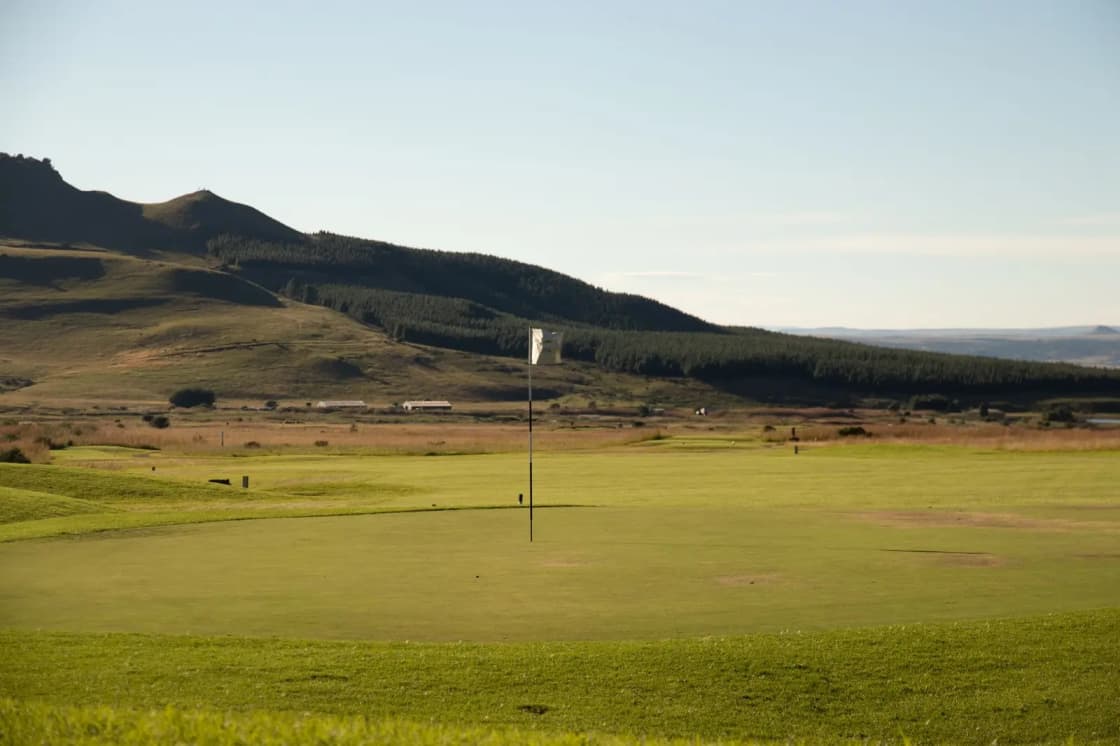

Utah Valley is a strange, lucky place to be a golfer. You have an 11,700-foot mountain filling the sky on one side, a lake on the other, and a dozen courses squeezed into the strip between them — most of them cheaper than what people pay an hour north, several of them good, and one of them regularly called one of the best values on the continent.
The catch is that nobody really writes this down. Ask around and you'll get the same three course names from whoever you asked, shaped entirely by which end of the valley they live on. So here's the whole map: what's here, what each course is for, and how to play the valley well without wasting money or a Saturday.
The short version
If you only remember four things:
- Best value: Hobble Creek, Springville. Golf Digest 4.5 stars, "one of the best values in North America."
- Best all-around round near Provo: The Links at Sleepy Ridge, Orem.
- Longest test: Timpanogos Golf Club's championship course, Provo — roughly 7,300 yards from the back tees.
- Best for beginners and evenings: The Pasture, the lighted 9-hole par-3 at Timpanogos.
Everything below is the long version.
Provo: Timpanogos Golf Club
Provo's public golf lives at Timpanogos Golf Club, an operation that traces its history back to 1923 and runs two very different courses.
The Championship Course is the serious one: 18 holes, par 72, playing about 7,300 yards from the longest tees. That's a real length — long enough that most players should think about which set of tees they belong on before ego takes over on the first hole. It's the valley's main tournament venue, home to the Primo Provo Open and a slate of club events through the season.
The Pasture is the other half, and it's underrated. A lighted 9-hole par-3 course solves several problems at once: it's where you take someone who has never played, where you squeeze in nine holes after work in July, and where you practice irons instead of hitting drivers on a range. Lights mean the day doesn't end when the sun drops behind the west side of the valley.
The club also runs a smokehouse, junior golf camps, lessons, and season passes, and participates in Youth on Course — a program that lets young players golf at heavily reduced rates. If you have a kid who's shown a flicker of interest, that's worth looking into before you buy anything.
Provo's other course, Riverside Country Club, is private.
Orem: The Links at Sleepy Ridge
The Links at Sleepy Ridge is the course people take visitors to. It's public, it's polished, and it does the thing well-run public courses do — creating a higher-end feel without the membership. Golfers consistently describe it as well-kept and scenic, sitting on the west side of Orem with open views back toward the mountains.
It's on the higher end of valley pricing, which is the trade. The common local verdict is that it's worth it, and that it's a course you play deliberately rather than as your default weekly round.
Sleepy Ridge also runs a reception venue, which makes it a double listing on this site — it turns up again in our Utah Valley wedding venues guide, and it's one of the few places in the valley where a wedding party and a foursome are equally at home.
Springville: Hobble Creek, the one everybody defends
If Utah Valley golf has a consensus champion, it's Hobble Creek Golf Course in Springville — a municipal course tucked into the mouth of Hobble Creek Canyon.
Golf Digest has rated it 4.5 stars and described it as "one of the best values in North America." That's not local boosterism; that's a national publication saying a small-city municipal course in Utah County punches far above its price.
What makes it work is the setting. Canyon courses feel different — trees, elevation change, a creek, cooler air on summer afternoons than you'll find out on the valley floor. It's the course to play in August when everything else is baking.
If you're making the drive, Springville has a free art museum and a downtown worth an hour on either side of a round. The consequence of being both cheap and beloved is obvious: it books up. Weekend mornings in peak season are competitive, and the reasonable strategy is to book as early as the system allows or play a weekday.
Spanish Fork, American Fork, Payson, Cedar Hills
The valley's other municipal and public courses stretch north and south, and they're the backbone of everyday golf here.
The Oaks at Spanish Fork is a public course on the south end, the natural home course for anyone living in Spanish Fork, Salem, or Mapleton.
Fox Hollow Golf Club in American Fork is the north valley's workhorse: an 18-hole layout opened in 1971, designed by Joe Williams, playing about 7,189 yards from the longest tees at par 72, with a course rating of 73.3 and a slope of 128. Locals describe it as challenging but mostly flat and comfortable to walk, with water in play on several holes — a good combination for people who want a real test without a cart. It runs a driving range and practice facility with lights, and tournament days can close walk-on availability, so the calendar is worth checking.
Gladstan Golf Course in Payson rounds out the south end and serves its community as the default local round. If you're already that far south, the Nebo Loop and the rest of Payson make an easy afternoon out of the drive.
Cedar Hills Golf Course anchors the north end at the mouth of American Fork Canyon, and right now it needs a caveat before you book anything. Course management issued a notice dated June 15, 2026 stating that because of ongoing construction, the course will not be available for full 18-hole play during the 2026 season. Nine holes are open, the short course stays open all season, and golfers who want eighteen are invited to play the same nine twice — the club asks for two and a half hours between tee times. Part of the course is cart-path only. That same notice tells players to check with the pro shop for current information on which holes are in play at any given time, which is the detail that matters: the specific nine moves, and the club's own homepage carries language describing both a front-nine and a back-nine configuration.
Two things follow from that. The city's press release of February 27, 2026 said full 18-hole play was expected during July and August — the June notice overtakes that forecast, which is worth knowing if you read the earlier announcement and planned a round around it. And essentially every third-party golf directory, booking sites included, still lists Cedar Hills as a straightforward 18-hole round of roughly 6,600 yards with no mention of construction at all. Published yardage varies between about 6,400 and 6,700 depending on the listing, and at least one directory files the course as private while the operator says public. Call the pro shop at (801) 796-1705 before you drive over. One more navigational wrinkle: a major booking site files the course's Clubhouse Drive address under Pleasant Grove rather than Cedar Hills, so search the course name and not the city. Our north bench guide covers the course in more detail.
Thanksgiving Point Golf Club in Lehi sits at the valley's northern edge and is the prestige entry: a Johnny Miller design, the largest golf course in Utah, and once ranked among the top ten new courses in the country by Golf Digest. It's a destination round rather than a casual one, and it pairs naturally with everything else at Thanksgiving Point.
Talons Cove in Saratoga Springs hosted the 2005 and 2006 Utah Open, which tells you what kind of course it is. It's the far northwest option, most convenient if you're already out in Saratoga Springs or Eagle Mountain.
Topgolf Vineyard, and when it's the right call
Topgolf Vineyard isn't a golf course, and treating it like one leads to disappointment in both directions.
What it is: climate-controlled hitting bays, target games with automatic scoring, food and drinks, and a format that works for groups where skill levels range from scratch to never-touched-a-club. That combination makes it one of the valley's better options for a group outing, a date, a work event, or a January afternoon when every course in the state is under snow.
What it isn't: a substitute for playing eighteen holes. You can groove a swing there, but you can't learn course management, lie variation, or the mental part of the game in a bay.
Use it for what it's good at and it's a genuine asset — particularly in winter, when the valley's golf options otherwise collapse to zero.
Ranges, practice, and winter
Playing eighteen is only part of golf here, and the practice infrastructure matters more than usual in a valley with a hard winter.
Most of the courses above run driving ranges and practice facilities, and several light them — Fox Hollow in American Fork keeps range lights on into the evening across much of the week, which extends the practice season considerably on both ends of the year. Timpanogos Golf Club runs practice facilities alongside its two courses, and The Pasture's lights mean you can play actual holes after dark rather than just hitting balls.
Lessons and instruction are available at most valley courses. If you're starting from zero, a handful of lessons before your first round saves more frustration than any equipment purchase will.
Winter is the real gap. From roughly November through March, valley golf ranges from unreliable to impossible. The options are Topgolf's heated bays in Vineyard, indoor simulators that have proliferated across Utah County in recent years, or driving south — St. George is a four-hour trip and plays year-round, which is why so many Utah Valley golfers make a spring pilgrimage there before local courses open.
Junior and family golf
Utah Valley is a good place to raise a golfer, and the costs are lower than most parents assume.
Youth on Course is the program worth knowing about first. Participating courses — Timpanogos Golf Club among them — offer heavily reduced rates for young players, which changes golf from an expensive hobby into an affordable one for a kid who wants to play often.
Junior golf camps run through the summer at multiple valley courses, and they're a reasonable way to find out whether a child's interest is real before investing in clubs.
Par-3 and executive courses are the right venue for family rounds. Nine holes at The Pasture with a ten-year-old is a good evening. Eighteen at a 7,300-yard championship layout with the same ten-year-old is a bad one, for everybody including the group behind you.
A note on etiquette that saves grief: on a busy course, let faster groups play through. Utah Valley courses are friendly, but pace of play is where friendliness gets tested.
Which course for which occasion
- Your regular weekly round: whichever municipal course is closest. That's the honest answer — convenience wins over time.
- A round with visiting family: Sleepy Ridge or Thanksgiving Point. Both photograph well and neither requires an apology.
- A cheap round that's still good: Hobble Creek, weekday.
- Teaching someone to play: The Pasture, or Topgolf if they're nervous.
- A serious test of your game: Timpanogos Championship or Fox Hollow, back tees.
- A hot August afternoon: Hobble Creek, up the canyon where it's cooler.
- A corporate or group outing: Topgolf handles mixed skill levels better than any course will.
How the season works here
This is the part that catches transplants.
Utah Valley golf is a shoulder-season game as much as a summer one. The dependable window runs roughly April through October, but the edges move every single year with snowpack, spring warmth, and how each course's grounds crew reads conditions. Some valley-floor courses will open a mild winter day. Others won't.
Two practical notes:
Frost delays are real and they last into spring. A clear 45-degree morning can still mean a two-hour hold, because frozen turf damages easily under foot traffic. Call ahead or check the course's social feed rather than showing up at 7 a.m. hopeful.
Summer afternoons are hot and the valley is dry. July and August rounds go better early or late. Canyon-mouth courses like Hobble Creek run noticeably cooler than courses out toward the lake. Carry more water than you think you need — the altitude and the low humidity dehydrate people faster than they expect, a theme that runs through everything outdoors here, from golf to hiking Timpanogos to running at 4,500 feet, where the standard advice is to expect 30 to 60 seconds per mile slower until you adapt.
Late-summer air quality is worth a glance too. Wildfire smoke can settle into the valley for stretches, and if you're sensitive to it, an AQI check before a four-hour walk is a reasonable habit.
Playing the valley well: a strategy
If you're new to golf: start at The Pasture or a range. Par-3 courses are where you build competence without the humiliation tax of holding up a full course.
If you're a decent player on a budget: learn the twilight rates. Every course prices late afternoon lower, and in June and July there's enough light to finish. Combine that with weekday play and Utah Valley becomes one of the cheapest places on the Wasatch Front to golf frequently.
If you play a lot: run the season-pass math early in spring. Passes and punch cards change the calculus fast if you're playing weekly, and the break-even is usually lower than people assume.
If you're hosting visitors: Sleepy Ridge or Thanksgiving Point for polish, Hobble Creek for the story. Out-of-towners consistently react more to Hobble Creek's canyon setting than to anything else in the valley.
If you have kids: ask about Youth on Course and junior camps. Utah Valley has an unusually deep junior golf culture, and the entry costs are lower than most parents expect.
Playing at altitude
One adjustment transplants consistently miss: the ball flies farther here.
Utah Valley sits around 4,500 feet above sea level, and the thinner air means less drag. The common rule of thumb is roughly 2% additional carry per thousand feet of elevation, which works out to something like 8–10% more distance than you'd get at sea level. On a 150-yard approach, that's a full club — and it's why visiting golfers spend their first round flying greens and wondering what happened.
Two practical consequences. Club down until you've recalibrated; take one less club than the yardage suggests and see where it lands. And expect less spin and more roll on firm summer fairways, which changes how approach shots behave on landing.
The mountains also distort distance perception. A green with a 7,000-foot wall behind it looks closer than it is. Trust the yardage marker over your eyes.
A note on prices, hours, and everything else that moves
We deliberately don't publish green fees here.
Rates in this valley change by season, by day of the week, by time of day, by residency, and by year — and a guide that quotes a 2026 twilight rate is a guide that's wrong by next spring. Every course listed above posts current pricing and tee-time booking on its own site. That's the source worth trusting.
The same applies to opening dates, tournament closures, range hours, and cart policies. Check before you drive.
Cedar Hills is the live illustration. A course can be mid-renovation, publish that fact plainly on its own site, and still appear across every major booking directory as a normal 18-hole round — because those listings are built from a database record that nobody updated. The course's own site and its pro shop are the only sources that know what is open this week.
Where golf fits in the valley
Golf is one thread in a valley that's built for being outside. A morning round at Hobble Creek and an afternoon up Hobble Creek Canyon is a complete Saturday. Fox Hollow sits minutes from American Fork Canyon and the Alpine Loop. Timpanogos Golf Club is a short drive from the Provo River Parkway.
If you're building a weekend around any of it, our things to do in Utah Valley guide covers the rest — and if you're new here and still figuring out which end of the valley to live on, the city guides get into that in detail.
The short version, one more time: play Hobble Creek. Then argue with someone about whether it's really the best. That's the local tradition.
Related Guides
- ATV & UTV Rentals Near Provo: Nobody Rents From Provo, and Other Things Worth Knowing First
- Hiking Mount Nebo: The Highest Peak in the Wasatch, and Nobody Agrees How High
- Soldier Hollow: The Olympic Venue You Can Actually Use
- Indoor Golf Simulators in Utah Valley: How to Play Through a Wasatch Winter
Frequently Asked Questions
What is the best golf course in Utah Valley?
Are there public golf courses in Provo?
When does golf season start in Utah Valley?
How much does it cost to golf in Utah Valley?
Where can a beginner learn to golf in Utah Valley?
Is Topgolf in Vineyard the same as playing golf?
Sources
The facts in this guide were checked against these sources. Hours, fees and rules change, so confirm anything time-sensitive with the source before you go. How we make Provo.com.
- FAQs: Recreation Center: Timpanogos Golf Club, Provo City. Checked October 12, 2026.
- Recreation Center Triple Play Access, Provo City. Checked October 12, 2026.