Utah Valley is a runner's valley for nine months of the year and a problem for three. The problem is not the cold — the dry Wasatch cold is easy to dress for — and it is not entirely the snow, because the city stretch of the river trail gets plowed. The problem is the air. From December into February the valley's bowl fills with an inversion, a lid of warm air over a pool of cold air that traps fine particulate at the floor for days at a time, and on the worst of those days the state's own guidance is that nobody should be breathing hard outside. The runners who keep a base through a Provo winter do it indoors, on a short list of tracks and a longer list of treadmills, and come out in March ready for a spring race calendar that starts earlier than almost anywhere in the country.
This is the guide to that indoor list and the winter around it: every indoor track in the valley and its laps-per-mile, who can use each one and what it costs, the air-quality rule that decides whether to run outside at all, which outdoor trails survive January, the traction and headlamp gear, and the December-to-March plan that lands a runner at the Provo City Half in shape. Our running routes guide covers the year-round routes; our race calendar covers what the winter is training for; and the marathon guide covers the June race that most of the winter's miles are secretly about. Facility details below come from the facilities' own published pages and are hedged; hours and fees change, and the track closes when the gym floor beneath it is booked.
The Air, First
Everything else in this guide is secondary to one habit: checking the air-quality forecast the night before a run.
The valley's winter inversions are a geographic fact. High pressure settles over the Great Basin, the valley floor cools, the warm air aloft caps it, and the exhaust and wood smoke of a few hundred thousand people accumulate under the lid until a storm comes through and stirs it out. The measured pollutant is PM2.5, fine particulate, and on a bad day the valley's floor has some of the worst readings in the country. The Utah Division of Air Quality publishes a daily forecast and a color-coded index — green, yellow, orange, red — for Utah County, and the runners here treat it as the weather.
The working rule, which is the state's guidance restated: green, run outside. Yellow, run but shorten or ease. Orange and red, go indoors. Hard breathing at the valley floor in a red-air event is not a toughness question; it is a measurable dose of particulate to the lungs, and the state's own recommendation is to move exercise inside. The inversion breaks with a storm, and the days after a storm — cold, clear, the air scrubbed — are the best outdoor running of the winter. A runner who plans the week around the forecast gets the outdoor days and loses nothing; a runner who plans around the calendar runs on the wrong days.
The one geographic escape: the inversion is a valley-floor phenomenon, and the bench and the canyons above about 5,500 feet are often in clean air while the floor is orange. The Provo Canyon trail above the mouth, when it is not iced, and the higher neighborhoods on the east bench are the outdoor options on a floor-inversion day, and the Nordic centers up the canyons are in a different atmosphere entirely.
The Indoor Tracks
Provo Recreation Center
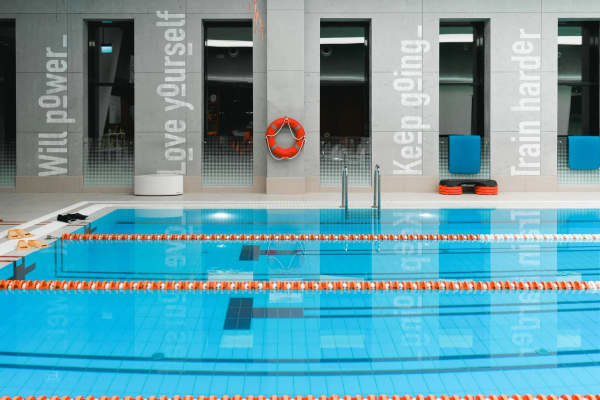
The valley's flagship rec center, at 320 West 500 North, has an elevated three-lane indoor track on its second-level fitness mezzanine: 6.5 laps to the mile, per the city's amenities page, for ages 14 and up, with single-wide strollers allowed on the track (but not elsewhere on the fitness level). It is the best public running track in the valley — the lap count is short enough for real intervals (a 400-meter repeat is 1.6 laps, which is close enough to count by), the lanes are marked for direction, and the surface is a cushioned running surface rather than a gym floor. It overlooks the gym, which means it closes or crowds during tournaments on the floor below; the center posts the closures. Access is a day pass or a membership, with resident and non-resident rates, and the student rate — dropped to $25 a month for BYU and UVU students in a 2026 promotion — is the cheapest indoor-track access in the valley for anyone with a student ID. The full guide has the fee table, the hours and the rest of the building. The center is closed on Sundays.
BYU Smith Fieldhouse
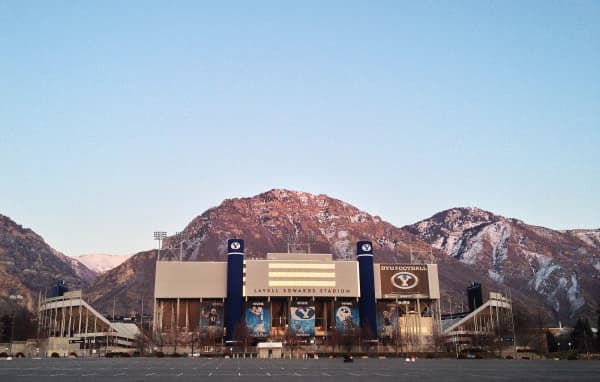
The university's indoor track, at the west end of the Smith Fieldhouse, is the valley's best track by a distance and the least accessible: four lanes, with a long outer track at 5 laps to the mile and a short inner track at 7 1/7 laps, per BYU's student-wellness page, which also notes that the facility wristband required elsewhere in the building is not required for the track. It is a campus facility for students, staff and their guests, and the varsity track program uses it; non-affiliated visitors should not assume access. For a BYU student, it is the winter answer, and it is free. The outdoor tracks — the Helaman track south of the stadium and the west track near the former Provo High site, both nine-lane 400-meter rubberized ovals — are usable on clean-air days when they are clear of snow, which is more often than a newcomer expects.
Lehi Legacy Center
Lehi's recreation center at 123 North Center has an indoor track, an aquatic center and a full fitness floor, and it serves the north valley the way Provo's serves the south. The lap count and the current fees are on the city's Legacy Center pages; the track shares the building's membership and day-pass structure. North-valley runners in Lehi, American Fork, Saratoga Springs and Eagle Mountain treat it as home.
Orem, American Fork and the south valley
Orem's fitness center, American Fork's recreation center, and the newer rec centers in Spanish Fork, Payson and the west-side cities each have a walking-and-running track or loop, with lap counts and fees on each city's page. The pattern across them: the newer buildings (built or renovated in the last fifteen years) have elevated tracks with running surfaces; the older ones have a loop around the gym perimeter that is better for walking than for intervals. Look for the laps-per-mile figure at the track entrance and on the city's page; under about 8 laps is a running track, over 10 is a walking loop, and a runner should treat each accordingly.
UVU and the commercial gyms
UVU's fitness facilities are for students and staff, and its indoor options are the reason the university's runners are on the Orem floor all winter. The commercial gyms in the valley — the large chains in Orem, Lehi and Provo — mostly do not have tracks; a few have a short loop around the floor, and all of them have treadmills by the row. Our gym guide covers which is which.
The Outdoor Options That Survive January
On a clean-air day, the valley has real outdoor winter running, and it is worth knowing which surfaces hold up.
The Provo River Trail, city stretch. From Utah Lake State Park up through the west-side parks and along the river toward the canyon mouth, the paved trail is maintained through the winter and is the valley's most reliable outdoor surface. It is flat, it is lit in a few park stretches and dark elsewhere, and after a storm it is plowed within a day or two. The canyon section above the mouth, which is the summer's best running, ices in the shade and drifts in the wind and is not reliable from December to March.
The Murdock Canal Trail. The north valley's paved artery, from Lehi through American Fork, Pleasant Grove and Lindon to Orem, is plowed by the cities along it in most winters and is the north valley's winter long-run route. It is exposed and windy; it is also flat and long.
The Jordan River Parkway. At the far north end, the Lehi and Saratoga Springs stretches are maintained; the trail runs north into Salt Lake County and is the route for anyone who wants twenty flat miles.
The campuses. BYU and UVU clear their paths early and thoroughly, and a loop of the BYU campus on a clean morning in January is a respectable five miles with hills.
The neighborhoods. Sidewalks are the homeowners' job and vary block to block; the older east-bench neighborhoods are the worst for ice and the best for hills. A road runner in winter runs the plowed street edge more than the sidewalk, and does it in daylight.
The foothills. The Bonneville Shoreline Trail and the canyon side trails are snow and mud until March and belong to the trail runners with spikes and the patience for postholing. On a clean-air day after a storm they are beautiful and slow.
Gear for the Dark and the Ice
The valley's useful winter daylight runs from about 7:30 a.m. to 5:30 p.m. in December, and most training miles happen outside it. A headlamp and reflective gear are not optional; the river trail has no lighting for most of its length and the neighborhood streets have drivers who are not expecting anyone on foot.
For traction, the runners here use three things: strap-on coil or spike devices over a road shoe for the icy weeks, a lugged winter trail shoe for the packed-snow trails, and — the cheap local fix — short hex-head sheet-metal screws driven into the sole of an old pair of shoes, which grip black ice on the river trail better than anything sold for the purpose. The dry cold is easy to layer for; the mistake every newcomer makes is overdressing by one layer, which a runner discovers at mile one.
The sports-medicine clinics see a winter pattern of their own: falls on ice, and the calf and Achilles complaints that come from months of track turns in one direction. The fix for the second is to reverse direction on the track — the rec centers post a direction schedule and change it daily for exactly this reason — and to keep the long runs outdoors on the flat trail whenever the air allows.
The Treadmill Question
Local runners argue about this, and the honest answer is that both sides are right about different weeks. A track at 6.5 laps to the mile is bearable for intervals and a tempo run and maddening for a 16-miler; a treadmill is bearable for easy base miles and maddening for anything with speed. The rec centers put both on the same fitness level, the commercial gyms have rows of treadmills, and a home treadmill is the winter purchase that half the valley's serious runners have made.
The use case that settles it is the inversion week. A red-air stretch of five or six days — and the valley gets two or three of those most winters — is a treadmill stretch, full stop, and a runner who refuses the belt on principle loses the week. The track is for the intervals, the treadmill for the base, and the outdoors for the clean days, and a runner who keeps all three available has a winter.
The December-to-March Plan
The valley's spring races come early: the Provo City Half on the first Saturday of May, the Utah Valley half and marathon on the first Saturday of June. That means the base is built in January and February, indoors, and the plan most local runners follow looks like this.
December. Easy base miles on the track and the treadmill, three or four days a week; the long run outdoors on the plowed river trail on any clean-air weekend. The holiday 5Ks for fun. Nothing hard.
January. Intervals on the track — the Provo track's 6.5 laps make 400-meter repeats a clean count, and the mile repeats are 6.5 laps exactly. The long run lengthens, still indoors during inversion weeks and outdoors after storms. The Bonneville Backyard Ultra crowd is doing something else entirely.
February. The light returns and the long runs move outdoors and lengthen; the Murdock and the river trail are the routes. Tempo runs on the track. The first hill work on the campus loop or the bench streets on clean days. Registration for the May half is made.
March. The mouth of Provo Canyon clears, the canyon trail opens, and the downhill training for the spring canyon halfs starts — because there is no downhill indoors, and the descent is what the May and June races are. The first charity 5Ks. The track is now for the one hard session a week; everything else is outside.
It works. The valley's spring race fields are fast in part because the winter forced the structure: intervals indoors, base on the belt, long runs on the clean days, and a March that arrives with the legs already built. A runner who follows the forecast and the plan comes out of a Provo winter in better shape than a runner in a mild climate who ran outside every day and never did a track session.
For the Walker and the Family
The rec-center tracks are walking tracks as much as running tracks, and in the winter they are the valley's senior-center and stroller-hour venues: the Provo track's stroller allowance is used, the mid-morning hours are the walkers', and the direction schedule keeps the lanes orderly. A family with a fourteen-year-old who wants to run and a parent who wants to walk can use the same track at the same time; a family with younger children uses the gym floor below or the pool. The centers' snow-day programming fills the gym on the days the schools close, which is when the track above it is busiest and least runnable.
The Short Version
Utah Valley's winter running problem is the air, not the cold: check the state's air-quality forecast the night before, run outside on green days, ease on yellow, and go indoors on orange and red. Indoors means the Provo Recreation Center's elevated track (6.5 laps to the mile, 14 and up, $25 a month for students), the Lehi Legacy Center and the other cities' rec tracks, BYU's Smith Fieldhouse for students (5 and 7-and-a-seventh laps), and treadmills for the inversion weeks. Outdoors on clean days means the plowed city stretch of the Provo River Trail, the Murdock Canal Trail and the campuses, with a headlamp, traction, and one layer less than feels right. Build the base in January on the track, take the long runs outside in February, and get on the canyon trail in March for the downhill — because the May and June races are downhill, and there is no downhill indoors.
Related Guides
- Running Routes in Provo
- Running Races in Utah Valley: The Annual Calendar
- The Utah Valley Marathon: Runner's and Spectator's Guide
- The Provo Recreation Center
- Best Gyms & Fitness Options in Provo
- Cross-Country Skiing Near Provo
- Provo Weather: The Year, Month by Month
- Sports Medicine in Utah Valley
Frequently Asked Questions
Where are the indoor tracks in Utah Valley?
How many laps to a mile on each track?
How much does it cost to use a rec-center track?
When is it safe to run outside in winter here?
Which outdoor trails get plowed?
What traction gear do runners here use?
Is a treadmill a reasonable substitute?
How do I come out of winter ready for the May half?
Sources
The facts in this guide were checked against these sources. Hours, fees and rules change, so confirm anything time-sensitive with the source before you go. How we make Provo.com.
- Provo City: Amenities, Provo City. Checked October 12, 2026.
- Senior Help Guide: community centers, Mountainland Association of Governments. Checked October 12, 2026.
- Tracks & Fields, BYU Student Wellness. Checked October 12, 2026.
- Utah Valley Marathon. Checked October 12, 2026.