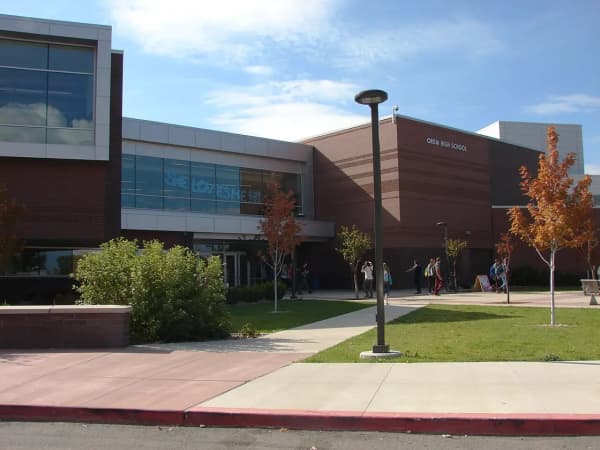

Lake Mountain School District is the smallest of the three districts replacing Alpine School District and the one most likely to look completely different in ten years. It serves the Cedar Valley — Eagle Mountain, Saratoga Springs, Cedar Fort and Fairfield — where the defining fact is not how many students there are but how fast that number is climbing.
It takes over on July 1, 2027. It has already bought land for a high school that does not exist yet, on a campus model no other Utah district has tried.
The four cities, and the ridge they're named for
Lake Mountain covers Eagle Mountain, Saratoga Springs, Cedar Fort and Fairfield, along with unincorporated pockets that follow the boundaries the Utah County Commission approved in 2025.
The name comes from the ridge itself. Lake Mountain runs north to south along the west shore of Utah Lake, and it is the physical reason this district exists as a separate thing. Everything on the far side of it belongs to a valley that developed on its own timetable, connected to the rest of Utah County by a small number of roads and by not much else.
Cedar Fort and Fairfield are the reminder that this is not simply a suburban district. Both are small, old agricultural towns with a few hundred residents apiece, and they now share a district with two of the fastest-growing cities in the state. Whatever Lake Mountain does about small-school policy will matter enormously to them and be nearly invisible to everyone else.
Why the west side voted to leave
This was Proposition 14 on the November 2024 ballot, and the case for it was straightforward.
Eagle Mountain and Saratoga Springs were built in a hurry. Both went from essentially open ground to tens of thousands of residents within a generation, and a growth curve like that generates a school construction backlog faster than any district can clear it. Residents argued that when a seven-member board governing more than 80,000 students weighed a new elementary on the west side against needs in older, more politically established communities, the west side kept losing.
Whether that was true in any specific budget year is arguable. What is not arguable is that the argument persuaded voters, and that the same growth curve is what makes the new district's job hard. A district whose enrollment is climbing has to build ahead of the students, and building ahead of students is expensive before anyone arrives to help pay for it.
Eagle Mountain's own summary of the vote put representation, construction priorities and the difficulty of serving a wide area with differing needs at the center of it — which is a fair reading of what residents said.
Who runs it
Seven board members were elected in nonpartisan races on November 4, 2025 and sworn in on November 25. Julie King is board president, and she has been the district's most visible public voice through the transition.
The superintendent search drew more than 20 applicants. In January 2026 the board named Dr. Vicki Carter as inaugural superintendent — a veteran of roughly 35 years in education, and paired her with a deputy.
That deputy is Dr. Amanda Bollinger, with about 25 years in Utah education.
The mix is worth noticing. Aspen Peaks and Timpanogos both hired from inside Alpine at the top. Lake Mountain hired an Alpine insider as superintendent and went outside for the number two — a reasonable hedge for a district that has said openly it wants to do things differently.
The 100 acres, and the campus nobody in Utah has built
The most interesting thing Lake Mountain has done so far has nothing to do with the split.
In spring 2026 the board approved acquiring 100 acres in Eagle Mountain for a future high school. Buying land is an unusual step for a district with no operating revenue yet, and families should watch how it is paid for.
The plan for the site is what makes it notable. The high school is intended to sit alongside facilities for Utah Valley University and Mountainland Technical College on the same campus. Concurrent enrollment is common in Utah and several districts run it well. A single campus hosting a high school, a university presence and a technical college together is rare.
The idea is that a student finishing high school on that campus could step into a technical certificate or a university pathway without changing addresses.
Two things are worth holding lightly here. The campus does not exist — this is land acquisition and intent, not a ribbon cutting. And a district that has not yet run a single payroll is committing to a long-term capital obligation. The board's stated reasoning is that securing sites ahead of growth is cheaper than buying them later, which is the correct instinct in a valley where land prices have moved the way they have.
What the split does not change
The school year beginning this month runs under Alpine School District. Alpine sets the calendar, employs the teachers, drives the buses, handles registration and special education, and answers the phone. Lake Mountain has a board, two superintendents and a Saratoga Springs address, and no authority over a classroom until July 2027.
Your child's school is not moving because of the split. Schools stay where they are and keep their students; the district name on the letterhead changes. The processes that can move a student are boundary studies, and those run separately with their own public meetings.
Teachers, and what carries over
The Legislature settled the employment questions in SB188, which revised the district-division sections of the education code and fixed the allocation date at July 1, 2027.
The protections are specific. An employee assigned to a school on that date stays at that school and becomes an employee of the district the building sits in. Salaries do not decrease in the first year. Tenure earned under Alpine transfers. Accrued leave is retained or compensated.
The gap is for people not attached to a building — central office administrators, district specialists, program directors. They have a right to a contract with a district, not to their current job.
For a Lake Mountain family, the practical read is that your child's teacher will very likely still be your child's teacher in August 2027.
The small-town question
Cedar Fort and Fairfield are going to test this board in a way the two big cities will not.
Both are small enough that a single school closure or consolidation is an existential question for the community rather than a line item. Both sit a considerable drive from the growth corridor where the district's construction money is going to go. And both now hold a fraction of the district's enrollment while holding an equal claim on its attention.
Large districts absorb this quietly — Alpine had enough scale that a rural school in the Cedar Valley was a rounding error in the budget and could be carried without argument. A district a fraction of Alpine's size does not have that cushion. Whatever policy Lake Mountain adopts on minimum school size, transportation distance and small-school funding will land hard out there.
Nothing has been proposed. This is a structural pressure, not a plan, and it is worth naming precisely because it is the kind of pressure that only becomes visible once a specific school is on an agenda.
What a new district has to build before it opens
"New school district" sounds like a renaming. The list of things Lake Mountain has to construct from nothing before August 2027 is considerably longer.
A payroll system that can pay every employee on the first working day. A human resources function that has already onboarded all of them. A student information system holding every transcript, immunization record, individualized education program and free-and-reduced-lunch determination, migrated intact out of Alpine's. Bus routes drawn and drivers hired for a service area that includes both dense subdivisions and long rural runs. Food service, a warehouse, a maintenance yard, a curriculum adoption, an athletics affiliation, a special education administration, a policy manual, legal counsel.
Most of that is invisible to families until it fails. It is also why the new boards started work well ahead of the handover: eighteen months is close to the minimum for this work, and districts elsewhere that have done it report the student data migration as the piece that causes the most pain.
Taxes and the growth paradox
No rate has been adopted, and each board sets its own for the first time going into 2027-28 under Utah's Truth in Taxation process, which requires an advertised notice and a public hearing before any increase above the certified rate.
Lake Mountain's position is double-edged, more so than either sibling district's.
On one side, it has the fastest-growing tax base in the county. New rooftops bring new assessed value, and a growing base can carry more revenue at a flat rate.
On the other, growth is the expensive kind of good news. Every new subdivision eventually needs a school, schools are built with bonded debt, and bonded debt is repaid out of property tax. Building ahead of enrollment — which the 100-acre purchase shows this board intends to do — costs money before the students arrive to justify it.
Add the fixed overhead any new district takes on: a superintendent, a deputy, a business office, a transportation department, a special education administration. Spread across the smallest enrollment of the three, that overhead is heavier per student here than anywhere else in the former Alpine footprint.
None of that is a prediction of a rate increase. It is the reason to read the Truth in Taxation notice when it arrives instead of the neighborhood thread about it.
The asset split, from the west side
Buildings follow geography, so Lake Mountain knows which schools it inherits. Everything else is a negotiation among three boards, run through joint committees with Alpine supplying information and recommendations rather than decisions.
Lake Mountain enters that negotiation with the weakest hand of the three on shared physical assets, for a simple reason: almost none of them are here. Alpine's district office is in American Fork. The warehouses, the central kitchens, the maintenance operations and the bus depots that serve the whole footprint were sited where the district's population center was decades ago, which is not the Cedar Valley. A district that ends up with a fair share of the value of those assets still has to build its own versions of them on this side of the ridge.
Debt allocation runs the other way and is worth watching. Alpine bonded to build schools all over its territory, including the wave of Cedar Valley construction that made this district viable in the first place. How that outstanding debt is apportioned determines which taxpayers keep paying for which buildings for years after the district that issued the bonds has ceased to exist.
The Legislature has directed some startup funding to the new districts for the transition. Against a school construction program, that is not a large number. It is intended to keep specific projects from stalling in the interregnum, not to capitalize a district.
What parents should do
- Confirm your district by city using the list above. Cedar Valley residents in unincorporated areas should check the county's approved map rather than assuming.
- Subscribe to Lake Mountain board notices. The board meets at least monthly and posts agendas in advance.
- Attend boundary study meetings early, at the stage where criteria are set rather than after a map is drawn. That is when parent input carries weight.
- Follow the Eagle Mountain campus decisions if you have a child who will be in high school after 2030. What gets built there shapes the whole district's feeder pattern.
- Watch for Truth in Taxation notices in the summers of 2027 and 2028.
- Keep your own copies of an IEP, a 504 plan, a transcript or a transfer approval. Student data migration between district systems is where paperwork goes missing.
If you're buying a house here
Listings in Eagle Mountain and Saratoga Springs will say "Alpine School District" for a while yet. That is accurate today and will be wrong before mid-2027, and it is worth correcting in your own head rather than assuming an agent has.
More importantly, a school assignment in a fast-growing area is the least stable fact in a listing. Cedar Valley schools have opened, filled and rebalanced repeatedly over the past decade, and a new district running its own boundary study is not going to make that more predictable in the short run. Confirm any assignment that matters to you directly with the district, in writing, and treat it as today's answer.
Our guides to living in Eagle Mountain, living in Saratoga Springs and buying a home near Provo cover the rest.
The short version
Lake Mountain School District takes over schools in Eagle Mountain, Saratoga Springs, Cedar Fort and Fairfield on July 1, 2027, under superintendent Vicki Carter, deputy superintendent Amanda Bollinger and a board led by Julie King. It is the smallest and fastest-growing of the three districts replacing Alpine School District, which means the heaviest per-student overhead and the strongest case for building ahead of demand. It has already secured 100 acres in Eagle Mountain for a high school intended to share a campus with UVU and Mountainland Technical College. Your child's coming school year still runs under Alpine, teachers keep their buildings and salaries, no tax rate is set, and boundary studies rather than the split itself are what could change which school your child attends.
Related reading: Alpine School District · Aspen Peaks School District · Timpanogos School District · School boundaries and open enrollment in Utah Valley · Which district am I in? Before and after the split
Bonds, and the mechanism nobody expected to need
A district that has to build schools has to borrow, and a district that does not yet exist cannot borrow. The Legislature solved that in 2025 with a set of provisions that are unusual, and they explain how construction in the west county can be financed before July 2027.
Utah Code § 53G-3-302(5), added by S.B. 188, allows the local school
board of the divided district to issue debt on behalf of the districts that
will replace it. It may issue a lease revenue bond under Utah Code § 11-14-103, and it may issue a general obligation bond for the interlocal
agreement participants on behalf of the relevant new and reorganized new
districts. In either case the instrument must designate the new districts as the
joint recipients of the bond proceeds, in proportion to the property tax values
within each district, must obligate each recipient to repay its proportional
share of the remaining debt after the allocation date, and must exclude the
bond from the divided district's outstanding bonded indebtedness. The divided
district makes the payments until the allocation date; after that each new
district carries its share. A general obligation bond still requires majority
approval by the voters of the divided district who vote on the question.
Both subsections apply retrospectively to bonds a divided district issued after November 4, 2024.
The provision written for a bond that failed
The most interesting sentence in the chapter is Utah Code § 53G-3-302(5)(c). If, within the preceding three years, voters across the
divided district rejected a general obligation bond that a majority of voters
within the area now inside a new or reorganized new district voted in favor
of, the divided district's board shall issue a lease revenue bond for that
area. Not may. Shall. And that lease revenue bond is expressly exempted from the
combined total limitation in Utah Code § 11-14-103(6)(b)(i), precisely because
the voters in the relevant area already said yes once.
Read that provision alongside a fast-growing area whose bond needs have historically been outvoted by the rest of a very large district, and its purpose is not hard to see.
The debt that comes with you regardless
Separately, and this is the part that affects a tax bill rather than a
construction schedule, Utah Code § 53G-3-307 handles Alpine's existing
debt. Where a new district's creation date falls on or after May 10, 2011,
property in both the new and the reorganized new district remains subject to a
levy to pay the divided district's outstanding bonded indebtedness. Both boards
impose a rate that generates, from the combined districts, the revenue required
each year to meet that obligation — calculated on the adjusted assessed value
of each district as of the creation date, as the State Tax Commission
determines. A new district's board may abate that levy to the extent it has money
available to pay the reorganized district the equivalent revenue instead.
Bonds that Alpine's voters approved but that were never issued are handled differently again. Under § 53G-3-307(4) the new and reorganized boards decide their fate by mutual agreement, based primarily on the representation made to the voters at the time of the bond election — and until they decide, the reorganized district may not issue them if property in the new district would be taxed to pay them.
Related Guides
- West Provo: The Half of the City Everyone Else Drives Past
- Cedar Valley High vs Westlake High — the district's two high schools
Frequently Asked Questions
What cities are in Lake Mountain School District?
Who is the superintendent of Lake Mountain School District?
When does Lake Mountain start operating schools?
Why did the west side want its own district?
What is the K-16 campus Lake Mountain is building?
Will Lake Mountain raise property taxes?
Do teachers keep their jobs when Lake Mountain takes over?
Which high schools are in Lake Mountain School District?
Sources
The facts in this guide were checked against these sources. Hours, fees and rules change, so confirm anything time-sensitive with the source before you go. How we make Provo.com.
- Higher Education is Coming to Eagle Mountain City, Eagle Mountain City. Checked October 12, 2026.
- Lake Mountain School District Board Meeting agenda, April 30, 2026, Utah Public Notice Website. Checked October 12, 2026.
- New Lake Mountain School District Board sworn in, transition begins, Eagle Mountain City. Checked October 12, 2026.
- Utah Code 53G-3-302 and 53G-3-307, Utah State Legislature. Checked October 12, 2026.
- New Utah County school districts officially name inaugural superintendents, KUTV. Checked October 12, 2026.