
More on Springville: every guide we have published there, in one place.
Springville is the Utah Valley city that most often gets discussed in the wrong conversation. For two years the valley has talked about almost nothing but the Alpine School District split, and a great deal of that conversation has washed south over cities the split does not touch. Springville is the clearest example.
This guide is the area-by-area companion to our broader guide to living in Springville. Where that page covers the city as a whole, this one gets into how the parts differ from each other — and starts by clearing away the thing that is not a factor here at all.
Springville at a glance
Springville sits directly south of Provo on I-15, with US-89 running through it as well. It was settled in 1850 and incorporated in 1853, originally called Hobble Creek — a name that survives in the canyon, the creek and the golf course east of town.
The "Art City" identity came later and has proven remarkably durable. The Springville Museum of Art traces its collection to 1903, and for a city of this size, having a nationally respectable art museum at its center is unusual. That heritage shapes the festival calendar, the downtown feel and the way the city thinks of itself.
Springville is primarily a bedroom community with a meaningful commercial and light-industrial base along the freeway corridor. Most residents commute north into the Provo–Orem job market or further up the valley.
The thing that is not a factor here
Springville is in Nebo School District and was never part of Alpine.
That sentence does more work than any other in this guide, so it is worth being precise about what it means.
Utah County voters approved splitting Alpine School District three ways. Alpine dissolves on 30 June 2027, and three successor districts — Aspen Peaks, Lake Mountain and Timpanogos — become operational on 1 July 2027. Every one of those districts covers cities in the northern and central parts of the county.
Springville is in none of them. So are Spanish Fork, Mapleton, Salem, Payson and Santaquin. The whole south end of the county belongs to Nebo School District, which is not being split, not being renamed, not inheriting a share of Alpine's buildings or debts, and not conducting the boundary studies that are currently unsettling families in Lehi and Orem.
For a buyer this has a specific and practical value. In the northern cities, a house purchase right now carries an unresolved variable: which district, which board, which tax rate, which feeder school after the boundary work concludes. In Springville that variable does not exist. What you see is what continues. Our guide to Alpine's dissolution covers the northern picture if you are comparing across the divide.
The caveat is small but real, and it appears later in this guide: Springville has one school seam that does matter, and it is internal to Nebo rather than anything to do with the split.
The one thing to know before you compare neighborhoods
Springville's neighborhoods are not official designations.
Provo City operates a formal Neighborhood District Program: every resident lives in one of 35 mapped neighborhoods, grouped into five districts, and volunteer boards approved by the City Council give them a place in city governance. When a Provo resident names their neighborhood, they are naming a civic unit that appears on a city map.
Springville has no equivalent. What it has instead is a mix of subdivision names, creek and canyon geography, and informal shorthand about which part of town you are in. People will tell you they live "up by the canyon" or "over on the west side" and those are useful descriptions, but they are not administrative units and they have no fixed edges.
Three consequences follow.
The boundaries are soft and contested. Two residents will draw the line between areas differently, and neither is wrong, because there is no authority to be right against.
Nothing binds an area name to an HOA. Springville's associations are concentrated in newer edge subdivisions, but you cannot infer that from the area name. Read the governing documents for the specific property.
Nothing binds an area name to a school. This matters more in Springville than people expect, for reasons covered below.
The areas
Downtown and the historic core
The original settlement grid around Main and the museum. Oldest housing stock in the city — pioneer-era and craftsman homes, mature tree canopy, larger and less uniform lots than any subdivision produces.
This is where Springville's civic weight sits: the museum, the older parks, the commercial strip, the festival route. It is the most walkable part of the city by a wide margin, though "walkable" in Utah Valley terms still means most errands involve a car.
Suits: buyers who want character and grown-in landscaping, renovators, people who value being able to walk to something. Costs you: older systems, older roofs, unpermitted-addition risk, and lot layouts that predate modern subdivision standards.
The east bench and Hobble Creek
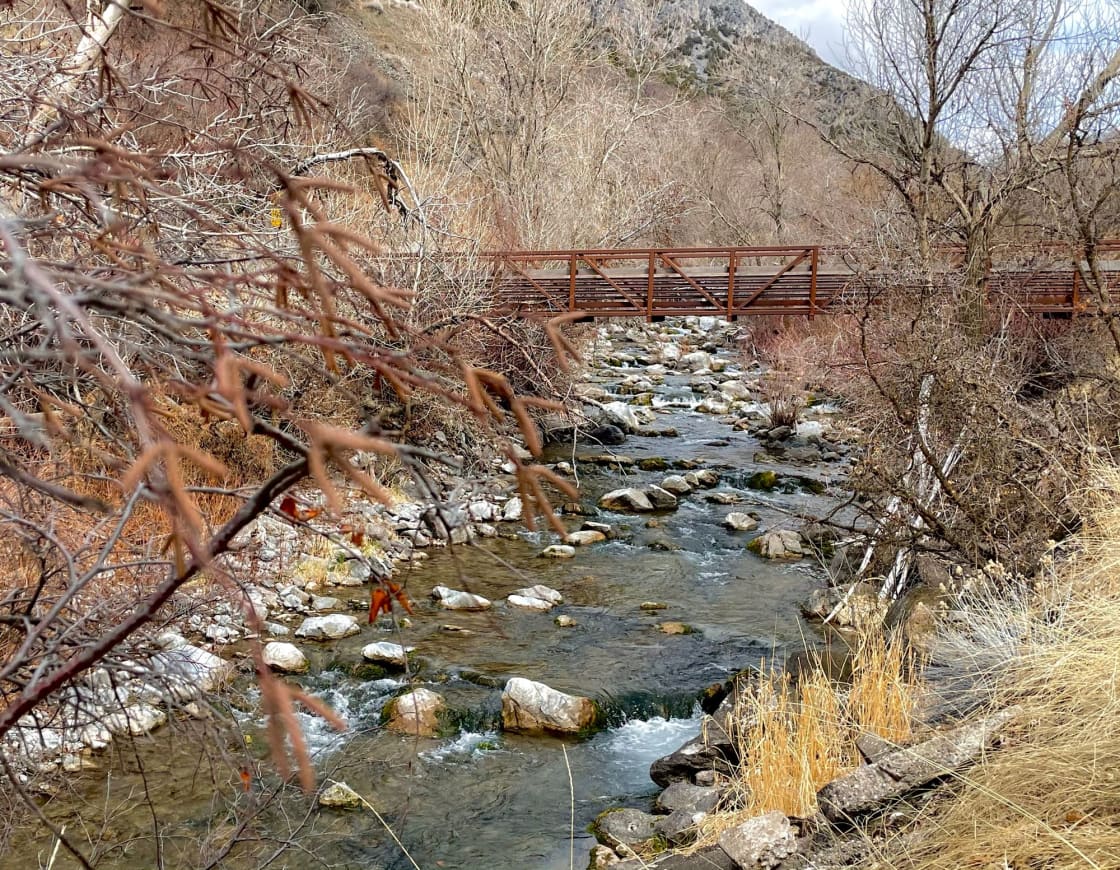
Running up toward the mouth of Hobble Creek Canyon, this is where much of the newer subdivision development has gone. Higher elevation, better views back across the valley, and the shortest access to the canyon, the golf course and the picnic areas.
Housing here skews newer and more uniform than downtown. This is also where formal HOAs are most likely to appear in Springville.
Suits: buyers who want newer construction, canyon access and mountain views without leaving the city. Costs you: a longer drive to the freeway; the winter grades that any bench position carries; more HOA involvement than the flat.
The west side
Between the older core and the freeway, running out toward the lake. Flatter, more mixed in use, with the city's commercial and light-industrial footprint concentrated along the corridor.
The trade here is legible: this is the fastest reach to an I-15 interchange in the city, and it is the least residential-feeling part of Springville as a direct result.
Suits: commuters who want the shortest possible route to the freeway; buyers looking for value. Costs you: proximity to commercial and industrial use; the least scenic position in the city.
North Springville
The band closest to the Provo line and the northern interchange. Shortest commute up the valley, and increasingly continuous with development on the Provo side.
Suits: Provo and Orem commuters who want Springville's housing character with the shortest drive. Costs you: less of the distinct small-city feel that draws people to Springville in the first place.
South Springville, toward Mapleton
The end of the city running toward the Mapleton line. Generally quieter, generally more residential, and the one part of Springville where school assignment is a live question rather than a formality.
Suits: buyers who want a quieter position while staying inside Springville city limits. Costs you: the longest drive to Springville's own civic core — and an assignment check you cannot skip.
The school seam that does matter
Springville's great advantage for families is that the complete K-12 pipeline sits inside the city. Elementary schools, a junior high and Springville High School are all within the city boundary, so students generally do not leave town for their education. Most families here never have to think about assignment at all.
The exception is the south end. A number of homes toward the Mapleton line feed into schools in Mapleton instead. Both cities are in Nebo, so the district is not in question — but the building your child attends, the bus route, the school community and the commute all change.
This is a textbook case of why an area name is not a substitute for an address check. Two houses a few streets apart, both unambiguously in Springville, both unambiguously in Nebo, can send children to different schools. No subdivision name will tell you which.
The verification itself is straightforward and takes minutes rather than hours. Nebo publishes school boundaries and operates an address lookup; run the exact street address rather than the subdivision, the cross street or the listing agent's summary. Do it for each of elementary, junior high and high school, because the three sets of boundaries do not necessarily agree with one another — a house can sit inside Springville's elementary boundary and outside its junior high boundary. Then do it again in the year you buy, because boundaries in a growing district get revisited.
If a seller or an agent tells you the schools verbally, treat that as a starting point rather than an answer. It is one of the most commonly repeated pieces of stale information in any housing market, and it is repeated in good faith almost every time.
Charter options, including academies within the city, add further choice on top of the assigned pipeline. For the broader picture of how valley schools compare, our schools guide covers the region.
What a canyon-mouth address means
Springville's east side runs up against the mouth of Hobble Creek Canyon, and canyon-mouth positions carry a specific set of characteristics that buyers from outside the region consistently underestimate — in both directions.
The upside is real and durable. Canyon access is minutes rather than a drive. The golf course, the picnic areas and the scenic canyon road are effectively local amenities rather than day trips. Views back across the valley improve with every hundred feet of elevation. Summer evenings are noticeably cooler than on the valley floor, because canyons breathe downhill after sunset.
The complications are equally real. Canyon mouths funnel wind, and they funnel it hard enough that residents in these positions plan around it. Winter driving involves grades, and grades get plowed in an order that is not always the order you would choose. Foothill positions across Utah Valley also sit closer to wildfire exposure than valley-floor ones do, which affects both maintenance expectations and how an insurer looks at the property — worth raising with an agent early rather than at underwriting.
Water is the other canyon-mouth consideration. Creeks that are placid for eleven months of the year carry snowmelt in spring, and the relationship between a specific lot and the drainage is worth understanding before you buy rather than during a wet April.
None of this argues against a bench address. It argues for going into one with eyes open, and for asking a canyon-mouth-specific set of questions rather than the generic ones.
The south-county trade
Springville sits on one side of a decision that a lot of Utah Valley buyers are making right now, and it is worth naming the trade explicitly.
The northern cities — Lehi, American Fork, Saratoga Springs, Eagle Mountain — offer proximity to the Silicon Slopes job corridor, the newest housing stock in the county and the strongest employment growth. They also come with the highest price pressure, the most HOA governance, the heaviest construction traffic and, right now, an unresolved school district question.
The south county offers the inverse. Springville gives you an older and more varied housing stock, materially less HOA involvement, a settled school district, a shorter and more predictable commute to Provo and Orem, and a city that is growing at a manageable rather than explosive pace. What it costs you is reach to the northern job corridor, which from Springville is a genuine commute rather than a hop.
The honest way to run this decision is not to ask which city is better. It is to ask where you will drive on a Tuesday morning. A household with both earners working in Lehi is fighting geography by living in Springville. A household working in Provo, Orem or south county is fighting geography by living in Lehi. Most other considerations are noise next to that one.
The Payson and Spanish Fork guides cover the cities further south if the extra few minutes buy you something.
What differs between these areas
Strip away the shorthand and Springville's areas differ on a short list of variables.
Age of the housing stock. The single biggest differentiator. Downtown gives you character, mature trees and a maintenance schedule that starts sooner. The bench and edge subdivisions give you predictable systems and no shade for fifteen years.
Whether there is an HOA at all. In much of Springville there is not. That is a meaningful difference from the northern cities, where HOA governance is close to universal in newer stock.
Distance to the freeway ramp. Springville's whole commuter proposition rests on I-15 access, and the west and north sides are materially closer to it than the bench is.
Elevation and winter. The bench drives differently in January. Grades, wind exposure and plowing order are all real, and none of them appear in a listing photograph.
Proximity to commercial and industrial use. Concentrated on the west side along the corridor. Worth walking at different times of day before deciding how much it matters to you.
Reading the building eras
Springville's housing stock spans more distinct construction periods than most Utah Valley cities, and learning to recognize them tells you more than any area name will.
Pioneer and early-settlement housing clusters around the original grid. Thick walls, small original footprints, and almost always a sequence of additions layered on over a century. These are the most characterful houses in the city and the most likely to hold a surprise behind a wall.
Early-twentieth-century craftsman and bungalow stock fills much of the older core. Deep porches, built-in cabinetry, and the tree canopy that came up with them. This is the housing that gives downtown Springville its look.
Mid-century subdivisions ring the core — ranch and split-level houses on regular lots, laid out when the city first expanded past its original grid. Systems in this stock are typically on their second or third replacement cycle, which is useful to know because it means the expensive items may already have been dealt with.
Late-century and contemporary subdivisions occupy the bench and the city's edges. Predictable systems, uniform streetscapes, HOAs where they exist at all, and landscaping that has not yet matured.
The practical value of reading eras rather than names is that the era tells you what to inspect, what to budget for and what the street will look like in ten years. A subdivision name tells you what a marketing team wanted you to feel.
Renting in Springville
Springville's rental supply is smaller than in the apartment-heavy cities to the north, and that shapes the search in a specific way: there is less purpose-built product, more of the stock is individual houses and basement units, and inventory turns over less predictably.
The practical advice is to start looking earlier than you would in Provo or Lehi. Springville does not have Provo's enormous synchronised contract cycle driven by the academic calendar, so there is no single moment when a large block of units comes available. Nor does it have Lehi's steady stream of newly completed professionally managed buildings. What it has is a modest, mostly private-landlord market where good units go quickly and quietly.
For how asking rents order across the valley generally, our Utah Valley rent guide covers the comparison.
What the map doesn't tell you
Older housing changes what due diligence means. In a master-planned city the questions are about which phase you are buying into and what the covenants say. In Springville they run toward the age of a roof, a furnace or a sewer lateral, and whether an addition was ever permitted. Budget for a more thorough inspection.
The numbered grid runs from a local origin. Utah cities lay out numbered street grids measured from their own origin point, and Springville's is not Provo's. A street that appears continuous across a city line is quietly renumbering underneath you. Our address grid explainer covers why this happens across the valley.
Springville is not landlocked, but it is bounded. The city sits between Provo, Mapleton, Spanish Fork and the lake, and where its edges sit has been settled by annexation over time. Addresses near a seam can be administratively surprising — which city's police and fire respond, which city issues a permit, which council you vote for.
Art City Days reshapes downtown for a week. The first full week of June brings parades, a carnival, a balloon festival and entertainment through the historic core. If you buy on the route, that is a feature or a bug depending entirely on temperament, and it is worth knowing before rather than after.
The seams, city by city
Toward Provo, on the north, the built environment runs nearly continuous and the transition is hard to see from the road. What changes at the line is substantial: Provo has its own school district, its own formal neighborhood program, its own municipal services and a very different housing market driven by two universities. A Springville address a mile from the line lives a materially different life from a Provo one.
Toward Mapleton, on the southeast, the seam is the softest in the county — shared district, shared schools in places, similar character. The difference is municipal rather than lived: taxes, permits, utilities and elections.
Toward Spanish Fork, on the south, both cities are Nebo and both are freeway-adjacent. Spanish Fork is the larger and faster-growing of the two, with more new construction.
Toward Utah Lake, on the west, the city runs out into flatter, more open land. Positions out here trade proximity to everything for space and quiet, and carry the lake's own considerations — our Utah Lake guide covers what the lake is like as a neighbor.
Choosing in one pass
Where do you commute? North to Provo, Orem or Salt Lake favors the north end and the west side for freeway reach. If you work locally or south, the bench and downtown open back up.
Old house or new house? Springville is one of the few valley cities where this is a genuine choice rather than a foregone conclusion. Downtown and the bench are close to opposite answers.
Does an HOA help you or annoy you? Much of Springville has none. Decide which you want before you shop rather than discovering it in the disclosures.
Do you need to check the school? If you are looking south of the core, yes, at the address. Everywhere else in the city, the pipeline is internal and straightforward.
For the broader relocation picture, our moving to Utah Valley guide covers settling in, and buying a home near Provo covers the purchase process.
Listings, schools and the rules that apply
The same three pointers every neighborhood guide on this site carries. Listings: the Provo.com real estate hub and its market-data page, asking rents only. Schools: Springville is Nebo School District and always has been, which is the one thing the 2027 district split does not change here. The rules: Utah renters' rights for any lease, the HOA guide for the newer east-side subdivisions, and the detached-ADU guide for the October 1 state rule that applies to Springville's larger older lots.
Related Guides
- Provo.com real estate hub — the listings board and market data
- Utah renters' rights — deposits, notice and repairs, statewide
- HOA guide for Utah Valley — for the governed subdivisions
- Living in Springville — the full city guide
- Nebo School District — the district Springville has always been in
- Alpine School District — the split that does not affect Springville
- Living in Mapleton — the neighbor that shares Springville's district
- Living in Spanish Fork — the next city south
- Spanish Fork Neighborhoods Guide — the same treatment one city south
- Orem Neighborhoods Guide — the same treatment further north
- Annexation and city boundaries in Utah County
- The Utah address grid, explained
- Mapleton neighborhoods
Frequently Asked Questions
What are the best neighborhoods in Springville Utah?
Is Springville affected by the Alpine School District split?
Are Springville's neighborhoods official designations?
Which Springville homes feed into Mapleton schools?
Is Springville a good place to live if I work in Provo or Orem?
Why doesn't this guide publish home prices for Springville?
Does Springville have HOAs?
What is the difference between Springville and Mapleton?
Sources
The facts in this guide were checked against these sources. Hours, fees and rules change, so confirm anything time-sensitive with the source before you go. How we make Provo.com.
- About the City | Springville City, Springville City. Checked October 12, 2026.
- Art City Days | The Art City, Springville City. Checked October 12, 2026.
- ACS 5-Year 2024 Data Profile DP03: Springville city, Utah, U.S. Census Bureau (via USAFacts Government Data Connector). Checked October 12, 2026.
- Neighborhood District Program | Provo, UT, Provo City Council. Checked October 12, 2026.
- Voters approve split of Alpine School District, Eagle Mountain City. Checked October 12, 2026.
- History | Springville Museum of Art, Springville Museum of Art. Checked October 12, 2026.


