Provo does not have a dark sky. The valley glows, and the nearest place where the Milky Way is a plain fact instead of a long drive is farther out than most people assume. Utah, though, has more certified dark sky places than most states, and the useful question for someone living in Utah County is which ones are realistic for an evening, which need a weekend, and which are a planned trip.
This guide ranks them by one thing: how far each is from Provo by road. The roster comes from the National Park Service and Utah State Parks. The DarkSky International directory, which is the official register of International Dark Sky Places, returned an access error to our research tools on the day this was written, so we did not copy a list from it. Every place below is one an official park page says is designated. Before you plan around a particular name, confirm it in the DarkSky place finder at darksky.org, since sources disagree on totals and new places are added.
For gear, moon phases and the local canyons, start with our stargazing near Provo guide. For the big five national parks sorted by season, see the parent comparison, Utah's national parks from Provo, ranked.
How this list is ranked
The ranking is by driving distance and time from Center Street and University Avenue in downtown Provo to the named point for each place, using OpenStreetMap routing (OSRM) estimates with no traffic. It is the same method used in our national parks comparison, and the national park figures here match that page. These are estimates. They do not know about a closure on US-6, snow on a mountain pass or a Friday afternoon on I-15, and your phone may show a different number. Treat them as a way to compare places, and check a map for the day you go.
We rank on access only. We do not rank by how dark the sky is, and that matters, because the places differ in kind. A site that is 31 minutes from Provo is certified under a different category from one that is hours away at a remote monument. The access ranking tells you what is easy. It does not tell you which sky is best.
A few other plain rules apply to all of these:
- Distance comes first. A closer place that you will go to beats a better one you keep postponing.
- Official pages only for facts. Designations, years and hours below come from nps.gov or stateparks.utah.gov pages read on November 7, 2026.
- Where a page does not say, we say so. Several pages do not list fees or years, so we point you to the fee page instead of guessing.
The ranking at a glance
| Rank | Place | From Provo (OSRM estimate) |
|---|---|---|
| 1 | Timpanogos Cave National Monument | 19 mi, 31 min |
| 2 | Jordanelle State Park | 38 mi, 56 min |
| 3 | Rockport State Park | 53 mi, 1 hr 13 min |
| 4 | East Canyon State Park | 72 mi, 1 hr 38 min |
| 5 | Antelope Island State Park | 88 mi, 1 hr 53 min |
| 6 | Fremont Indian State Park | 141 mi, 2 hr 32 min |
| 7 | Steinaker State Park | 161 mi, 3 hr 17 min |
| 8 | Capitol Reef National Park | 181 mi, 3 hr 35 min |
| 9 | Goblin Valley State Park | 177 mi, 3 hr 38 min |
| 10 | Arches National Park | 187 mi, 3 hr 44 min |
| 11 | Cedar Breaks National Monument | 209 mi, 3 hr 52 min |
| 12 | Bryce Canyon National Park | 226 mi, 4 hr 4 min |
| 13 | Canyonlands (Island in the Sky) | 201 mi, 4 hr 11 min |
| 14 | Dead Horse Point State Park | 201 mi, 4 hr 20 min |
| 15 | Snow Canyon State Park | 267 mi, 4 hr 35 min |
| 16 | Zion National Park (Zion Canyon) | 265 mi, 4 hr 36 min |
| 17 | Natural Bridges National Monument | 282 mi, 5 hr 48 min |
| 18 | Goosenecks State Park | 316 mi, 6 hr 29 min |
| 19 | Hovenweep National Monument | 311 mi, 6 hr 31 min |
Rainbow Bridge National Monument is a Dark Sky Sanctuary, but the Park Service night skies page gives no directions, so it has no rank. The list also leaves out Kodachrome Basin State Park, which Utah State Parks announced as a new Dark Sky Park in January 2021 but which does not appear on the state's current Dark Skies page. Check the DarkSky directory before counting it.
Rank 8 and 9 are a close call in practice: Goblin Valley's estimated distance is shorter by miles but longer by minutes. Ranked by minutes, Capitol Reef edges it. Neither order should settle a trip.
Tier one: under two hours, doable for an evening
1. Timpanogos Cave National Monument (31 minutes)
The closest certified place. The Park Service says Timpanogos Cave was certified in September 2020 by the International Dark-Sky Association as an Urban Night Sky Place, and that it was the first National Park Service unit to receive that certification. The same release explains the category: it recognizes sites near or surrounded by large urban areas that actively promote an authentic nighttime experience. It also says the certification "does not carry any legal or regulatory authority."
The release lists the address as 2038 W. Alpine Loop Road, American Fork, and says night sky programs are held with partners including the Uinta-Wasatch-Cache National Forest and local astronomy groups, in American Fork Canyon during summer. This is the place for a weeknight. It is not the place to see the sky a desert park offers, and the category was designed with that tradeoff in mind. Our Timpanogos Cave guide covers the cave tours and the canyon road.
2. Jordanelle State Park (56 minutes)
The Utah State Parks page says: "Jordanelle State Park is a designated International Dark Sky Park." The park is in Heber City, in Wasatch County, above the Heber Valley along Jordanelle Reservoir. Day-use hours are 6 a.m. to 10 p.m., with quiet hours from 10 p.m. to 7 a.m. The page says the park never closes its gates, though the Ross Creek day-use gate closes at 11 p.m. It lists no night sky programs, so treat it as a self-guided stop and check the state's dark skies page for events.
The state's Dark Skies page says its ten listed parks hold either an International Dark Sky Park or an International Urban Night Sky Place designation without saying which applies where. If the type matters to you, confirm it in the DarkSky directory. For the reservoir and lodging, see Deer Creek and Jordanelle and Heber Valley and Midway.
3. Rockport State Park (1 hour 13 minutes)
Rockport, near Wanship in Summit County, is on Utah State Parks' Dark Skies list. The state's January 2021 announcement named it with Jordanelle and Kodachrome Basin as new designations. We did not get a park page for Rockport to quote hours or programs, so check stateparks.utah.gov before you drive. It is a reasonable pairing with Jordanelle, since the two are on the same side of the Wasatch Back.
4. East Canyon State Park (1 hour 38 minutes)
East Canyon is in Morgan. Its page says the park has an "International Dark Sky certification" but does not name the type. Hours are 6 a.m. to 10 p.m. The page mentions campfire stories under starlit skies and a Dark Sky tag in the activity list, but describes no formal night sky programs. For program details it points to the state's Dark Skies page.
5. Antelope Island State Park (1 hour 53 minutes)
Antelope Island is a designated International Dark Sky Park, per the park page. The page lists the park as open year-round from 6 a.m. to 10 p.m., closed Thanksgiving and Christmas, with the visitor center open 9 a.m. to 5 p.m. It gives no fee amounts and refers you to the Day Pass site and the Park Fees page. Rideshare services do not pick up from the park, so the page advises having a car.
The island is out in the Great Salt Lake and reached by a causeway, which adds slow minutes the OSRM estimate does not capture. Our Antelope Island guide budgets for that. If you want to be on the island after dark, read the Day Pass and hours rules first, since the park page lists a 10 p.m. close.
Tier two: a long day or one night away
6. Fremont Indian State Park (2 hours 32 minutes)
On the state's dark sky list. It is in Sevier County, and at about 141 miles it is the first stop on this list that needs a real road trip. We did not read a Fremont Indian park page, so confirm hours and designation type with the state before going.
7. Steinaker State Park (3 hours 17 minutes)
Also on the state's list, in Uintah County. The state's resource list notes it has a dark sky wayside panel. We did not read the park's own page, so check it for hours and camping.
8. Capitol Reef National Park (3 hours 35 minutes)
The Park Service says Capitol Reef became the seventh National Park Service unit certified as an International Dark Sky Park, in 2015, and that it earned the Gold Tier rating for the highest quality night skies. In its April 2015 release, the park said improvements to outdoor fixtures raised "night-friendly" lighting from 30 percent to 70 percent. A later Park Service night sky assessment rated conditions good overall.
The stargazing page recommends Panorama Point and the Cedar Mesa Primitive Campground and says many parking areas work for stargazing. An annual Heritage Starfest ties to the designation, so check the park's calendar for dates. For the orchards, Scenic Drive and lodging, see Capitol Reef from Provo.
9. Goblin Valley State Park (3 hours 38 minutes)
Goblin Valley is a designated International Dark Sky Park and the park says it protects its dark skies. The park page lists it as open from 6 a.m. to 10 p.m. daily, with the visitor center open 9 a.m. to 5 p.m., and lists a Constellation Tour on its November 7 events calendar. Lodging includes primitive and RV sites, tent pads and yurts, reserved through the park. See Goblin Valley from Provo for the route and the flash flood warning for slot canyons.
10. Arches National Park (3 hours 44 minutes)
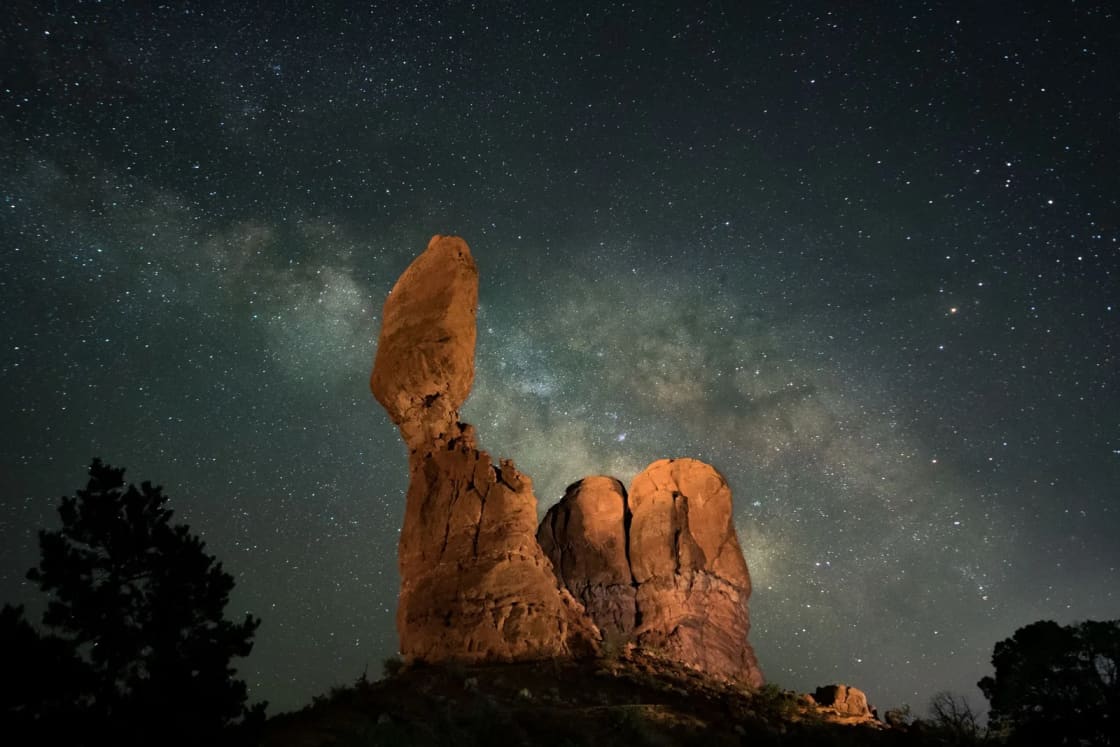
Arches was certified as an International Dark Sky Park in 2019, per the Park Service stargazing page. It recommends the Balanced Rock Picnic Area, the Windows Section, Garden of Eden Viewpoint and Panorama Point, and says the farther north you drive from Moab, the darker the sky. It also lists a "Stargaze with a Ranger" calendar for southeast Utah. Entry rules have changed in recent years, so read Arches entry reservations: what happened and how to check before you plan, and use Moab from Provo for lodging and the route.
11. Cedar Breaks National Monument (3 hours 52 minutes)
Designated in 2017, the 16th National Park Service unit to be an International Dark Sky Park and the first in southwestern Utah, per the Park Service release. Its elevation is 10,350 feet, and the release says its summer ranger-led stargazing programs were described as the highest such programs in the national park system at that elevation. The monument is about 30 minutes east of Cedar City. High elevation means cold nights even in summer, and our Cedar Breaks and Brian Head guide covers season and road notes.
12. Bryce Canyon National Park (4 hours 4 minutes)
The Park Service night skies page says Bryce gained International Dark Sky status in 2019, with a certification date of August 13 on its history page. The park runs an annual Astronomy Festival, scheduled June 11 to 13 in 2026, free with park admission, and offers ranger-led astronomy programs through the summer season. Parking near the telescope field and visitor center is closed during night events, and the Park Service points visitors to a shuttle. See Bryce Canyon from Provo.
13. Canyonlands National Park, Island in the Sky (4 hours 11 minutes)
Canyonlands was designated a Gold Tier International Dark Sky Park in 2015, per the Park Service. The park runs night sky ranger programs and belongs to the Colorado Plateau Dark Sky Cooperative. The Park Service's night photography advice is useful for anyone with a camera: avoid lighting landscapes or rock formations with artificial light, which is acceptable only for route-finding or minimum-impact camping. The Needles district is a much longer drive, about 264 miles and 5 hours 32 minutes by our national parks comparison.
14. Dead Horse Point State Park (4 hours 20 minutes)
Dead Horse Point is a designated International Dark Sky Park. The park is open from 6 a.m. to 10 p.m. year-round, and the page says day-use fees cover time only until the 10 p.m. closure. To stay later you can camp in the campgrounds or yurts, join a ranger-led activity, or join a company with a special use permit. The events list showed a Star Party on November 7 from 6:30 to 8:30 p.m. and other evening programs, though the page does not give years, so check the calendar. The visitor center is open daily 7 a.m. to 5 p.m.
15. Snow Canyon State Park (4 hours 35 minutes)
Snow Canyon, in Washington County, is on the Utah State Parks Dark Skies list. We did not read the park's own page. Its estimated drive is within a minute of Zion Canyon's, so the two can share a trip. Confirm hours and the designation type before planning.
16. Zion National Park (4 hours 36 minutes)
Zion is an International Dark Sky Park, per the Park Service stargazing page, which does not give a year. It lists spots including the Pa'rus Trail and the Human History Museum patio in Zion Canyon, the Checkerboard Mesa Pullout on the east side, Lava Point Overlook (which closes seasonally with snow) and Timber Creek Parking Lot at Kolob Canyons. The page notes the Zion Canyon Scenic Drive is mostly shuttle-only, so check the shuttle schedule, and that there is no food access at night and no cell service. Zion's Kolob Canyons entrance is close to I-15 and is the faster approach from Provo, about 3 hours 44 minutes per our national parks comparison. See Zion and St. George from Provo.
Tier three: plan a trip around it
17. Natural Bridges National Monument (5 hours 48 minutes)
The Park Service says Natural Bridges was designated the world's first International Dark Sky Park, in 2007, and describes it as home to some of the darkest skies in the country. The campground is by reservation only, and in summer the visitor center is open 9 a.m. to 4 p.m. daily. The page lists no fee amounts and does not give directions. If you're coming from Utah County, pairing it with Capitol Reef or Moab makes the drive worth the miles.
18. Goosenecks State Park (6 hours 29 minutes)
On the state's Dark Skies list. The park is in San Juan County. We did not read its page. Its distance puts it in the same trip as Natural Bridges, so a weekend loop through that corner of the state can include both. Confirm details with the state first.
19. Hovenweep National Monument (6 hours 31 minutes)
An International Dark Sky Park since 2014, and, per the Park Service, "the first dark sky park to span two states," across Utah and Colorado. The page says the units are remote and warns that GPS devices may give misleading directions, so it recommends carrying a paper map. Campsites must be reserved in advance. Summer days are hot, often 95 to 100 degrees. The page features stargazing and the Milky Way over the stone structures.
Rainbow Bridge National Monument (not ranked)
The Park Service says Rainbow Bridge is an International Dark Sky Sanctuary, the first in the National Park Service and fourth in the world. The page we read lists no directions or designation year. It is managed from Glen Canyon National Recreation Area, with a headquarters phone number of 928-608-6200. Check the Glen Canyon pages for access before you plan anything.
Which one fits your evening
You have a weeknight and a car. Timpanogos Cave or Jordanelle. Go for the experience of being in a canyon or beside a reservoir with the valley behind you. Do not expect desert-park darkness.
You have a Saturday and want to be home. Antelope Island, East Canyon or Rockport. Check the posted 10 p.m. close and be out on time.
You are building a weekend. Capitol Reef and Goblin Valley sit in the same region. Moab pairs Arches, Dead Horse Point and Canyonlands. Cedar Breaks, Bryce and Zion form a southwestern Utah route.
You want the darkest tier in official terms. Capitol Reef and Canyonlands hold Gold Tier ratings per the Park Service. Natural Bridges carries the first-in-the-world designation. All three are a long way from Provo.
What to bring
The Park Service's own tips repeat across Zion and Arches. Check the moon phase, since a new moon or a moon below the horizon gives the darkest skies. Allow 20 to 30 minutes for your eyes to adjust. Use a red light, since white light, including a phone screen, harms night vision. Bring warm layers, food and water, and expect no cell service at remote sites. Zion's page says the sky is darkest from 1.5 hours after sunset until 1.5 hours before sunrise.
Who should skip it
If you can only manage a few hours and the weather is cloudy, none of this is worth the gas. Anyone who needs a guaranteed program should check each park's calendar, because several pages list events only as individual dates. And if you are trying to go beyond 10 p.m. at a state park, read the day-use rules before you leave, because most close then.
What to check before going
- The DarkSky place finder. It is the official register, and counts differ across sources.
- Park pages for hours and fees. Many official pages point to separate fee pages instead of listing amounts.
- Road and weather conditions. High-elevation sites such as Cedar Breaks and Zion's Lava Point can be affected by snow.
- A map. Our drive times are estimates. For the longer drives, a map app with the day's traffic will serve you better.
For more trips out of Utah County, see 100 things to do in Utah from Provo.
Frequently Asked Questions
What is the closest International Dark Sky Place to Provo?
Which Utah dark sky place is easiest to reach from Provo in a single evening?
Which dark sky place in Utah is the farthest drive from Provo?
Are all of Utah's national parks International Dark Sky Parks?
Was Natural Bridges really the first International Dark Sky Park?
Do I need a reservation or a fee to stargaze at these places?
What is the difference between a Dark Sky Park and an Urban Night Sky Place?
How can I confirm a place is still on the official list?
Sources
The facts in this guide were checked against these sources. Hours, fees and rules change, so confirm anything time-sensitive with the source before you go. How we make Provo.com.
- Utah State Parks: Dark Skies, Utah State Parks. Checked November 7, 2026.
- Timpanogos Cave National Monument Certified by International Dark-Sky Association as Urban Night Sky Place, National Park Service. Checked November 7, 2026.
- Cedar Breaks National Monument Designated as an International Dark Sky Park, National Park Service. Checked November 7, 2026.
- Stargazing - Arches National Park, National Park Service. Checked November 7, 2026.
- Stargazing - Zion National Park, National Park Service. Checked November 7, 2026.
- Lightscape / Night Sky - Canyonlands National Park, National Park Service. Checked November 7, 2026.
- Night Skies - Rainbow Bridge National Monument, National Park Service. Checked November 7, 2026.
- Natural Bridges National Monument, National Park Service. Checked November 7, 2026.
- Hovenweep National Monument, National Park Service. Checked November 7, 2026.
- Antelope Island State Park, Utah State Parks. Checked November 7, 2026.
- Jordanelle State Park, Utah State Parks. Checked November 7, 2026.
- Dead Horse Point State Park, Utah State Parks. Checked November 7, 2026.
- Goblin Valley State Park, Utah State Parks. Checked November 7, 2026.
- East Canyon State Park, Utah State Parks. Checked November 7, 2026.
- Capitol Reef National Park Receives International Dark Sky Designation, National Park Service. Checked November 7, 2026.
- Night Skies - Bryce Canyon National Park, National Park Service. Checked November 7, 2026.