
There is a lavender farm in Mona that half of Utah has photographed and a surprising number of people have driven to at entirely the wrong time of year.
It is worth going. It is also worth understanding two things first: what it is called now, and when the flowers are there.
The short version
A large aromatic-plant farm and distillery in Mona, Juab County, about 35–40 minutes south of Provo. Visitor center open year-round, Monday to Saturday, 10 to 5. Lavender blooms for a short window in early summer. Guided tours, a petting zoo, wagon and paddle boat rides. Now branded Mt. Nebo Botanical Farm and Distillery rather than the Young Living Lavender Farm.
The name problem, stated plainly
Almost all the search demand for this place uses the name Young Living Lavender Farm. That is not what it is currently called, and the confusion is real rather than pedantic.
Visit Utah and Juab County's tourism site describe it as the Mt. Nebo Botanical Farm and Distillery. The old name persists in listings, reviews, road signage memory and every conversation anyone has ever had about it.
They are the same farm at the same address. If you are searching, use whichever gets you there; if you are asking directions locally, "the lavender farm in Mona" works on anyone.
Why the rename happened
The clue is in the newer name. This has not been a lavender-only operation for a long time, and calling it a lavender farm undersold what is grown there.
The property produces clary sage, goldenrod, Melissa, juniper and blue yarrow alongside the lavender. A botanical farm and distillery is a more accurate description of a working aromatic-crop business than a name that implies a single flower in a single month.
Where it is
3700 North Highway 91, Mona, Utah.
Mona is in Juab County, south of Santaquin and Payson, roughly 70 miles south of Salt Lake City. From Provo the drive is roughly 35 to 40 minutes: I-15 south to exit 242, then the Mona Road.
It sits in the shadow of Mount Nebo, the reason for the current name.
The bloom window is the whole story
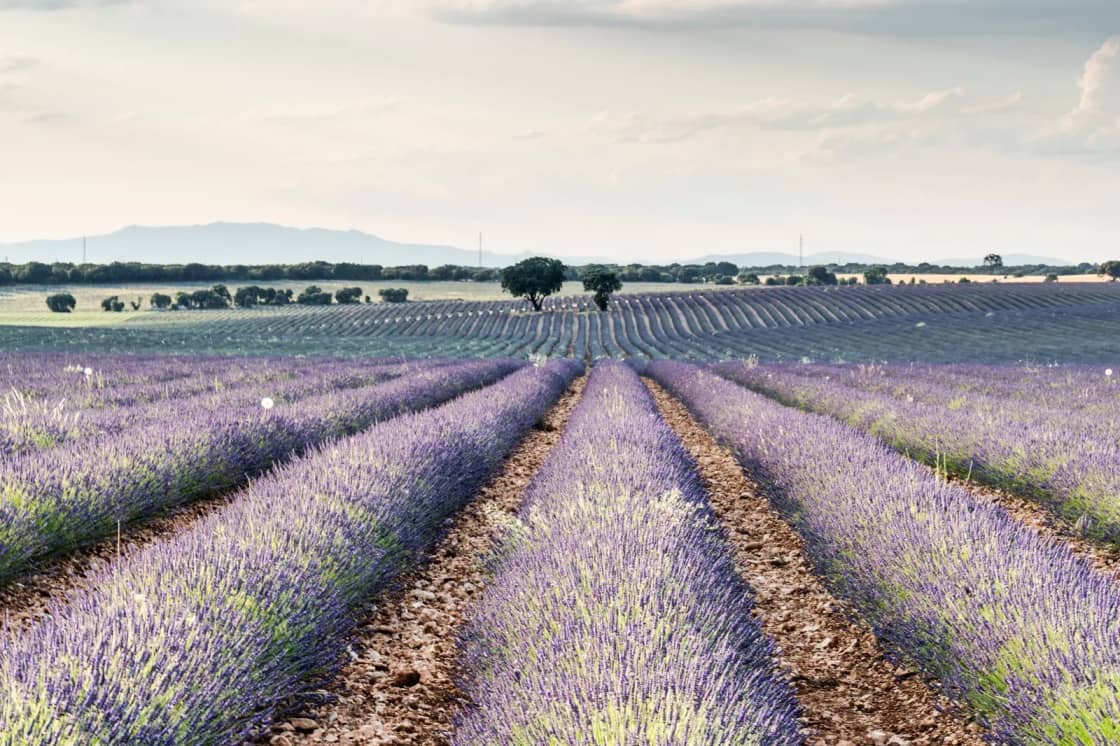
Lavender in Mona blooms for a short window in early summer, and the timing moves with the weather.
Nothing else about this article matters as much as that paragraph. If purple fields are the reason for the trip, call the farm before you drive down.
What is in bloom the rest of the year
The farm grows other aromatic crops, including goldenrod, so what you see depends on the month. The visitor center is open year-round regardless, which is why an off-season visit is a perfectly good outing as long as you know what you are getting.
Whether you can walk in the fields
Not reliably, and this catches people out.
Foot traffic through an unharvested aromatic crop damages the product, so a working farm may close fields to guests even inside the bloom window.
Plan for the possibility that you will see the lavender rather than stand in it.
The scale of the place
The farm covers nearly 1,700 acres; it began in 1994 as a farmhouse with 160 acres.
This is not a boutique u-pick operation with a farm shop. It is agricultural production at industrial scale that happens to welcome visitors, and the difference shows in how much of it you can access.
The distillery
Distillation is the point of the farm, and the tour is built around it. Visit Utah describes the Mona operation as one of the world's largest privately owned essential oil distilleries, and notes that one acre of lavender produces up to 5 liters of oil. For anyone who has only encountered essential oils as retail products, watching the extraction end of the process is the part of the visit that teaches you something.
It is also a research facility
Less advertised, and more interesting than the gift shop: the farm operates as a research site and is described as home to one of the world's largest data-focused libraries on aromatic plants.
You will not tour the library. But it explains why the property grows the range of crops it does, and why the farm is framed as botanical rather than decorative.
The animals
There is a petting zoo on the property.
For families this is the reliable half of the visit. Flowers are seasonal; animals are not.
Wagon rides and paddle boats
Wagon rides run through the fields, which during bloom is the best way to see them if walking is not permitted.
There are paddle boat rides and a rock wall. Availability varies by season and by day, and none of it is guaranteed on a quiet weekday in February.
Events
The farm hosts events through the year, including an annual Fall Festival and PRCA rodeo, plus weddings and family reunions. Check the farm's events site for current dates.
Essential oil classes and retreats
The farm hosts events through the year.
This is a distinctly Utah County crossover: a wellness-industry destination that is simultaneously a working farm and a tourist stop.
Hours and the last-tour trap
The visitor center is open year-round, Monday through Saturday, from 10am to 5pm.
The trap is that tours are booked online, so arriving late in the afternoon can mean a shop and a walk round the grounds rather than a tour. Book ahead if the tour is the point; Juab County's tourism page lists the farm's phone as 1-801-418-8973.
What it costs
Check tour prices when you book. The store is not cheap, which is unsurprising given what it sells, and specific activities and events carry their own charges.
Private events are a separate business entirely, with deposits, coordinators and hourly overage charges. If you are looking at the farm as a wedding or reunion venue, that is a different conversation from a Saturday visit.
The Young Living connection
The farm is a Young Living property, run by the essential oils company.
That connection is worth understanding because it shapes the visit. The store sells Young Living products, the tour explains Young Living's process, and a substantial share of visitors are people already involved with the company. None of that stops it being a good farm to visit — but it is a company property rather than a neutral agricultural attraction, and it is more useful to know that going in.
Combining it with the Nebo Loop
This is the strongest argument for the trip and almost nobody makes it. Mona sits at the southern end of the Nebo Loop Scenic Byway, one of the best drives in Utah and spectacular in autumn.
The Mount Nebo hike is in the same country. A day that pairs the farm with the loop is a considerably better day than the farm alone, and it solves the off-season problem — go in late September for the byway and take the farm as the stop rather than the destination.
Payson and Santaquin on the way
You pass both. Our guides to things to do in Payson and living in Payson cover the town, and south Utah County restaurants covers the food between here and Provo.
Mona itself is small. Plan to eat before you arrive or on the way back.
Photography
The rows against the dry hills are the shot, and the light in the hour before sunset is the light that makes it.
If you are going for photographs specifically, go on a weekday during bloom, ask at the store what is accessible, and do not assume you can walk into the rows for a portrait. It is a crop.
Accessibility
The visitor center and store are straightforward. The farm is a large rural property with gravel, grass, uneven ground and long distances between things.
Wagon rides help considerably. As with any working farm, a phone call about specific needs will get you a better answer than a website.
What surprises people
Two things. The first is the scale — visitors expect a farm and find something closer to a landscape.
The second is how much is not lavender. Arriving in the wrong month and discovering that the famous purple photograph represents a few weeks of a twelve-month operation is the single most common experience people report, and it is entirely avoidable with one calendar check.
Who it is for
Anyone in the bloom window, without qualification. Families year-round, for the animals and the wagon rides. Anyone driving the Nebo Loop, as the natural southern anchor of the day.
People hoping for a compact, ticketed, self-contained attraction should adjust expectations. This is a farm.
Why the bloom is so short
Lavender is a Mediterranean crop being grown at altitude in a high desert, and the flowering window it gets here is narrower than it would be in Provence or the Pacific Northwest.
Mona has cold nights well into spring and hot, dry summers. The plant flowers, the oil content peaks, and the harvest has to follow quickly — because the crop is grown for distillation rather than for display, cutting is timed to oil yield, not to visitor season. That is the whole reason the purple disappears so abruptly.
Harvest is the thing to watch for
If you can time it, arriving while cutting is underway is more interesting than arriving to look at intact rows.
Harvest is when the farm is doing the job it exists to do, when the distillery is running at volume, and when the smell across the property is at its strongest. It is also, inevitably, when the fields are most likely to be closed to foot traffic. You trade access for activity.
The smell, which nobody warns you about
Visitors describe the scent across the property during bloom as overwhelming in the literal sense — not unpleasant, but far stronger than anything a shop or a garden prepares you for.
Anyone sensitive to strong fragrance should factor that in. A working aromatic distillery processing lavender at scale is a different sensory proposition from a bottle of oil.
What to bring
Sun protection and water, first. This is open, exposed, high-desert country and there is very little shade between the buildings.
Beyond that: closed shoes for the grounds and the animal areas, a hat, and cash or card for the store. If you are photographing, a lens hood is more useful here than anywhere else in the county, because the light comes off the pale ground as well as the sky.
How long to allow
Two to three hours covers the tour, the store, the animals and a walk round the grounds comfortably.
Add time on event days for queues. If you are pairing it with the Nebo Loop, treat the farm as a two-hour stop inside a full-day drive rather than trying to give both a whole afternoon.
The best-value version of this trip
If you are weighing whether it justifies the drive, the answer depends almost entirely on how you frame it.
As a destination in its own right, outside bloom, it is a pleasant but modest couple of hours — a tour, a shop, some animals and a view. As one stop on a day that also takes in the Nebo Loop, Payson Lakes and the country around Mount Nebo, it becomes the civilized, sit-down, buy-something part of a day that is otherwise all driving and hiking. That is the version worth planning.
One thing to check before you leave home
Ring the farm. It is a working agricultural property, and what is accessible on any given day depends on the crop cycle, the weather and what the distillery is doing.
A five-minute call will tell you whether the lavender is standing, whether the fields are open, when the last tour runs and whether the wagon is operating. Every disappointment reported by visitors to this farm would have been prevented by that call.
The honest verdict
Go in the early-summer bloom window, confirmed by phone, if you want the lavender. Go any time between April and October if you want a pleasant rural afternoon with animals, a distillery tour and one of the better views in central Utah.
And know before you set off that the place you are looking for as the Young Living Lavender Farm now answers to Mt. Nebo Botanical Farm and Distillery. Same fields, same address, same mountain behind it.
Fire rules in a July field, and the map that decides where they apply
A lavender field at peak bloom is a few acres of dry, oil-bearing plants in the hottest and driest month of a Utah year, at the foot of a mountain range, in country that is mostly dry grass. That is worth knowing about before you visit, and Utah has an unusually specific body of law about ignition sources in exactly this kind of place. It is also the law that decides whether the canyon drive above the farm is open to any flame at all.
The provision that closes an area, and the four kinds of area it can close
The rule is not in the fireworks statutes. It is at Utah Code § 15A-5-202.5(1)(b), part of the State Construction and Fire Codes Act, which deletes Section 310.8 of the International Fire Code — Hazardous environmental conditions — and rewrites it.
The rewritten text is worth reading closely, because it reaches far past fireworks. It applies where a fire code official determines that existing or historical hazardous environmental conditions necessitate controlled use of any ignition source, including fireworks, lighters, matches, sky lanterns, and smoking materials.
Where those conditions exist in a municipality, the legislative body may prohibit ignition or use of an ignition source in four kinds of area, set out at paragraphs 1.1.1 through 1.1.4:
- mountainous, brush-covered, forest-covered, or dry grass-covered areas;
- within 200 feet of waterways, trails, canyons, washes, ravines, or similar areas;
- the wildland urban interface area, defined in the text itself as the line, area or zone where structures or other human development meet or intermingle with undeveloped wildland or land used for agriculture;
- and a limited area just outside those, in order to make the closed area readily identifiable.
Where the conditions exist in an unincorporated area, paragraph 1.2 gives the power instead to the state forester, after consulting the county fire code official with jurisdiction.
Two things about that list matter for a drive up a canyon to a farm. The 200-foot buffer at 1.1.2 attaches to trails and canyons as well as waterways. And the wildland urban interface definition expressly includes land being used for an agricultural purpose — which is what a working farm at the edge of undeveloped country is.
How a closure has to be drawn, and the two-of-five-years test
The rewritten section does not let an official close an area by gesture. Paragraph 2 requires the closed area to be designated along readily identifiable features like major roadways, waterways or geographic features; requires the boundary to be as close as practical to the actual hazardous area; and requires the closed area to be identified through a written description or map readily available to the public.
Closures based on a historical hazardous condition are tighter still. Paragraph 3.1 requires a finding that the condition existed in the defined area before July 1 in at least two of the preceding five years. Paragraph 3.2 requires a map. Paragraph 3.3 requires that map to be provided to the county before May 1 of each year the area is closed. Paragraph 4 states the consequence plainly: no map, no historical closure.
Utah Code § 53-7-225(6) then puts the pieces together. Where a municipal legislative body or the state forester provides such a map to a county, the county must, before June 1 of the same year, create a county-wide map showing every area within the county where fireworks are prohibited, provide it to each retailer that sells fireworks in the county and to the state fire marshal, and publish it on the county's website.
§ 53-7-225(7) closes the loop at the point of sale: a retailer must display a sign, clearly visible near the point of sale, giving the legal discharge dates and times and the criminal charge and fine for discharging outside them or inside a prohibited area — and must display the county's map.
The liability rule, which is the part worth taking seriously
Utah Code § 53-7-225.1(1)(a) provides that an individual who negligently, recklessly or intentionally causes or spreads a fire through discharge of a division 1.4G explosive is liable for the cost of suppressing that fire and any damages the fire causes. Under (1)(b), where that individual is a minor, the parent or legal guardian having legal custody is liable for those costs and damages — subject to a court's power under (1)(c) to waive part or all of it on a finding of good cause and reasonable supervision.
§ 53-7-225.1(2)(a) removes the obvious defenses: the conduct counts regardless of whether the discharge was inside the permitted time periods, and regardless of whether the fire began on private, state, federal or tribal land. And (2)(b) provides that discharging in an area closed under § 15A-5-202.5(1)(b) constitutes the negligent, reckless or intentional conduct the section describes.
The practical version for a July visit
Assume no open flame anywhere near the fields or the canyon. The farm's own rules will say so, and the state's closure regime is likely saying so too.
Check the county map before you plan anything involving fire. It is required to be published on the county website by June 1, and it is the authoritative answer to a question most people try to answer from a city name.
Smoking materials are on the same list as fireworks. Paragraph 1 names them explicitly, which surprises people who read closures as being about the Fourth of July.
Farm hours, tour times, and the bloom window all move year to year — confirm them with the farm before driving out.
Related Guides
- Moab from Provo: Planning the Drive, Arches and Canyonlands
- Bear Lake from Provo: Turquoise Water, Raspberry Shakes, Real Distance
- Zion and St. George from Provo: The Southern Utah Weekend
- Dispersed Camping Near Provo: The Rules, The Roads & What Most Guides Get Wrong (2026)
- Heber Valley & Midway from Provo: The Day Trip Through the Canyon
- The Heber Creeper: A Complete Guide to the Heber Valley Railroad
- Logan and Cache Valley from Provo: The Other College Valley
- Park City from Provo: The Year-Round Day Trip Guide
- U-Pick Orchards in Santaquin and Payson
Frequently Asked Questions
Is the Young Living Lavender Farm still open?
When does the lavender bloom?
Where is it and how far is the drive?
What are the visitor center hours?
Do you have to pay?
Can you walk in the lavender fields?
What is there to do besides look at lavender?
Is it only lavender?
Sources
The facts in this guide were checked against these sources. Hours, fees and rules change, so confirm anything time-sensitive with the source before you go. How we make Provo.com.
- Mt. Nebo Botanical Farm, Juab County Tourism. Checked October 12, 2026.
- Utah Code 15A-5-202.5, Utah Legislature. Checked October 12, 2026.
- Utah Code 53-7-225, Utah Legislature. Checked October 12, 2026.
- Utah Code 53-7-225.1, Utah Legislature. Checked October 12, 2026.
- Mt. Nebo Botanical Farm & Distillery, Visit Utah. Checked October 12, 2026.