
Snowmobiling in Utah Valley is a sport with two front doors and they are an hour apart. The first is American Fork Canyon, where the closed road above Tibble Fork Reservoir is the Utah County end of a 70-mile groomed trail system that crosses the Wasatch to Midway, and where the people who own machines have been riding since the trail was cut. The second is Daniels Summit, the pass between Heber and Strawberry Reservoir on U.S. 40, where a lodge and a marina rent sleds by the hour and guide first-timers on 200 miles of groomed trail through the Uinta foothills — and where nearly every Utah Valley family that has ever tried snowmobiling tried it.
This guide covers both doors: the groomed system and the closed canyon roads for people with their own machine, the rentals and guided tours for people without one, what a day costs, the registration and youth rules, the Forest Service travel plan that says where you can and cannot ride, and the avalanche problem, which is the part of this sport that kills people and the part beginners think does not apply to them. Prices are the operators' most recent postings as of early September 2026 and change with the season; the rental operations open when there is snow and close when there is not, and one of them ended the 2024-25 season early for lack of it.
The Groomed System: Midway to Tibble Fork
The core of Utah County snowmobiling is a cooperative trail network that Wasatch Mountain State Park, the Uinta-Wasatch-Cache National Forest, and UDOT maintain together across the ridge between the Heber Valley and American Fork Canyon. It runs roughly 70 miles of groomed trail, with parking, restrooms, and warming facilities on the Midway side at the state park's visitor center and golf-course clubhouse, and a trailhead with parking and restrooms on the Utah County side at Tibble Fork Reservoir.
The named trails, from the Midway side, start easy — the Midway Reservoir trail (about five miles) and the Snake Creek trail (about four) climb gradually from the valley floor past the golf course, with switchbacks that open onto the Heber Valley and deer and wild turkeys in the lower sections. The Cummings Parkway (about eight miles) runs the ridge. The spine of the system is the Mill Flat–Tibble Fork trail, nearly 16 miles, which climbs from the Mill Flat trailhead on the Midway side to the summit of the Wasatch and descends through American Fork Canyon to Tibble Fork Reservoir, with several designated play areas along the way where riders can leave the trail and run open slopes. Off it branch the Cascade Spring trail (about five miles), the Mutual Dell trail (about ten and a half, down the American Fork side toward the summer campground), the Silver Lake and Mill Canyon spurs, and a three-and-a-half-mile trail toward Sundance along the closed Alpine Loop road.
From Provo, the Utah County entrance is the practical one: Tibble Fork is about 45 minutes away, up American Fork Canyon on Utah 92 past the fee station to the reservoir, where the plowed road ends at the winter trailhead. The state park entrance in Midway is about an hour. The two are connected by the trail, and a strong rider can do the full crossing and return in a day. Our Tibble Fork guide covers the reservoir and the winter parking, and the American Fork Canyon guide covers the canyon's fee and the winter gate.
The system is groomed for snowmobiles, but skiers and snowshoers use it too, especially on the Midway side near the golf course, and the etiquette is to slow down for them. It is also the only groomed snowmobile trail in the county; everything else is a closed road or open country.
The Closed Roads
Utah County's canyon highways close to cars each winter above their gates, and the closed roads are where local riders go when they are not on the groomed system.
The Alpine Loop. Utah 92 over the shoulder of Timpanogos closes above Sundance on the Provo Canyon side and above Tibble Fork on the American Fork side. The American Fork side is part of the groomed system. The Provo Canyon side above the Aspen Grove gate is open to snowmobiles under the forest travel plan but is narrower, steeper, and shared with a steady stream of skiers, snowshoers, and sledders, especially on weekends near the gate; our cross-country guide describes it from the skier's side. The Mount Timpanogos Wilderness lies to the south of the road for most of its length, and motorized travel inside the wilderness boundary is a federal violation whether or not the sign is visible under the snow.
The Nebo Loop. The scenic byway from Payson Canyon over the Nebo range to Nephi closes each fall and is one of the most popular unregulated snowmobile corridors in central Utah. From the Payson side, the closed road climbs from the gate past the Payson Lakes turnoff to the summit country above 9,000 feet, where the open terrain around the overlooks is big, windblown, and drifted. There is a Forest Service trailhead at the gate. The Mount Nebo Wilderness sits along the west side of the loop; same rule. Our Nebo Loop guide covers the road in its open season, and the summit in winter is an entirely different place.
Squaw Peak and Hobble Creek. The Squaw Peak road above Provo and the Right Fork of Hobble Creek above Springville close in winter and see some riding, mostly by people who live near the gates. Both are steep, both have avalanche terrain, and neither is groomed.
The Mirror Lake Highway. Utah 150 above Kamas closes at a winter gate and the closed road into the Uintas, about 90 minutes from Provo, is one of the state's great snowmobile corridors — deep snow, high country, and a Forest Service trail system fanning out from it, including the Soapstone Basin and the Wolf Creek area toward Hanna. It is covered by the UAC's Uintas forecast, not Provo's.
Every one of these roads is governed by the Uinta-Wasatch-Cache National Forest's travel management plan, which designates where over-snow vehicles are allowed, and the plan is what a ranger enforces. The forest publishes winter travel maps; the Pleasant Grove ranger district office is the Utah County contact, and the map is worth having in the sled before the first ride, because "the road was closed so I rode it" is not a defense in the wilderness.
Daniels Summit: The Rental Front Door
Daniels Summit Lodge sits on U.S. 40 at the top of Daniels Canyon, the pass between the Heber Valley and the Strawberry Reservoir basin, at about 8,000 feet on the edge of the Uinta National Forest — roughly an hour from Provo up Provo Canyon through Heber and up the canyon. It is the largest snowmobile rental and guide operation within reach of Utah Valley and the place most families in the county tried the sport for the first time.
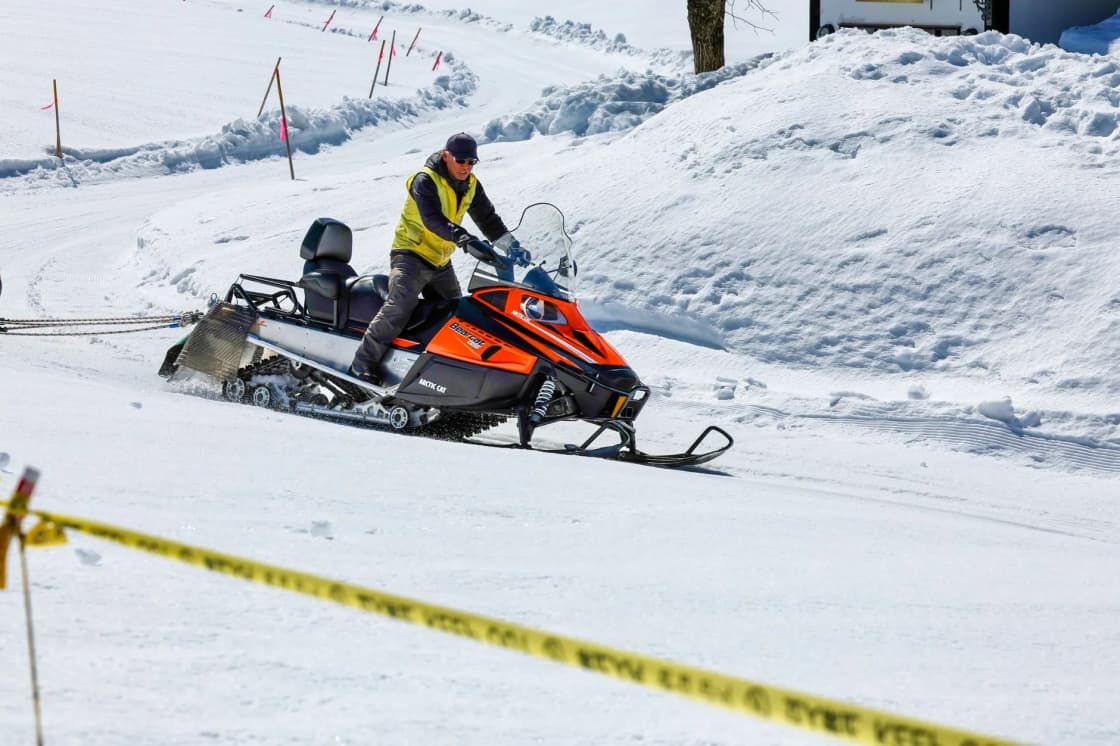
The draw is direct access: the rental center is at the trailhead, the lodge is at the trailhead, and riders leave from the lot onto a system the lodge describes as more than 200 miles of terrain, with a 35-mile loop trail groomed daily and open off-trail riding in the meadows and timber toward Strawberry. There is no trailering and no shuttle; you check in, get the machine and the helmet, and ride. The lodge runs guided tours for beginners and self-guided rentals for people who have ridden, on a fleet of trail sleds; the tours include the sled and helmet, and the lodge rents suits and boots.
Recent posted prices, which the lodge says vary by date and availability: self-guided rentals from about $240 for two hours, about $290 for a half day, and about $370 for a full day; guided two-hour tours from about $290 per sled; private guided tours from about $780. Self-guided rentals have required a minimum of two sleds per group, a maximum of ten, and no more than two riders on a machine. The lodge has run stay-and-play packages — two or more nights with a dining credit and a discount on the riding — and has an indoor pool and a restaurant, which is why it is a weekend rather than a day trip for families with children too young to ride. Our Heber Valley guide covers the drive and the rest of the valley.
The caveat is snow. Daniels Summit ended its 2024-25 season early, posting that limited snowfall had closed the operation; in a normal year it runs from mid-December into March. Check the lodge's site for the current season's status before booking.
Strawberry Bay and the Heber Outfitters
A few miles past Daniels Summit on U.S. 40, at Strawberry Reservoir, the marina that rents boats in summer rents snowmobiles in winter. Strawberry Bay Marina has posted two-rider Ski-Doo Expedition sleds at about $274 for a half day (four hours) and $374 for a full day (9 a.m. to 4 p.m.), plus fuel, with guided trips and a shuttle service, and the marina describes the surrounding country as more than 250 miles of open and groomed terrain with views of Nebo and Timpanogos across the basin. It caters to groups and takes larger parties by arrangement. The Strawberry country is higher, colder, and more open than Daniels Summit's timber, and it holds snow later into the spring. Our ice fishing guide covers the same reservoir from the other winter sport it hosts.
Heber City has several rental and guide operations — Uinta Recreation and Lofty Peaks Adventures are the two most-reviewed — that rent sleds and trailer them to the trailheads, and a Springville powersports dealer that rents. At least one operator based in Provo has advertised a 24-hour rental with a free trailer for a flat rate plus mandatory insurance, with delivery to trailheads for a fee, which is the option for a group with a truck and a hitch that wants to ride Tibble Fork or Nebo without buying a machine. For any of these, read the fine print on the damage deposit and the fuel charge, because that is where the posted rate grows.
The Rules
Registration. Every snowmobile operated on public land in Utah must be registered with the Utah Division of Motor Vehicles, with the current sticker displayed, and non-residents whose home state does not have reciprocity buy a Utah non-resident OHV permit. The registration fee funds the grooming. Rental operators handle it on their machines.
Youth. Utah treats snowmobiles as off-highway vehicles, and the state's OHV rules apply: nobody under eight may operate one on public land, and anyone under eighteen who does must have completed the state's youth OHV education course — free, online, through Utah State Parks — and carry the certificate. Helmets are required for riders under eighteen. A child riding as a passenger with an adult is fine at any age, with a helmet.
Adults. Utah does not require a driver's license, an adult education course, or a helmet for adult riders on public land, though the state's free online course is worth the hour and every rental operator requires a helmet regardless. Rental operators generally require the driver to be sixteen or eighteen with a valid license.
Where. The Forest Service travel plan governs the national forest, which is nearly all the terrain in this guide; wilderness areas are closed to all motorized travel; state parks have their own rules; and private land, which is a surprising amount of the Strawberry and Heber country, needs the owner's permission. Watershed closures apply in parts of the Wasatch — the Salt Lake City watershed in the Cottonwoods is closed to snowmobiles entirely. Our ATV and UTV guide covers the same OHV rules in their summer form.
Speed and sound. Utah has no statewide snowmobile speed limit on public land, but the groomed trails are shared, and the etiquette — slow for skiers, snowshoers, and dogs; pass on the right; hand signals for the number of riders behind you — is the difference between a trail system that stays open and one that gets restricted.
The Avalanche Problem
This is the section to read twice. In a typical Utah winter, snowmobilers account for a large share — some years the largest share — of the state's avalanche deaths, and the reasons are structural. A machine puts a rider into steep, remote, high terrain in minutes, with none of the snow sense a skier picks up in three hours of climbing it. High-marking — running the sled as far up a steep slope as it will go, then turning down — is the single most reliable way a human can trigger a slab avalanche, because it puts a heavy load at exactly the point on the slope where the snowpack is most stressed. And a snowmobile group is often spread out and moving, so the people who could dig a buried rider out are not watching when it happens.
The fix is the same as for skiers, and it is not optional. Every rider in the group carries an avalanche transceiver, a metal shovel, and a probe, and has practiced with them; a group in which one person has the gear cannot rescue anyone. Every rider reads the Utah Avalanche Center's forecast for the region before the ride — the Provo forecast for American Fork Canyon, the Alpine Loop, Nebo, and Hobble Creek; the Uintas forecast for Daniels Summit, Strawberry, and the Mirror Lake country. On any day the forecast is above Low for the aspects and elevations you will ride, you stay on the groomed trail and off the slopes, and you do not high-mark. One rider on a slope at a time, the rest watching from a safe spot. And take the free Know Before You Go presentation, which the UAC built with snowmobilers as much as skiers in mind. Our avalanche safety guide covers the forecast, the gear, and the snowpack; the physics do not care what you are riding.
The rental operators run guided tours on groomed trail for beginners precisely because a guide keeps the group off the slopes on a bad day. Take the guided tour the first time. The self-guided rental is for the second.
What to Wear, and What to Bring
Snowmobiling is colder than skiing because you are sitting still in a wind you are making. A full snowmobile suit, or an insulated waterproof shell with bibs; heavy insulated boots rated well below zero; thick gloves or mittens with a windproof shell, plus liners; a balaclava; and a full-face or motocross-style helmet with goggles, which the rental outfits provide and which you should own if you ride your own machine. Base layers that wick, wool socks, no cotton. Hand and toe warmers, several sets. The rental operators rent suits and boots for people who do not own them, and it is worth the money the first time.
Bring water, food, a phone with maps downloaded, a satellite messenger for anywhere out of cell coverage (which is most of the Strawberry country and all of the upper canyons), a tow strap, a small tool kit, and a spare belt if it is your machine. Fuel: a full tank, and know your range, because a sled that runs dry at the summit of the Nebo Loop is a very long walk.
The Season and a First Day
The riding season runs December through March, with January and February the reliable months and early March often the best — deep base, longer days, and firmer morning snow. Daniels Summit and Strawberry, at 8,000 feet, are usually rideable by mid-December; the Tibble Fork–Midway system depends on the Wasatch and is groomed as long as it holds; the Nebo summit drifts deep and rides into April while the lower road is mud. A dry winter closes everything early, and a warm March ends it fast.
A first day, for a Utah Valley family without a machine: book a guided two-hour tour at Daniels Summit or Strawberry Bay for a weekday morning in late January; rent the suits and boots; leave Provo by 7:30 to be checked in by 9; ride the groomed loop with the guide; eat at the lodge; be home by 4. For a family that liked it, the next step is a half-day self-guided rental, then a used sled and a trailer and the drive to Tibble Fork on a Saturday morning with the neighbors who have been doing it for twenty years, which is how most of the riders in this county got started.
The Short Version
Own a machine: Tibble Fork, 45 minutes, the Utah County end of a 70-mile groomed system to Midway; the closed Alpine Loop and Nebo Loop roads; the Mirror Lake Highway 90 minutes east. Rent one: Daniels Summit Lodge and Strawberry Bay Marina, an hour east on U.S. 40, roughly $240 to $370 for a self-guided sled and about $290 for a guided two hours, plus fuel and gear. Rules: register the machine, youth course and helmet under 18, no riders under 8, the forest travel map in the sled, stay out of the wilderness. Wear: more than for skiing. And carry a beacon, shovel, and probe, read the forecast, and do not high-mark, because the avalanche does not know you are on a snowmobile.
Related Guides
- Tibble Fork Reservoir
- American Fork Canyon
- Nebo Loop Scenic Byway
- Avalanche Safety in Utah Valley
- Backcountry Skiing 101 from Utah Valley
- Cross-Country Skiing Near Provo
- Heber Valley and Midway from Provo
- ATV and UTV Rentals in Utah Valley
Frequently Asked Questions
Where is the closest snowmobiling to Provo?
Where can I rent a snowmobile near Provo?
Do I need a license or a class to snowmobile in Utah?
Can I ride the Alpine Loop or the Nebo Loop in winter?
How dangerous is it, really?
What does a first day cost with a rental?
What should I wear?
When is the season?