
If you asked most people in Provo to name the city's best-known small business on Center Street, a surprising number would say the one where you make your own soap.
That deserves an explanation, because on paper it sounds absurd. A workshop above a thrift store, where you pay a flat fee to pour scented soap into a mold and wait for it to harden, has become one of the most reliably booked evening activities in a city of a hundred thousand people. It is a good business, and it is also a very precise piece of evidence about what Provo's social economy actually looks like.
Both halves of that are worth going into.
What it actually is
The Soap Factory sits at 54 West Center Street in downtown Provo, upstairs, above a ground-floor retail unit. That last detail matters more than it sounds and we will come back to it.
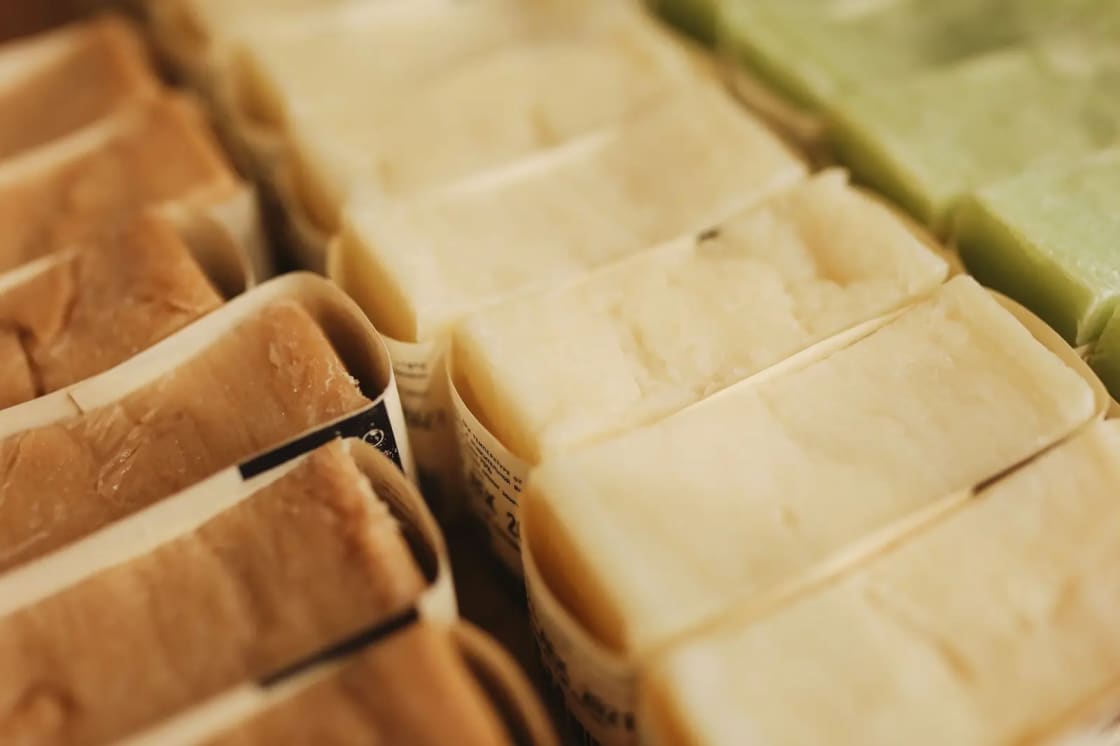
The format is straightforward. You arrive, you choose from a large inventory of molds — the business advertises hundreds of shapes — then pick scents from a range of essential oils and colorants from mineral pigments. You pour, mix, and add whatever inclusions you have chosen. The soap sets while you wait, and there is an optional painting stage for the ones that take it. You leave with a set weight of finished bars, generally described as two or three small to medium ones.
The whole thing runs about an hour to an hour and a half. Pricing has been advertised as a flat per-person figure in the mid-teens, though the structure has changed over the years — older reviews describe a separate lab fee that does not appear in current descriptions, so confirm the current price before planning a group budget.
It has been operating since around the middle of the 2010s. The founder's own account is that he tested the idea by having strangers come to his living room to make soap, and when people were willing to travel and pay for that, he took it seriously.
The access problem nobody puts in the headline
This is the detail we would want a family member to know before booking, so it goes high on the page rather than buried in a list.
The workshop is upstairs and it is not wheelchair accessible. The business says so itself. There is no ambiguity about it and no workaround offered.
For a solo visit or a couple that is a non-issue. For a ward activity, a family reunion, a birthday party or a work outing — exactly the kinds of bookings this place takes — it is the difference between an inclusive evening and someone sitting in a car. Ask about it at booking, and if it does not work for your group, our indoor activities guide covers ground-floor alternatives.
Why a soap workshop thrives here specifically
This is the more interesting question, and the answer says something about the city.
Provo has an enormous population of young adults, a very high rate of dating, and almost none of the default American date infrastructure. There is essentially no bar scene. Alcohol is not the social lubricant it is in comparable college towns. Sunday removes a full day from the weekend calendar for a large share of the population. And the dominant social culture places real weight on activity dates — doing a thing together rather than sitting across a table.
Put those together and you get demand for a category that barely exists elsewhere: paid, alcohol-free, hour-long activities you can do with someone you have just met, that give you something to talk about and something to take home.
That is the market. The Soap Factory is one of the cleanest examples of a business built directly on top of it, and the same forces explain the density of dessert shops, escape rooms, karaoke rooms, pottery painting and mini-golf in this valley relative to its size. Our dating in Provo guide covers the culture that produces the demand, and the date ideas roundup covers the rest of the category.
The honest limits
Two things reviewers say consistently, and they pull in opposite directions.
The experience gets good reviews. The staff come in for repeated, specific praise. The choice element is genuinely fun, and the pace suits people who do not know each other well — there is always something to be doing, which is exactly what an awkward first hour needs.
The soap itself divides people. Some visitors report bars that hold up fine. Others report soap that fell apart on first use, and at least one review describes exactly that disappointment with a child. This is a real pattern in the feedback rather than an outlier.
The reconciliation is simple and worth stating plainly: you are buying an evening, not a supply of soap. Judged as an activity it works. Judged as a soap purchase it is expensive and inconsistent. Go in with the first framing and the complaint evaporates.
Practical planning
Hours are evening-weighted. The workshop has run late-afternoon-to-evening hours on weekdays and a longer Saturday, closed Sunday. That suits students and couples and is awkward for families with small children, who will want the Saturday slot.
Parking is downtown parking. Center Street has street parking and there are lots nearby; on a Friday evening in term time expect to walk a block or two. Our downtown Provo guide covers the geography.
Wear something you do not mind marking. It is not a messy activity by craft standards, but pigment is pigment.
Groups over about ten need arranging in advance. The business handles private bookings for field trips, birthdays and corporate outings, and those are scheduled outside normal hours rather than squeezed into them.
Combine it with dinner. The location is the whole advantage. An hour of soap plus dinner on Center Street is a complete evening without moving a car.
A note on the name, because it misleads people
"The Soap Factory" sounds like two things it is not.
It is not a factory in any manufacturing sense — there is no production line, no bulk output, no retail supply operation behind it. It is a workshop room where customers make small batches by hand.
It is also not a music or event venue, which is a genuine and recurring mix-up. Provo does have a well-known independent live music room, and it is Velour on University Avenue, a completely different business a few blocks away with a completely different history. If you arrived at this page looking for a concert, you want that one.
And it should not be confused with the Startup Candy Factory, the century-old building on 100 West that genuinely was an industrial operation and that now hosts events. Provo has several businesses with "factory" in the name and only some of them ever made anything at scale. Our Startup Candy history covers the one that did.
What a session actually looks like
Useful to know if you are the one who booked it and will be explaining it to everyone else.
You choose molds first. This takes longer than anyone expects, because the inventory is large and choosing is the fun part. Groups routinely spend a third of their session here.
Then scent. Essential oils, chosen individually or blended. This is where people who came in skeptical usually get involved, because smelling forty things in a row is inherently entertaining.
Then color. Mineral pigments, layered or swirled depending on how ambitious you are feeling and how forgiving your mold is.
Then you pour and mix. The actual production step is short. It is also the step where the difference between a careful person and an enthusiastic one becomes visible in the finished bar.
Then you wait. The soap needs to set enough to handle. This is dead time by design and it is where the conversation happens — which, for a first date, is the entire product.
Then optional painting, and you leave with your bars.
Booking for a group: the checklist
Confirm the access situation first. Upstairs, no wheelchair access. This is the question to ask before you pick a date, not after.
Count heads honestly. Private bookings are arranged outside normal hours for larger groups. Turning up with fourteen people at a walk-in slot on a Friday will not go well.
Check the current price per person, not the price in a review from three years ago. The structure has changed.
Pick Saturday if there are children. The weekday hours start late.
Allow two hours in the plan even though the activity is ninety minutes. Parking, arriving, choosing and paying all take real time.
Decide the dinner half in advance. The location only pays off if you use it, and downtown Provo on a Friday evening is not a place to be deciding where to eat at seven o'clock with a group of ten.
Who it is actually for
First and second dates. This is the core use case and the reason the business exists. It solves the two hardest problems of an early date at once: what to do with your hands, and what to talk about.
Groups that need an activity everyone can do. No skill floor, no fitness requirement, no competitive element that makes someone feel bad — subject to the access limitation above.
Visiting family. Particularly the middle stretch of a visit, when you have done the canyon and the campus tour and need something indoors.
Children old enough to follow instructions. Field trips are a regular booking for a reason.
Less obviously for: anyone who genuinely wants good handmade soap, anyone who needs a step-free venue, and anyone who finds structured activities more stressful than a conversation over dinner.
Where it sits among Provo's paid activities
Provo has an unusually deep bench in this category, and the honest comparison helps.
If you want the cheapest possible evening, the free things to do and cheap date ideas guides will beat any paid workshop, and the canyon costs nothing at all.
If you want something with a competitive edge, escape rooms and the arcade-and-games category do a different job.
If you want a take-home object, this and the pottery-painting category are the two main options, and they suit different temperaments — soap is faster and less precious, pottery is slower and more forgiving of perfectionism.
If you want the version with the best story attached, the answer in this city is usually the canyon or a downtown institution with a century of history behind it, and our oldest businesses in Provo guide covers those.
Downtown Provo, and why the location matters
The Soap Factory's address is doing a lot of work, and it is worth understanding what Center Street has become.
Downtown Provo spent decades as the part of the city people drove through. Over the last fifteen years it has turned into the part they drive to — a genuine restaurant cluster, independent retail, the Provo City Center Temple rebuilt out of a burned tabernacle a few blocks away, a live music room, and the density of small businesses that only appears once foot traffic is reliable.
A ninety-minute paid activity is a very different proposition on a street where there is somewhere to go afterwards. Half the value of this booking is that it slots into an evening rather than being the whole of one.
It also means the business benefits from something it did not build. On a Friday evening, the people walking past on Center Street are already out — and a workshop that accepts walk-ins on a street with foot traffic is capturing a market that a suburban strip-mall location could not reach at all.
What it costs against the alternatives
A flat mid-teens fee per person sounds like a lot for soap and very little for an evening, and both readings are correct depending on what you compare it to.
Against a movie it is competitive once you count a ticket and concessions, and it produces conversation instead of two hours of silence — which for an early date is the entire argument.
Against dinner out it is cheap. Two people can do this for less than one main course at the higher end of Center Street.
Against the free options it loses on price and wins on structure. A walk up the canyon costs nothing and is more beautiful; it also requires that you already be comfortable with each other, which is precisely the thing a first date does not have.
Against the other paid activities it sits mid-range: cheaper than an escape room per person, more than mini-golf, roughly level with pottery painting.
The category this really belongs to is what you might call structured conversation — you are paying for a reason to be in a room together with something to do. Priced that way it is one of the better values in the city, and the fact that it has survived and stayed busy for a decade in a market where activity businesses churn constantly is the strongest evidence that it works.
The short version
A make-your-own soap workshop, upstairs on Center Street, about ninety minutes, a flat fee in the mid-teens per person, reservations or walk-ins, closed Sunday, not wheelchair accessible, staff people rave about, soap people are divided on.
It is not a hidden gem — it is one of the most-searched businesses in the city, which is itself the tell. In a place with this many young adults and this little conventional nightlife, a room where you can make something with your hands for an hour is not a novelty. It is core infrastructure.
What "climb at your own risk" actually means in Utah
Every climbing gym in the country hands you a release and a phrase about assuming the risk. Utah has an unusually well-developed body of law behind that phrase, and the version that matters is not the one on the sign.
Utah recognizes three distinct branches of assumption of risk, set out in Moore v. Burton Lumber & Hardware Co. and Jacobsen Construction Co. v. Structo-Lite Engineering, Inc., and restated by the Utah Supreme Court in Rutherford v. Talisker Canyons Finance Co., 2019 UT 27.
Primary express assumption of risk is the contract — a party expressly agreeing not to sue for injury that may later be caused by another's acts. That is the waiver at the front desk, and in Utah it is generally enforceable as to an adult's claim for ordinary negligence.
Primary implied assumption of risk, usually just called primary assumption of risk, is different and does not involve a signature at all. It describes a relationship in which the defendant owes no duty of care — because the person was exposed to a risk that the defendant, exercising due care, could not avoid. Where no duty is owed there can be no negligence. As the court put it, primary assumption of risk is best understood to negate any further duty once the operator has discharged its initial duty of reasonable care. Gravity is the obvious example: a gym cannot eliminate the fact that climbing involves height.
Secondary assumption of risk is the unreasonable encountering of a known and appreciated risk, and Utah treats it as a phase of contributory negligence. This is the branch that changed. Before 1973 it was a complete bar to recovery. The Utah Comparative Negligence Act of 1973 folded it into contributory negligence, expressly providing that "contributory negligence" includes "assumption of risk," so that unreasonable conduct by an injured person reduces or defeats recovery by comparison rather than automatically ending the case.
Why that matters at a climbing wall
The distinction is the difference between a risk the gym cannot design away and one it simply did not.
Falling while bouldering is intrinsic to bouldering. A worn-through mat seam, an auto-belay past its service interval, or a route set over an unpadded corner are not intrinsic to anything — they are ordinary maintenance questions, and no amount of sign-posting converts them into inherent risks of the sport. Utah's framework makes an operator's duty of reasonable care the pivot, not the customer's signature.
And for anyone under 18, the signature does less again: under Hawkins ex rel. Hawkins v. Peart, 2001 UT 94, reaffirmed in Rutherford, a parent cannot release a minor's prospective claim for negligence in Utah.
What to look at on a first visit
None of this is a reason to hesitate about climbing, which remains one of the safer things a teenager can do with an afternoon in Provo. It is a reason to notice the things that indicate an operator is managing risk rather than paperwork:
- Is the belay check real? A gym that watches you tie in and tests your belay before letting you on a rope is doing the most important thing it does.
- Mat coverage and seams, particularly where two pads meet at a corner or beneath a traverse.
- Auto-belay tags. Reputable gyms mark service dates visibly.
- Staffing on the floor during peak evening hours versus a quiet afternoon.
- Whether children are supervised by ratio or by assumption. Ask what the policy is before a birthday group arrives, not during one.
Related Guides
- All-Together Playground: The Park 4,100 Volunteers Built in Six Days
- The Bean Museum: Provo's Free Natural History Collection
- Lehi Roller Mills: The Footloose Landmark That Quietly Changed Its Name
- Ashton Gardens at Thanksgiving Point: What It Costs, What's Open, and the Waterfall Problem
- Cascade Springs: The Complete Visitor Guide (2026)
- Timpanogos Cave National Monument: The Complete Visitor Guide (2026)
- Butterfly Biosphere: Utah's Only Butterfly Conservatory
Frequently Asked Questions
What is The Soap Factory in Provo?
How much does The Soap Factory cost?
How long does it take?
Do you need a reservation, or can you walk in?
Is The Soap Factory wheelchair accessible?
Is it good for kids?
Is the soap any good?
What else is nearby on Center Street?