
Utah Valley sits an hour from one of the best trout fisheries in the western United States, and a surprising number of people who live here have never fished it. Strawberry Reservoir is not a local secret — it draws anglers from across the state and beyond — but from Provo it is close enough to be a morning, which is a different proposition from a trip.
It is also a reservoir with unusual rules. The regulations at Strawberry are stricter and more specific than Utah's statewide defaults, they exist for a documented biological reason, and they are the thing most likely to get a visiting angler in trouble.
Fishing regulations change between guidebook years. Everything below should be confirmed against the current Utah Fishing Guidebook from the Division of Wildlife Resources before you fish.
The drive, and the one thing to know about it
From Provo the route is up Provo Canyon on US-189 to Heber City, then southeast on US-40 climbing over Daniels Summit. Under an hour to the west end in decent conditions.
The thing to know is Daniels Summit. It is a real mountain pass, it collects weather that Heber does not have, and it is routinely the difference between an easy drive and a bad one between November and April. Utah Valley drivers who check the forecast for Provo and leave are the ones who get caught, because the valley can be clear while the summit is not.
In summer none of this applies and the drive is straightforwardly pleasant. In winter, check conditions for the pass specifically rather than for either end of the route.
What kind of water this is
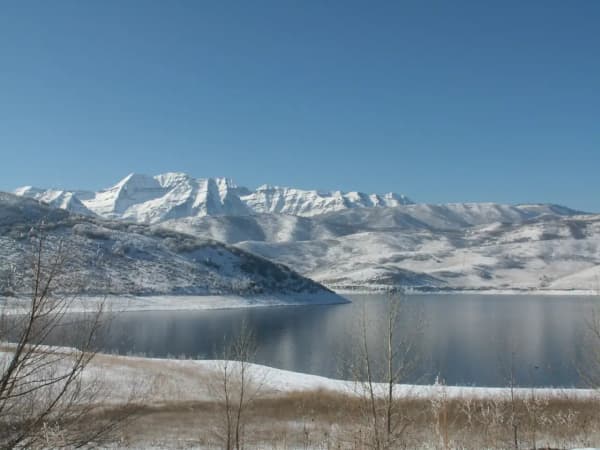
Strawberry sits at roughly 7,600 feet, which puts it in a different climate from Utah Valley entirely. It is large, open and shallow-shouldered in places, with long shorelines and few natural windbreaks.
This shapes everything about fishing it. The altitude means the season runs differently from the valley below — ice comes early and leaves late, and summer afternoons are pleasant when Provo is punishing. The openness means wind is the dominant variable on any given day, and an hour of morning calm can turn into conditions a small boat has no business being in.
It is a big-water fishery in the sense that matters: the scale rewards knowing a few areas well rather than trying to cover it.
The fish, in order of why you came
Bear Lake cutthroat trout are the headline. They are the reason for the reservoir's reputation, the reason for the special regulations, and the fish most people are targeting. They run large and they are aggressive predators.
Rainbow trout are the reliable second species and the one most likely to make a beginner's day, particularly from shore.
Kokanee salmon are landlocked sockeye, silver most of the year and turning deep red as spawning approaches, with males developing a hooked jaw and a pronounced hump. They are counted as part of the trout limit rather than separately, which is a detail people miss.
Utah chubs are the fourth species and the one nobody is fishing for. They are the forage base and the management problem simultaneously, and understanding that is the key to understanding the rules.
The slot limit, explained rather than recited
The rule: all cutthroat trout between 15 and 22 inches must be released immediately. You may keep up to two cutthroat under 15 inches and no more than one over 22 inches, within a combined daily limit of four trout or kokanee.
The reason is chub control. Strawberry's cutthroat eat Utah chubs, and chubs, left unchecked, outcompete rainbow trout and kokanee for food and can degrade the whole fishery. Cutthroat become materially better at eating chubs as they get larger. The slot therefore protects fish precisely through the size band where they are transitioning into effective predators, so they survive to do the job the reservoir needs them to do.
Framed that way it stops feeling like a restriction and starts looking like the reason there are big fish to catch at all. Conservation officers report the slot limit as the most common violation they encounter here in winter, usually from people who did not know rather than people cheating.
The filleting rule people break by accident
At Strawberry you may not fillet trout and salmon, and you may not remove heads or tails, in the field or in transit. The same rule applies at Scofield, Lost Creek and Panguitch Lake.
You can clean and cook fish at the reservoir. What you cannot do is process them into unidentifiable fillets for the drive home. The purpose is enforcement: an officer needs to be able to identify the species and measure the length, and a fillet in a cooler defeats both.
This one catches campers in particular, because filleting at the site is a normal thing to do almost everywhere else in the state.
Tributaries, and the seasonal closure
The streams feeding Strawberry are managed separately from the reservoir, and several close seasonally to protect spawning fish. There is also a period in the fall when kokanee are protected while they run upstream, during which possessing them is illegal and fishing the tributaries is closed.
The practical version: the main body of the reservoir has no closed season, but the inlets do, and the calendar for them is in the guidebook rather than posted at every access point. If your plan involves moving water rather than the reservoir itself, check that specifically.
Fishing near the inlet stream can also be closed as posted during spring spawning operations, which are part of how the fishery is managed rather than an inconvenience.
The marinas and where people launch
Strawberry Bay is the main developed area, with the largest marina, boat launching, and the most services on the reservoir. Soldier Creek is the other principal launch, at the eastern end.
For a first visit from Provo, the west end is closer and the more obvious choice. The reservoir is large enough that the two ends fish differently and locals develop preferences that have more to do with wind direction and habit than with any general truth.
Facilities, launch fees and seasonal hours change year to year. Confirm what is open before towing a boat over the summit, particularly in shoulder season when marina services wind down before the fishing does.
Fishing it from shore, which is a real option
Not everything here requires a boat, and the assumption that it does keeps people away.
Shoreline access is extensive, and the periods when fish are close in — most reliably around ice-off in spring, and again in autumn — are exactly when bank fishing works best. A rainbow trout caught from shore counts the same as one caught from a boat.
The trade-off is that a boat lets you leave a windward shoreline and a bank angler cannot. On a day when the wind sets up hard against your bank, the honest answer is to move or to go home.
How people fish it
Three approaches dominate, and which one suits you decides whether you need a boat.
Trolling is the default from a boat in open water and the most efficient way to locate fish across a reservoir this size. It covers water, which is the whole problem at Strawberry.
Jigging comes into its own through the ice and over structure, and it is the technique most associated with the reservoir's larger cutthroat in winter.
Fly fishing works well here and is underrated by people who assume Strawberry is exclusively a hardware fishery. The shoulder seasons, and particularly the weeks after ice-off, are when it is most rewarding from a float tube or from the bank.
Bait rules, gear restrictions and pole limits are set in the guidebook and differ from statewide defaults on some Utah waters. Check the Strawberry entry specifically rather than assuming the general rule carries over.
The kokanee run, and its own rulebook
Kokanee deserve separate treatment because their season works unlike anything else on the reservoir.
Through much of the fall, kokanee are protected while they move toward the tributaries to spawn, and possessing them during that period is illegal. This is the rule that generates the most confusion, because a fish that is legal in July is not in September.
Utah also runs a limited snagging season on select waters, which is a management method rather than ordinary angling — it uses fish that will die after spawning regardless. Which waters, which dates and what tackle are all specified, and all of it moves year to year. If kokanee are the reason for your trip, read the current guidebook's kokanee provisions in full rather than the reservoir entry alone.
The spawning color change is spectacular, and late-season visitors often come to watch it rather than to fish.
Taking children
Strawberry can be an excellent family fishing day or a miserable one, and the variable is wind rather than fish.
The case for it: rainbow trout are catchable from shore, there is space, and a child who catches a trout at Strawberry has caught a trout in a place that matters. The case against: it is an hour each way, it is exposed, it is cold more often than valley families expect, and a windy afternoon with a bored six-year-old on an open shoreline is a long time.
For a first fishing experience with young children, the community ponds around Utah County are the better tool — closer, stocked, sheltered, and with a bathroom. Save Strawberry for when the child is invested enough to sit out a slow hour.
When not to drive here
An honest guide should say when the hour is not worth it.
If you want water for an evening after work, Deer Creek is closer and fishes well. If you want the Provo River, you are already there. If you want a guaranteed catch for a child, a community pond beats a premier fishery every time. And if the wind forecast for the reservoir is bad, Strawberry is the first plan to abandon rather than the last, because exposure is its defining feature.
Strawberry earns the drive when you want size, when you want ice fishing that justifies the effort, or when you want the specific experience of fishing big water without leaving the region. For everything else, the valley has closer answers.
Ice season
Strawberry is one of the most heavily fished ice waters in Utah, and on a good February weekend the traffic from the Wasatch Front is substantial.
Everything worth saying about ice safety applies here with an extra caution: this reservoir is large, and ice thickness is never uniform across it. Inlets, springs and moving water thin ice in ways that are not visible from the surface, and a thickness report describes where somebody drilled, not where you are about to walk. Our ice fishing guide covers reading conditions in more detail.
The other winter consideration is the drive. Daniels Summit in a storm is the reason to check conditions before committing, and the reason plenty of Utah Valley anglers fish closer water in January.
Aquatic invasive species, which is not optional
Utah runs an aggressive invasive-species program, and it applies to anyone moving a boat between waters. Quagga and zebra mussels are the target, and the requirements around cleaning, draining and drying are enforced.
Felt-soled wading boots are prohibited statewide, which surprises visiting anglers from other regions where they remain standard. If you are coming with gear bought elsewhere, check the soles before you pack.
None of this is onerous, but it is the kind of rule that carries a real penalty and generates no sympathy.
Camping and making it more than a day
Forest Service campgrounds serve the reservoir, and the area is a straightforward overnight from Utah Valley for people who want the early-morning window without a pre-dawn drive.
Reservations and season dates move, and high-elevation campgrounds open later and close earlier than valley intuition suggests. Our camping guide covers booking windows and stay limits for the region, which apply here.
The alternative shape, and a good one, is to combine the reservoir with Heber Valley on the way back rather than treating the drive as dead time in both directions.
The altitude and the weather, taken seriously
At 7,600 feet, weather here is not the weather you left. Afternoon thunderstorms build fast in summer, and an open reservoir is a poor place to be during one. Sun exposure at altitude is more intense than the temperature suggests, and people burn on cool days.
Wind is the variable that ruins trips. It is common, it builds through the day more often than not, and it makes a large open reservoir uncomfortable and, for small craft, hazardous. The local pattern is to fish early and be off the water or in a protected bay by afternoon.
Bring more layers than the valley forecast justifies. It is routinely twenty degrees cooler than Provo, and the wind adds to that.
What it costs, roughly
A Utah fishing license is the main fixed cost, available as short-term or annual and purchasable online from the Division of Wildlife Resources or from retailers around Utah Valley. For a household that fishes more than a couple of times a year, the annual is straightforward math.
Beyond that the day is fuel and whatever you spend on launching or camping. Compared with most outdoor days that involve driving an hour from Provo, Strawberry is inexpensive — the barrier has always been knowing the rules rather than affording the trip.
Practical things nobody mentions
Cell coverage is patchy around the reservoir and unreliable on parts of the drive over the summit. Download maps and the guidebook before you leave rather than assuming you can look up a regulation from the shoreline.
Fuel is the other one. Services thin out considerably between Heber and the reservoir, and the habit among people who fish here regularly is to fill up in Heber rather than gamble on the far end. In winter that stops being a convenience question.
Bring more water than the temperature suggests. At altitude, in wind, people dehydrate without noticing, and the reservoir is the one water source you should not drink from.
The water's other story
Strawberry is not a natural lake, and the Strawberry Valley Project that created it is one of the more consequential pieces of engineering in Utah Valley's history — an early federal reclamation project that moved water across a mountain range to irrigate the valley below.
The reservoir was later enlarged, drowning the original, which is why maps and old photographs do not match the shoreline you see. For anyone interested in why Utah Valley's agriculture looks the way it does, the water you are fishing is a substantial part of the answer.
The short version
An hour from Provo, at 7,600 feet, sits a reservoir with big cutthroat, a real kokanee run and a slot limit that exists for a documented reason. Learn the cutthroat rules before you cast, do not fillet anything for the drive home, watch Daniels Summit in winter and the wind in summer, and treat the guidebook rather than this page as the authority on limits.
Related Guides
- Best Fishing Spots Near Provo
- Ice Fishing Near Provo
- Deer Creek and Jordanelle Reservoirs
- Camping Near Provo
- Heber Valley and Midway from Provo
Frequently Asked Questions
How far is Strawberry Reservoir from Provo?
What is the slot limit at Strawberry?
Why does the slot limit exist?
Can I fillet fish at the reservoir?
Is Strawberry good for ice fishing?
Do I need a fishing license?
What species are in the reservoir?
When is the best time to go?
Sources
The facts in this guide were checked against these sources. Hours, fees and rules change, so confirm anything time-sensitive with the source before you go. How we make Provo.com.
- 2026 Utah Fishing Guidebook, Utah DWR. Checked October 12, 2026.