
More on The South Valley: every guide we have published there, in one place.
Salem is the kind of town that gets described as "a well-kept secret" by people who live there and "wait, where?" by people who don't.
It sits in south Utah Valley between Spanish Fork and Payson, built around a spring-fed pond that gave the place its first name. It's small, quiet, unhurried, and — by the standards of a county that has grown at breakneck speed for thirty years — remarkably unchanged in character.
If you're looking at the south end of the valley, here's what Salem offers.
The short version
Salem's population was 9,298 at the 2020 census, and about 12,200 in the Census Bureau's July 2025 estimate. It's among the smaller incorporated cities in Utah County, set back from I-15 in the southern half of the valley.
What draws people:
- More house for the money than the north valley.
- A genuine small-town identity with Salem Pond at its center.
- Nebo School District and Salem Hills High School.
- Quiet, settled, low-density community feel.
What to weigh:
- Limited commercial base — Spanish Fork and Payson handle daily needs.
- Long commute to Silicon Slopes and the north valley.
- Fewer amenities than larger neighbors.
- Growth pressure is arriving, as it has everywhere in the valley.
Pond Town: how Salem got its name
Salem has one of the better origin stories in the valley, and it's worth knowing because the geography still explains the town.
Early settlers called it "Pond Town", for the spring-fed pond that remains the city's centerpiece today.
The name changed later, to Salem, after New Salem, Massachusetts. That was the birthplace of Lyman Curtis, an early Latter-day Saint settler who had served as a bodyguard to Joseph Smith, and the renaming honored his contributions to the young community.
So the town is named for a Massachusetts village, but it was founded around a pond, and the pond is still the thing everyone gathers at. Practically speaking, it's still Pond Town.
Salem Pond and the shape of local life
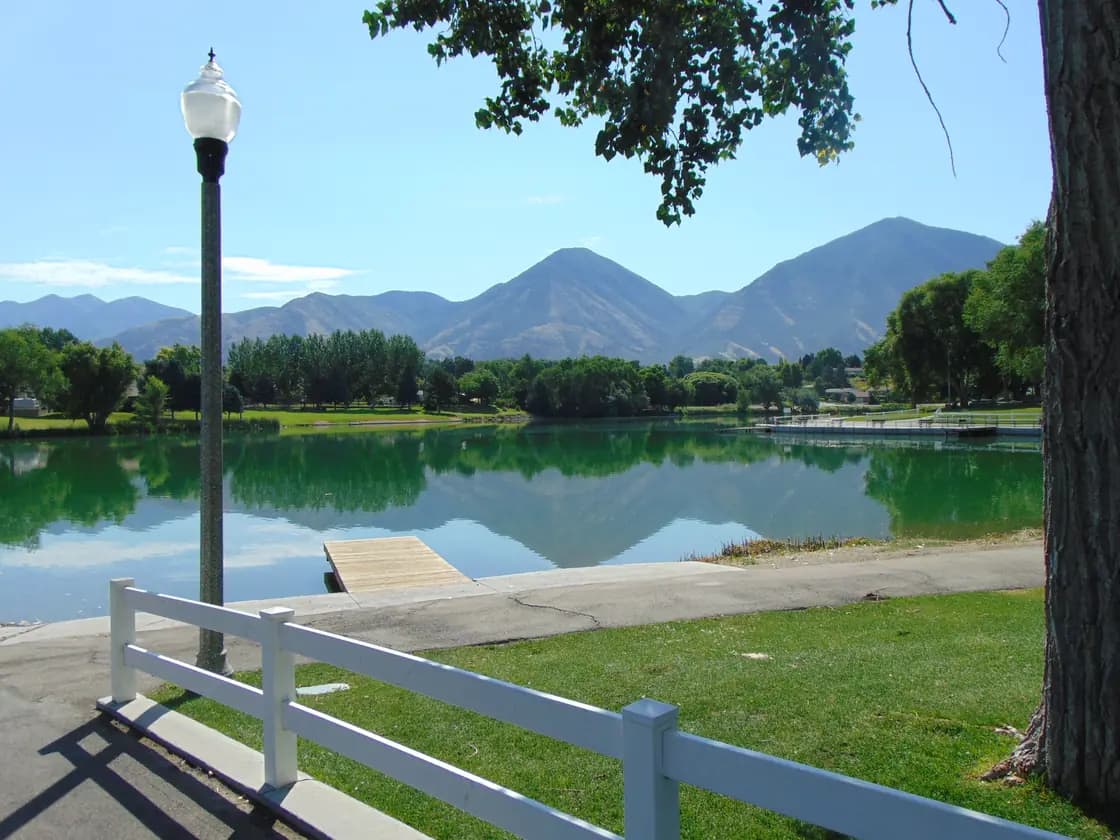
Salem Pond is the civic and social center of the city — a walking loop, fishing, waterfowl, summer evenings, and the site of community gatherings throughout the year, including the city's annual summer celebration. In a small town without a commercial downtown, the pond does the work that a main street does elsewhere. Salem sits at the top of a cluster of places that work this way — our guide to Utah County's small towns covers Elk Ridge, Woodland Hills, Genola, and Goshen, which are smaller again.
It's also pleasant, and one of the more pleasant urban ponds in Utah County. For visitors passing through south county, it's worth a stop. Our fishing near Provo guide covers the valley's options more broadly.
Up in the hills above town sits the Dream Mine, also known as the Relief Mine — a mining property associated with John Hyrum Koyle, who began the venture in the early twentieth century following a series of reported dreams about ore in the mountain. The mine never became a commercial operation, but it has remained a durable and distinctive piece of Utah folk history, and it's a recognized local landmark. The property is privately held, and visitors should respect posted access restrictions rather than attempting to explore it.
Housing in Salem
Salem offers more space and lower prices than the north valley, which is the primary financial argument for living here.
The housing stock mixes older homes near the original town center with newer subdivisions that have filled in around the edges as south county has grown. Lot sizes tend to be generous by valley standards, and some properties retain semi-rural character — outbuildings, animals, room to work.
Compared with neighbors: Spanish Fork is larger, more amenity-rich, and faster-turning; Payson is the value anchor of the south valley; Mapleton is the premium estate market. Salem sits in between — quieter than Spanish Fork, generally pricier than Payson, more modest than Mapleton.
Growth is coming to south county as the north valley fills and prices push buyers southward. Salem has absorbed less of that than Spanish Fork or Santaquin so far, but the trend is unmistakable, and buyers should expect continued development.
The mixed stock means the due-diligence checklist depends on which Salem you're buying. Near the original town center, the questions are the old-house ones: roof, furnace, sewer lateral, whether that addition was ever permitted, and how a pre-subdivision lot sits. In the newer edge subdivisions they flip to covenants and phase maps. And on the semi-rural properties that are Salem's distinctive draw — the ones with outbuildings and room for animals — confirm what the zoning on that specific parcel allows before you fall in love with the barn; animal rights vary lot by lot here, and a listing photo is not a land-use ruling.
Schools are the part of the decision that holds still. The Alpine School District split remaking the north county — three new districts in 2027 — is not a Salem story. The city sits in Nebo School District with Springville, Spanish Fork, Payson, Mapleton and Santaquin, and Nebo carries on unchanged.
Our real estate marketplace shows what's on the market valley-wide, and the buying a home guide covers the process.
Schools
Salem is served by the Nebo School District, which covers south Utah County — Spanish Fork, Springville, Mapleton, Payson, Santaquin, and Salem.
Salem students have traditionally attended Salem Hills High School.
One clarifying note, because it causes confusion: the Alpine School District split does not affect Salem. That transition — creating the Aspen Peaks, Lake Mountain, and Timpanogos districts in 2027 — applies only to cities in the northern half of the valley. Nebo is unaffected and continues as it is.
As anywhere, verify the specific school assignment for an address before buying; boundaries shift with growth. Our best schools guide provides broader valley context.
Getting around and the commute
Salem sits off I-15, with access routed through Spanish Fork or Payson.
Approximate drive times:
- Spanish Fork: under 10 minutes
- Payson: about 10 minutes
- Provo: 20–30 minutes
- Springville: 15–20 minutes
- Salt Lake City: an hour or more, traffic depending
- Silicon Slopes / Lehi: 45 minutes to an hour
That geography makes Salem workable for anyone employed in Provo, Springville, Spanish Fork, or south county — Springville carries a meaningful commercial and light-industrial base along the I-15 corridor, not just bedrooms — and difficult as a daily commute to the northern tech corridor. It's a meaningful constraint worth being honest about before buying.
For Salt Lake commuters, the FrontRunner guide covers rail options; Provo is the nearest station of consequence.
Outdoors and recreation
South Utah Valley is well positioned for the outdoors, and Salem sits close to a lot of it.
Payson Canyon and the Nebo Loop run south from Payson — one of the most scenic drives in the state, particularly in fall. Hobble Creek Canyon and Springville are close to the north. Utah Lake is a short drive west for boating and fishing.
Golfers have The Oaks at Spanish Fork and Gladstan in Payson minutes away, plus Hobble Creek in Springville — one of the best-value courses in the country, per Golf Digest. See the Utah Valley golf guide for the full picture.
For families, our family activities in Utah Valley guide covers what's within range, and things to do in Spanish Fork covers the nearest concentration of local options. For the immediate neighbors, our guide to things to do in Mapleton, Salem and Santaquin covers the canyons and orchards behind all three towns.
Shopping, dining, and daily life
Salem's commercial base is small. Groceries, restaurants, and services get handled in Spanish Fork — the south valley's main retail hub — or in Payson.
Our best restaurants in Spanish Fork guide covers the nearest dining, and the valley-wide restaurant guide covers the rest. For a full shopping trip, Provo and Orem are 20–30 minutes north.
What Salem provides is the other thing: a small community where people know each other, city events draw the city, and the pond is where you run into your neighbors. That's the trade, and residents make it deliberately.
Growth is coming south
The honest forward-looking note for anyone buying in Salem: south Utah County is where the valley's growth is heading next.
The mechanism is simple. North county — Lehi, Saratoga Springs, Eagle Mountain, American Fork — absorbed the last two decades of expansion and is filling in. Prices there rose accordingly. Buyers priced out have looked steadily further south, and Spanish Fork, Santaquin, and Payson have all grown substantially as a result.
Salem has absorbed less of that pressure so far than its neighbors, partly because it sits off the freeway and partly because it has less developable land in play. But the direction is clear, and prospective buyers should assume more development rather than less over the next decade.
What that means practically:
- The quiet is real now but shouldn't be treated as permanent or guaranteed.
- School capacity will face pressure as it has elsewhere in Nebo — ask about planned schools in any neighborhood you're considering.
- Land values have generally benefited from the trend, which cuts in the buyer's favor long-term and against them at purchase.
- City politics increasingly turn on growth-management questions, as they have across the valley.
None of this makes Salem a poor choice. It makes it a place worth buying with clear eyes about what the next ten years look like.
Who provides your utilities
Salem is a public-power town, and that is one of the least-known facts about living here.
Salem City owns its electric utility and is one of six member cities of the Utah Municipal Power Agency, the wholesale power agency formed in 1980 that also serves Provo, Spanish Fork, Nephi, Manti and Levan. UMPA is governed by a board made up of the mayor or a council member from each member city, which is the practical meaning of public power: the people who set the direction of your electricity supply are people you can vote for. The agency handles the wholesale side — generation ownership, contracts, forecasting, transmission scheduling — while each city runs its own poles, wires and billing.
There is a second provider in the picture. The South Utah Valley Electric Service District serves mutually inside Salem, as it does in Mapleton, Spanish Fork, Payson and Santaquin, so some addresses within the city are SESD customers rather than Salem City customers. SESD is itself a public entity covering a large area of south county, including agricultural land, orchards and canyons. Check the address, not the city. SESD publishes a lookup map, and the answer determines who bills you and who you call when the lights go out.
Water in Salem, as in most of the valley, may come through two pipes: treated culinary water for the house, and untreated secondary water for the yard where a property is connected. Given how much of Salem is built on former agricultural ground, secondary connections are common but not universal, and the difference in the cost of irrigating a lawn is substantial. Our guide to secondary water and water shares covers the shares, the transfer questions and the state metering deadline.
Natural gas is Enbridge Gas Utah, renamed from Dominion Energy Utah after Enbridge completed its acquisition in 2024. Salem is not a UTOPIA Fiber city, so internet is a private-provider market.
Who responds when you call 911
Salem runs its own public safety, which for a city this size is a choice rather than a default.
The Salem Police Department and the Salem Fire Department are both city departments, not contracts. Compare that with Vineyard, a much larger city that contracts policing to the Utah County Sheriff's Office and fire and medical response to Orem, or with Eagle Mountain, which despite a population many times Salem's still buys its law enforcement from the Sheriff. Salem pays to keep both in-house.
The trade-off is the one every small department faces. A city of Salem's size cannot staff specialist units around the clock, so investigations, forensics, SWAT response and search and rescue draw on county resources and mutual aid when they are needed. That is not a weakness so much as how policing in Utah County is structured — the Sheriff's Office maintains specialized teams that serve the whole county, and the small departments call on them. What the local department provides is presence, familiarity and a short route to the person who can resolve something.
For residents, the practical points are these. Non-emergency police and fire questions go to the city, not to the county. If your power is supplied by SESD rather than Salem City, an outage call goes to SESD. And if you are looking at a property on the agricultural edge of town, response distance is a fair question to raise about that specific address.
How a small city allocates its money across departments is decided in public, and who decides what in Utah Valley explains which body controls which decision.
Library access, which works differently than you would expect
Salem has its own city library, and that is the whole of its library membership — Salem sits in neither of Utah County's two reciprocal borrowing groups.
This surprises people, so it is worth stating plainly. Utah County has no county-wide library system. Instead there are two unconnected agreements and a lot of open water between them: Provo and Orem have an arrangement with each other, and a northern cooperative links Highland, Lehi, American Fork, Pleasant Grove and Eagle Mountain. Salem is in neither, along with Springville, Spanish Fork, Payson, Santaquin, Saratoga Springs and Vineyard.
The practical consequence is that your Salem card is free because Salem property tax pays for it, and a card at a neighboring city's library will generally cost a nonresident fee set to approximate what that city's households already contribute. That is not a penalty, it is the arithmetic of eighteen separate municipal budgets. The Utah County Bookmobile operates as an additional option countywide, and the statewide digital lending layer behaves more like a real system than the buildings do. Our guide to libraries in Utah County sets out what each card is worth.
Who Salem is right for
A strong fit if: you want small-town quiet and more house for the money, you work in Provo or south county, you have kids in Nebo schools, and you don't need retail at your doorstep.
Look elsewhere if: you commute daily to Lehi or Salt Lake, you want walkable amenities, or you want a larger city's services.
Compare against: Spanish Fork for more amenities and a larger city, Payson for lower prices, Mapleton for a premium large-lot market, Santaquin for the valley's southern edge.
Salem is Pond Town with a Massachusetts name — small, settled, and comfortable being exactly what it is.
Our Utah Valley city guides cover every community in the valley if you're still comparing, and the moving to Provo guide handles the practical side of getting here.
Salem's pond is the reason people from the rest of the county drive down here in December: the city floats lit trees on the water so the display doubles in the reflection. It is on our Christmas lights map.
Related Guides
- Salem Neighborhoods Guide — where to live, area by area
- Payson Neighborhoods Guide — the next city south
- Santaquin Neighborhoods Guide — the southern gateway
- Nebo School District — the district Salem has always been in
- The Water Lantern Festival in Salem
Frequently Asked Questions
Is Salem, Utah a good place to live?
How big is Salem, Utah?
Why is Salem, Utah called Salem?
What school district serves Salem, Utah?
What is the commute like from Salem?
What is the Dream Mine in Salem?
Does Salem run its own power company?
Does Salem have its own police and fire departments?
Sources
The facts in this guide were checked against these sources. Hours, fees and rules change, so confirm anything time-sensitive with the source before you go. How we make Provo.com.
- 2020 Decennial Census P1 (Salem city), U.S. Census Bureau. Checked October 12, 2026.
- SUB-EST2025 Utah places, U.S. Census Bureau. Checked October 12, 2026.
- UMPA - Serving Utah Since 1980, Utah Municipal Power Agency. Checked October 12, 2026.