
Ask families moving to Provo which neighborhoods they are looking at and two names come up before any others: Grandview and Edgemont.
They are usually mentioned together, which is reasonable — they occupy the same part of the city and serve a similar household — and then described interchangeably, which is not. They are distinct places with different terrain, different housing and a different feel.
This guide separates them, and is honest about the trade-offs, because most of what gets written about north Provo reads like a listing.
Where they are
Forget street boundaries for a moment and think about elevation, because that is what organizes this part of the city.
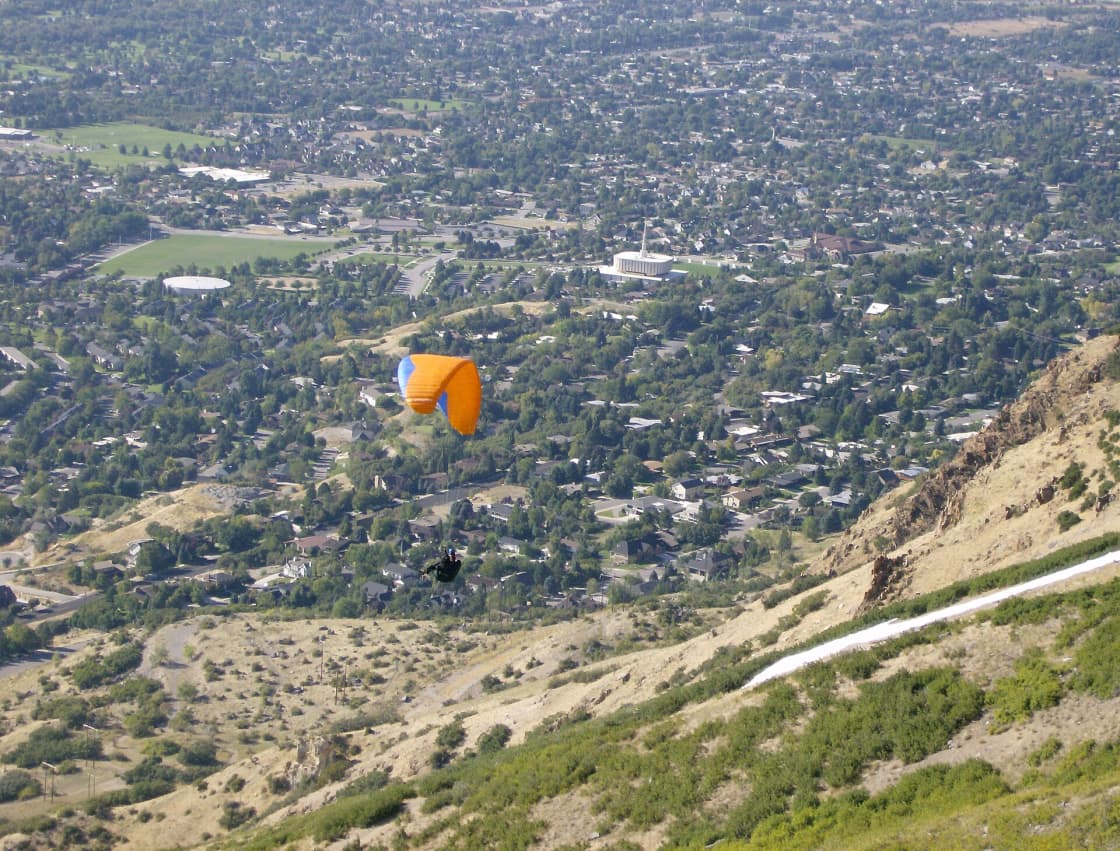
Provo sits on a valley floor that rises eastward toward the Wasatch. The rising ground is the bench — a term used constantly here and rarely explained to newcomers. It is a genuine topographic shelf, and it is why north Provo looks and behaves differently from the flat land west of it.
Edgemont is the higher, more easterly of the two, occupying the bench in Provo's northeast and running up toward the mountains. Grandview sits well to its west, on its own distinct rise in northwest Provo, and lower down. The city's Neighborhood District Program splits it into Grandview North and Grandview South, part of the Northwest District, while Edgemont belongs to the North District.
Grandview takes its name from the same thing that gives it its character: a hill with a view over the valley.
A warning worth taking seriously. The boundaries are fuzzy. City voting precincts, school attendance areas, real estate marketing and what residents call themselves do not agree, and none of them is definitive. People near the edges describe themselves either way. Any map presented as authoritative — including the mental one this guide just gave you — is an approximation.
What the bench changes
The elevation is not scenery. It changes daily life in specific ways, and this is the section most guides skip.
Views. Real and substantial. West-facing houses on the rise look out over the valley and Utah Lake, and that view is a large part of the price.
Summer evenings. The bench cools noticeably in the evening as air drains off the mountains. In a valley that gets hot in July, this is a tangible benefit.
Winter grade. The trade-off, and the one people underestimate. Streets that are pleasant in September are a different proposition under snow and ice. Steep driveways face a real grade, north-facing slopes hold ice long after the valley floor has cleared, and getting a car out on a bad morning is a skill.
If you are seriously considering a house here, visit the street on a cold morning, not a warm afternoon. Look at which way the driveway faces and how steeply it drops to the road. Our snow removal guide covers what maintaining these properties involves.
Mountain access. Immediate, and it changes behavior. Households here hike and run on weeknights because the trailhead is minutes away rather than a drive across town.
Grandview, specifically
Grandview is the more modest of the two names and the less discussed, which makes it the better value proposition for a certain buyer.
It sits on a hill in north Provo, lower and further west than Edgemont, closer to the commercial spine of the north side. That location is its main practical advantage: shorter trips to ordinary errands. Groceries, the freeway and the retail along the north side's main routes are simply nearer.
The housing is predominantly mid-century detached single-family — the postwar and later suburban stock that filled in north Provo as the city expanded — on regular lots with mature trees. Streets are quieter than the arterials and it is a walkable neighborhood internally, if not to many destinations.
The honest positioning: Grandview offers most of what people want from north Provo — detached houses, family-dominant streets, quiet, elevation, views from the right lots — usually at a lower entry point than Edgemont, in exchange for less dramatic mountain proximity and a less recognized name.
For buyers priced out of Edgemont who want the same daily life, this is the obvious place to look, and comparatively few out-of-area buyers arrive knowing the name.
Edgemont, specifically
Edgemont is the name that carries the reputation, and it is the higher and more established of the two.
It occupies the bench in Provo's northeast, running up toward the mountain front, and its defining features follow from that position: larger lots, serious views, and direct access to the canyon and the trail system.
The housing is more varied than Grandview's. There is substantial mid-century stock, plenty of larger and newer construction on the upper streets, and considerable variation between blocks — enough that generalizing about "Edgemont houses" is unwise. Streets nearer the mountain differ materially from streets nearer the boundary with Grandview.
Edgemont also has an unusual social characteristic worth naming, because it explains the neighborhood's stability. A meaningful share of households have a connection to BYU — faculty, staff, administration — and academic employment produces long tenure. People arrive, take a position, and stay for thirty years. The result is a neighborhood with low turnover, dense long-standing networks, and the associated trade-off: it can take a while to feel like a newcomer has arrived.
The family question, answered structurally
Both neighborhoods get described as family areas, and it is worth explaining why rather than treating it as a vibe.
Two structural facts produce it.
The housing stock is detached single-family. Neither area carries the density of purpose-built student housing that defines the blocks near campus.
Provo regulates household composition. The city's rules restrict where unrelated adults may share a dwelling, and that framework is a large part of why the student rental market concentrates where it does rather than spreading across the whole city. Our zoning explainer covers how this works and why it is one of the more consequential local ordinances for anyone buying here.
The combined effect is neighborhoods where the household mix skews strongly toward families and long-tenure owners, and where the annual student churn that shapes other parts of Provo is largely absent.
This is what many buyers want. It is worth being clear-eyed that it is produced by regulation, not by accident.
Schools, with the necessary caution
Both areas fall within Provo City School District, and the north side has historically fed toward Timpview High School, whose reputation is a real factor in what people pay here.
Now the caution, and please take it seriously: boundaries change. Districts redraw attendance areas as enrollment shifts and facilities change, and Utah's open enrollment provisions mean assignment is not the whole story.
Confirm the current assignment for the specific address with the district itself. Not from a listing, not from a neighbor, not from this page. A boundary is one of the few things a buyer can verify definitively in a few minutes, and one of the most expensive to get wrong.
Our guides to schools in Provo and Orem and charter schools in Utah Valley cover the wider picture, including the options that operate outside boundary assignment.
The trail access, which is the real amenity
If there is one thing that justifies the price premium on the bench, it is this.
The Bonneville Shoreline Trail runs along the bench through this part of the city — a long-distance route following the ancient shoreline of Lake Bonneville, the enormous prehistoric lake that once filled this basin. The bench itself is that shoreline. Residents are, quite literally, living on the beach of a lake that drained thousands of years ago.
Rock Canyon opens off the northeast side of the city and gives residents a serious canyon trail within minutes of home — used for hiking, trail running, and rock climbing on the canyon walls.
The practical significance is frequency rather than novelty. A trailhead you can reach in five minutes gets used on a Tuesday evening. One that requires crossing town gets used occasionally. For active households this is the single strongest argument for the area, and it is worth more than most of the features people tour houses looking at.
Our Bonneville Shoreline Trail and Rock Canyon guides cover both in detail.
What it costs, and why we will not give you a number
North Provo's bench sits at the upper end of the city's range. The drivers are consistent and unsurprising: detached houses, larger lots, views, mountain access, and a durable school reputation.
We are not publishing figures, and the reason is structural rather than coy. Utah is a non-disclosure state — sale prices are not recorded in a public register the way they are in most states. Any median you see quoted for a Provo neighborhood is built from partial data, usually listing-derived, and it can be meaningfully wrong at neighborhood granularity where sample sizes are small.
What to do instead: look at current listings on the specific streets you care about, and talk to an agent who works this part of the city. Block-to-block variation on the bench is large — a street near the mountain and a street near the Grandview boundary are different markets.
Our guide to buying a home in Provo covers the process, and property tax in Utah County covers the recurring cost, including the residential exemption that catches out buyers from other states.
The age of the housing, and what that means
Much of the stock in both neighborhoods is mid-century, and a good deal of it has been updated once — often in a decade whose taste has not aged well.
Practical implications for buyers:
Systems have a lifespan. Furnaces, water heaters, roofs and electrical panels in houses of this vintage are frequently at or past replacement age. Budget for it rather than being surprised by it.
Basements are common, and finishing or refinishing one is among the most common projects here — with permit and egress requirements people routinely discover late. Our basement finishing guide covers what is required.
Mature landscaping is an asset and a cost. Large established trees are a genuine benefit in a hot, dry valley and they require real maintenance.
Renovation is normal here, which means contractors know the housing type well — a meaningful advantage over an area where every project is bespoke.
Getting around from the north bench
The commute picture is better than the map suggests and worse than residents sometimes claim.
To BYU the trip is short — this is one of the area's genuine advantages, and part of why so many university households live here. A bicycle commute is realistic for a lot of people, with the caveat everyone discovers on day one: the ride home is uphill, and on the steeper bench streets it is meaningfully uphill. Times vary a good deal with the class-change cycle, when campus-adjacent traffic thickens quickly.
To the freeway you are crossing the city westward, which is fine outside peak and slower during it. Anyone commuting north toward the tech corridor should test the actual trip at the actual hour before committing, because the northbound stretch of I-15 in the morning is its own subject.
To downtown is a short drive and an unpleasant walk — the grade and distance combine against you in a way that is easy to underestimate looking at a map.
Transit is the weak point. Provo's frequent bus service runs the corridor between the universities and downtown rather than up the residential bench, so a household here is realistically a multi-car household. Our UVX guide covers what the rapid transit line does and does not reach, and the FrontRunner commuting guide covers the rail option for Salt Lake trips.
The honest summary: excellent for campus, ordinary for the valley, poor for car-free living.
What to check before buying on the bench
Bench properties have a specific inspection list that a general checklist will miss. If you are buying here, look at these deliberately.
Which way the driveway faces, and how steeply. A north-facing driveway on a grade holds ice for weeks. This single feature governs more winter frustration than any other.
Where water goes. On sloped ground, uphill drainage matters. Look at how the lot sheds water, where downspouts discharge, and whether the grading moves water away from the foundation or toward it. Ask about past water in the basement — and ask the neighbors, who have less reason to be careful with the answer.
Retaining walls. Sloped lots frequently have them. They are structural, they have a lifespan, and replacing a failing one is expensive. Establish who owns any wall on a boundary.
The age of the major systems, given the vintage of much of this housing — furnace, water heater, roof, electrical panel, sewer line.
Irrigation arrangements. Parts of Utah Valley are served by secondary or pressurized irrigation water, separate from culinary supply and billed separately, with its own seasonal schedule. Establish what a given property has, because assumptions carried from another state will be wrong.
View protection, or the lack of it. A view is a large part of the price and is generally not a legal right. Look at what is uphill and undeveloped, and check its zoning before assuming the outlook is permanent.
The honest downsides
Every guide should have this section and most do not.
Walkability to destinations is limited. These are residential neighborhoods. You will drive to dinner. If walking to a restaurant matters to you, downtown Provo does that better by a wide margin.
Winter is harder on the grade than on the valley floor. This is not a minor point and it recurs every year.
The price point is not entry-level for Provo. There are cheaper ways into the city.
Turnover is low, which is a virtue for stability and a friction for newcomers. Established networks take time to enter.
It is not central. Being on the northern bench means the rest of the valley is a drive.
Who these neighborhoods suit
A strong fit for families wanting detached housing and a stable school picture, households with a BYU connection, anyone who hikes or runs regularly enough for trailhead proximity to matter, and buyers who value quiet and space over walkable amenities.
A poor fit for students and young singles, who will find both the housing and the rules pointed elsewhere; for anyone wanting to walk to nightlife or restaurants; for buyers at the entry end of the market; and for people who dislike driving on winter hills, which is a real preference and not a trivial one.
The comparison worth making is with downtown Provo and the Tree Streets — older, flatter, more walkable, more mixed — and with the Riverbottoms on the other side of the city. Our full Provo neighborhoods guide sets all of them side by side.
Related Guides
- Provo neighborhoods guide — every area compared
- Downtown Provo — the walkable alternative
- Buying a home in Provo — the process, start to finish
- Schools in Provo and Orem — how the districts work
- Rock Canyon trail guide — the canyon on the doorstep
- Provo zoning explained — why the household mix looks the way it does
Frequently Asked Questions
Where exactly are Grandview and Edgemont in Provo?
Why are these neighborhoods described as family areas?
How far is it to BYU from the north Provo bench?
What schools serve these neighborhoods?
Is the bench different to live on?
Are these neighborhoods expensive compared with the rest of Provo?
What is the trail access like?
What are the honest downsides?
Sources
The facts in this guide were checked against these sources. Hours, fees and rules change, so confirm anything time-sensitive with the source before you go. How we make Provo.com.
- Neighborhood District Program | Provo, UT, Provo City Council. Checked October 12, 2026.
- Northwest District (formerly Neighborhood District 4) | Provo, UT, Provo City Council. Checked October 12, 2026.
- North District (formerly Neighborhood District 1) | Provo, UT, Provo City Council. Checked October 12, 2026.