
Utah Valley is a desert valley with a large lake, several reservoirs, a short outdoor season and a set of municipal pools that most residents underuse. Working out where to swim is more complicated than it should be, and the answer changes four times a year.
This guide sorts the options by type, because that is how the decision is really made: you want to swim laps, you want to entertain a four-year-old, or you want to get into open water, and those three are almost entirely different problems.
The season, which governs everything
Start here, because it invalidates half the options for half the year.
Outdoor swimming in Utah Valley runs roughly from late May to early September. Municipal outdoor pools and splash pads open around Memorial Day and close around Labor Day, with variation by city and by whether a facility has been able to staff lifeguards that year.
That is a fourteen-week window in a twelve-month year. Newcomers from milder climates consistently underestimate how short it is, and every summer produces a set of people who discover in mid-September that the splash pad they had been meaning to visit closed two weekends earlier.
Indoor facilities carry the other thirty-eight weeks, which is why the recreation centers matter more here than they would somewhere with a longer season.
Indoor pools: the year-round backbone
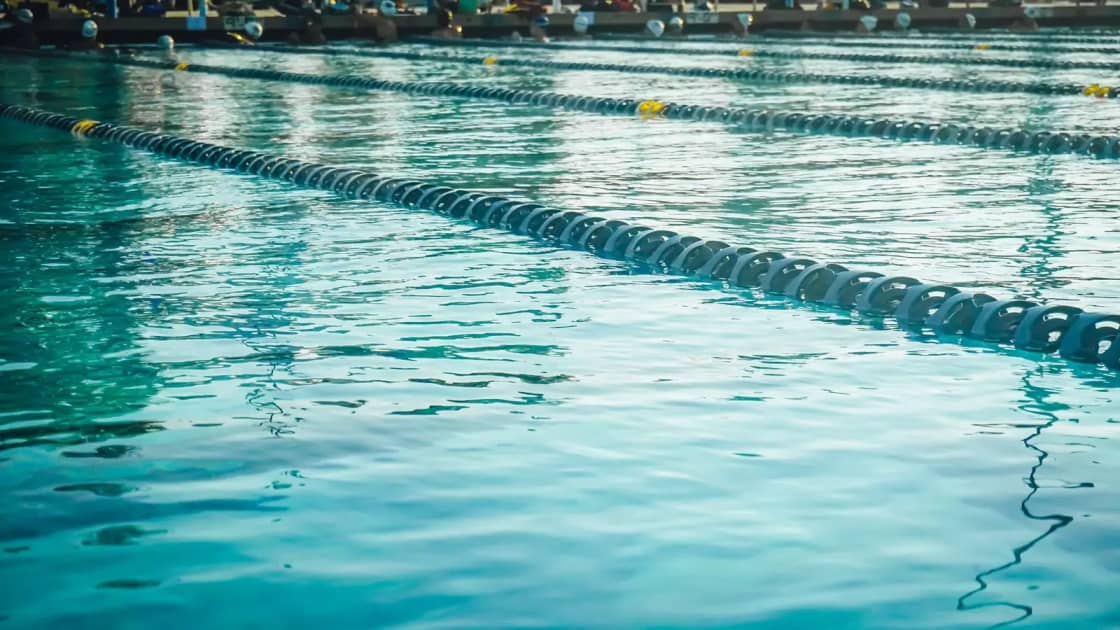
Municipal recreation centers do most of the county's actual swimming.
The Provo Recreation Center is the largest and best-known facility, and it is substantial — a modern municipal complex with multiple bodies of water serving different purposes, which is unusual for a city this size. Our full guide covers what is inside, what it costs and what nobody tells first-time visitors.
Several other Utah County cities operate aquatic facilities of their own, and residents of those cities frequently pay less at their own city's facility than at a neighboring one. Non-resident rates are standard practice and the differential can be significant, so if you live in Orem, Lehi, Springville or American Fork, check your own city's offering before defaulting to Provo.
University pools exist at both campuses but access generally depends on student status or membership, and they are not a general public option.
The practical shape of indoor swimming here: lap swim in the mornings and evenings, family and open swim in the afternoons and weekends, lessons filling much of the remaining schedule, and periodic closures for maintenance and swim meets. Check the specific facility's schedule rather than assuming, because a pool that is open is not necessarily a pool with a lane available.
Splash pads: the toddler answer
For children under about five, a splash pad usually beats a pool, and parents who have not worked this out yet are making their summers harder than necessary.
The reasons are structural. Splash pads have no depth, which removes the primary drowning risk and lets a parent supervise from a bench rather than in the water. They are free in most cities. They require no swim diapers, no lifeguard schedule, and no admission line. And a child who tires of it can simply walk onto the grass, which is not true of a pool.
Most Utah County cities operate at least one, typically inside a municipal park. They run through the warm months on timers or push-button activation and shut down for the season in autumn.
Our guides to toddler activities in Utah Valley and family activities cover the water-play options in more detail alongside everything else that works for that age.
The waterpark
Seven Peaks in Provo is the county's waterpark, and it has a more complicated story than a visitor would guess from the signage.
It has operated under different ownership arrangements across its history, its status has varied between seasons, and it has been the subject of a good deal of local discussion. Our Seven Peaks story covers how the property got to where it is.
The practical guidance is simpler than the history: confirm it is operating for the current season before planning a day around it. This is not advice we would give about a stable municipal facility, and it is the honest position on this one.
Open water: the lake
Utah Lake is the largest freshwater lake in the state and the most misunderstood body of water in the county.
People do swim in it. Lincoln Beach at the southern end is the traditional swimming spot, and the lake's shallowness means it warms up far earlier in the season than the reservoirs do.
The caveats are real and should not be softened. The lake is shallow — averaging only a few feet deep across much of its area — which makes it warm, which makes it prone to harmful algal blooms in some summers. Health advisories are issued when blooms occur, they are specific to particular areas of the lake, and they exist because the toxins involved are dangerous to people and especially to dogs.
The correct procedure is to check current advisories before going, treat a posted warning as binding, and keep dogs out of water that has any advisory attached. This is not excessive caution; it is the standard practice among people who use the lake regularly.
The lake is also excellent for things that are not swimming — kayaking and paddleboarding keep you on the surface rather than in the water, which sidesteps the issue entirely.
Open water: the reservoirs
Deer Creek and Jordanelle are the higher-elevation alternative, and they are a completely different swimming experience.
Both are colder, deeper and clearer than Utah Lake, sitting at elevation in the mountains above Provo Canyon. Both are state park facilities with entrance fees and developed beach areas. Both stay cold well into summer — snowmelt-fed reservoir water in June is not warm, whatever the air temperature is doing.
That cold is the safety issue rather than an inconvenience. Cold-water shock — the involuntary gasp reflex on sudden immersion — is a real drowning mechanism and it does not care how strong a swimmer you are. Enter gradually. Do not jump in from height into cold water on a hot day, which is precisely the situation where people get into trouble.
The other reservoir hazard is boat traffic. Designated swimming areas exist for a reason, and a swimmer outside one in open water is very difficult for a boat operator to see.
Lessons
Swim lessons in Utah County run primarily through municipal recreation centers, supplemented by private swim schools and seasonal programs.
The thing to know is the timing. Summer lesson sessions fill quickly — registration frequently opens weeks ahead and popular time slots go within days. Parents who wait until June to think about July lessons routinely find nothing available.
Our guide to swim lessons in Provo covers the providers and how registration works.
Adult lessons exist and are less oversubscribed, which is worth knowing for the substantial number of adults who never learned. Nobody at a municipal pool will make an issue of an adult beginner.
What it costs, and the resident-rate question
Swimming is one of the cheaper recreational activities available here, but the pricing structure has a wrinkle worth understanding.
Municipal recreation centers almost universally charge residents less than non-residents, and the gap is not trivial. A household in one city paying non-resident rates at a neighboring city's facility can end up paying substantially more than it would at home for a comparable pool. Annual and family passes change the arithmetic again, and for a family swimming more than roughly twice a month a pass is usually the cheaper path.
Splash pads are free almost everywhere. This is the single best value in the county's recreation offering and it goes underused by people who assume there must be a catch.
State park reservoirs charge per vehicle rather than per person, which rewards carpooling and penalizes a solo swimmer. An annual state park pass pays for itself quickly for anyone visiting the reservoirs more than a handful of times a season.
Waterpark admission is the most expensive option by a wide margin and is priced as an event rather than as recreation.
We do not print current figures for any of these, because municipal and state rates are revised on their own schedules and a stale number misleads. The structural points above hold regardless of what the rates are in a given year.
Altitude, sun and the things that catch visitors out
Two environmental factors here affect swimming more than people expect, and both catch out visitors from lower elevations.
The sun is stronger than it feels. Utah Valley sits around 4,500 feet, the air is dry, and the combination produces burns considerably faster than the same air temperature would at sea level. Water reflects additional UV upward. A day at an outdoor pool or on a reservoir beach without sunscreen produces burns that surprise people from humid coastal climates, where haze and humidity do more filtering than they realize.
Dehydration is faster. Dry air pulls moisture continuously, and swimmers do not notice sweating because they are already wet. Bring more water than instinct suggests, and note that this compounds at reservoir elevation, which is higher again than the valley floor.
The practical version: sunscreen reapplied more often than you would elsewhere, shade for children in the middle of the day, and water on hand even though you are surrounded by it.
Where this fits in a summer
Swimming is one thread in a short, intense outdoor season, and it competes with everything else that only works from June to September.
The scheduling insight is that water is the right answer for the hottest part of the day and a poor use of the coolest. Canyon hikes and the waterfalls work best in the morning; pools, splash pads and reservoirs work best from midday onward when the trails have become unpleasant.
A well-arranged summer day here frequently does both — a canyon in the morning, water in the afternoon — and the geography cooperates, because the reservoirs sit at the top of the same canyon the hikes are in. Our summer activities guide covers the wider set of options.
Hot springs, which are not swimming but get asked about anyway
Every guide to swimming in this area eventually gets the hot springs question, so it belongs here even though the activity is different.
There are developed and undeveloped hot springs within reach of Utah Valley, and they draw a steady stream of visitors. They are soaking rather than swimming — the water is hot, often shallow, and not suited to any kind of exercise.
The undeveloped ones carry a specific set of considerations that a municipal pool does not: no supervision, variable water temperature that can reach unsafe levels, water quality that is not monitored, and access that frequently involves a hike. They are also popular enough that solitude is rarely part of the experience.
Our guide to hot springs near Provo covers the specifics. Treat it as a separate activity from anything else on this page.
River swimming, and why we are not recommending it
The Provo River runs through the middle of the county and people do get into it, so it deserves a direct answer rather than an omission.
Swimming in the Provo River is not a good idea, and the reason is current rather than temperature. The river runs fast, particularly during spring runoff, with cold water, submerged obstacles and strainers — the debris formations that trap and hold a swimmer underwater. It is a river that has caused fatalities.
Tubing and floating on designated stretches with appropriate equipment is a different activity with its own guidance, covered in our river tubing and rafting guide. That is a supervised, equipped activity on chosen sections at chosen flow levels. Wading in wherever the river happens to be accessible is not the same thing.
Matching the option to the swimmer
Lap swimmer: indoor recreation center, morning or evening lane slots. Check the schedule; lanes are the scarce resource.
Family with toddlers: splash pad first, indoor leisure pool second. Both remove most of the supervision difficulty.
Family with school-age children: outdoor municipal pool in summer, recreation center the rest of the year, waterpark as an occasional event rather than a routine.
Teenagers: the waterpark and the reservoirs, in that order, and mostly for the social element rather than the swimming.
Open-water and triathlon training: the reservoirs, with a wetsuit for most of the season and never alone.
Visitors with one hot afternoon: the reservoirs if you have a car and want scenery, a municipal outdoor pool if you want simplicity.
Safety, briefly and without hedging
Utah has a persistent drowning problem in open water, and the pattern is consistent: adults, open water, no life jacket, often alcohol, often alone or unsupervised.
Three things carry most of the risk reduction. Wear a life jacket in open water, particularly on or near boats. Do not swim alone. Take cold water seriously and enter it gradually.
For children, layered supervision is the standard: designated adult watching, barriers where relevant, and swim competence taught early. Municipal pools have lifeguards; lakes and reservoirs largely do not, and a busy beach is not supervision.
The short version
Indoor recreation centers do the year-round work and Provo's is the flagship. Splash pads are the right answer for toddlers and are free. The waterpark needs a status check before you commit. Utah Lake is swimmable with an advisory check; the reservoirs are colder, clearer and require respect for the temperature.
And the season outdoors is fourteen weeks. If there is a single planning insight for a newcomer, it is that — use it while it is there, because it closes earlier than you think.
The legal difference between a city pool and a reservoir
Paying to swim changes your legal position more than it changes your afternoon, and the split runs almost exactly along the line this guide already draws between indoor pools and open water.
Open water is covered by a landowner-immunity statute. Utah Code Title 57, Chapter 14 removes a landowner's duty of care toward recreational users. Utah Code § 57-14-201 says an owner owes no duty to keep the land safe and no duty to warn of a dangerous condition on it; Utah Code § 57-14-102 lists swimming among the recreational purposes and defines "land" to include water and water courses; Utah Code § 57-14-101 confirms that public and private owners are both covered. Where the water is a reservoir with a state-park day-use fee, Utah Code § 57-14-204 provides that owners of a dam or reservoir who allow recreational use and do not themselves charge are treated as not having charged, even though you paid the Division of State Parks or the Division of Outdoor Recreation for the facilities.
On top of that, Utah's Governmental Immunity Act retains immunity for a natural condition on publicly owned or controlled land at Utah Code § 63G-7-201 — which is the lake bed, the drop-off, the cold and the algae.
A municipal pool is not covered by any of it. The recreational-use chapter holds only where use is permitted without charge, under Utah Code § 57-14-202, and Utah Code § 57-14-204 removes the protection where the owner charges a person to enter. An admission price is a charge, and Utah Code § 57-14-102 defines it as exactly that. So the immunity that covers the reservoir does not cover the aquatic center.
What governs a city pool instead
The Governmental Immunity Act, and it is a real waiver rather than a real immunity. Utah Code § 63G-7-301 waives immunity as to any injury proximately caused by the negligent act or omission of an employee within the scope of employment, and as to injury caused by a defective, unsafe or dangerous condition of a public building or structure. Lifeguarding is done by employees; a pool deck is a public structure.
The retained immunities in Utah Code § 63G-7-201 still bite at the edges — notably for a latent defective condition of a public building, and for the exercise of a discretionary function. And Utah Code § 63G-7-202 contains a rule that surprises people: a general duty a governmental entity owes to the public does not create a specific duty to any individual member of the public unless there is a special relationship. Broad statements about public safety are not promises to you.
The clock, which is the part that costs people their claims
This is the practical payload, and it applies to every public pool, splash pad and beach in the county.
Utah Code § 63G-7-402 bars a claim against a governmental entity unless a written notice of claim is filed within one year after the claim arises — not the ordinary personal-injury period. Utah Code § 63G-7-401 requires it to go to a specific officer: the city or town clerk for a city, the county clerk for a county, the superintendent or business administrator for a school district. Utah Code § 63G-7-403 gives the entity sixty days to acknowledge, bars you from filing suit until sixty days after the notice, and requires the action to be commenced within two years of the claim arising.
Two more: Utah Code § 63G-7-501 provides that an action under the chapter may not be tried as a small claims action, and Utah Code § 63G-7-603 prohibits punitive damages against a governmental entity.
If a child is injured at a public facility here, the single most important thing to know is that a one-year written notice requirement exists and that missing it ends the matter regardless of the merits.
Related Guides
- Mini Golf in Utah Valley: Where to Putt, and Why Provo Doesn't Have a Course
- Swim Teams and Swim Clubs in Utah Valley
Frequently Asked Questions
Where can you swim indoors year-round in Utah Valley?
Is there a waterpark in Utah Valley?
Can you swim in Utah Lake?
Where are the splash pads?
What about the reservoirs?
When does outdoor swimming season start and end?
Where can children learn to swim?
Is open-water swimming safe in the reservoirs?
Sources
The facts in this guide were checked against these sources. Hours, fees and rules change, so confirm anything time-sensitive with the source before you go. How we make Provo.com.
- Recreational Water Quality, Utah Department of Environmental Quality, Division of Water Quality. Checked October 12, 2026.
- Utah Lake State Park, Utah State Parks. Checked October 12, 2026.