
Drive US-189 up Provo Canyon on a Saturday in July and you will pass several hundred people having a better afternoon than you are. Most of them are at one of two places, and most Utah Valley residents could not tell you which is which.
Vivian Park and Nunn's Park are the canyon's two significant developed day-use areas. They are a few miles apart, they are both right off the highway, and they serve different purposes. Knowing the difference is the whole of this article, and it will save you an afternoon at some point.
The short version
Nunn's Park sits nearer the mouth of the canyon, a few minutes up from the valley floor. It is the smaller, plainer, closer one. You go there to be beside the river for a couple of hours without a plan.
Vivian Park sits further up, where the South Fork of the Provo River comes down to join the main stem. It is bigger, busier, and far more programmed. It is the one with the group pavilions, the railroad stop, and the reunion traffic. You go there when the afternoon has a schedule attached.
If you take one thing from this page: groups go to Vivian, and they book ahead.
Nunn's Park, and the name nobody can explain
Nunn's Park carries one of the better pieces of trivia in the county, and it is the reason the name looks like a typo.
It is named for Lucien L. Nunn, whose Telluride Institute operated in the canyon in connection with early hydroelectric development on the Provo River. Provo Canyon was a working corridor long before it was a recreation corridor — water and power came first, and the picnic tables arrived much later. Our Provo River Parkway guide covers where that history is still visible from the trail, including why the parking lot carries the name.
As a destination it is unfussy. River access, tables, shade, the sound of the water, and the canyon walls going up on both sides. It is the closest developed canyon picnic spot to Provo proper, which makes it the right answer for an after-work evening or a Sunday afternoon when you do not want to commit to a drive.
It also fills. Small park, short drive, warm evening — the arithmetic is not complicated.
Vivian Park, and why it is busier than it looks
Vivian Park is where the canyon does most of its organized socializing, and three separate things drive that.
The confluence. The South Fork joins the Provo River here, which means more water, more bank, and a more open bowl than the narrow stretches above and below. There is simply more room, and the geography is why.
The pavilions. Vivian is the canyon's group venue. Family reunions, ward activities, company barbecues and birthday parties all end up here, and in July they end up here in overlapping shifts. This is the reservation point, and it is where planning goes wrong for people who assume they can turn up.
The railroad. The Heber Valley Railroad runs through the canyon and stops at Vivian Park. That is unusual — there are not many places in Utah where you can board a scheduled train at a picnic ground — and it creates a distinct rhythm at the park on running days, with arrivals and departures concentrating people at particular times.
The combination means Vivian can be crowded in a way that a glance from the highway does not convey.
The river, which is the actual attraction
Both parks are river parks, and the Provo River is the reason either exists as a destination.
The stretch running down from around Vivian is the one people mean when they talk about tubing the Provo. It is a Utah Valley summer institution, and it is also a river rather than a lazy-river attraction at a water park. Flows change through the season, they change after storms, and early-summer runoff turns a friendly float into something else entirely. Our Provo River tubing and rafting guide covers the stretch, the outfitters and the timing properly.
The same water is a fishery. The Provo is one of the better-known trout rivers in this part of the state, and the canyon stretch gets fished hard. If that is why you are going, fishing near Provo covers the water, the access and the regulations that apply. Our Lower Provo fly-fishing page covers the access points.
And it is cold. Snowmelt-fed water in a canyon does not warm up the way a reservoir does. That surprises people every single summer, and it is worth telling children before rather than after.
Getting there, including the way that is not driving
Both parks sit directly on US-189, the canyon highway, which is the only practical driving route. It is a fast road with limited shoulder, the turnoffs come up quickly, and the canyon has a real crash history. Slow down earlier than feels necessary.
The Provo River Parkway runs the length of the corridor as a paved trail, which means both parks are reachable by bicycle from the valley floor. It is a genuine climb heading up and a fast descent coming back, and it is one of the better rides in the county.
And, uniquely, the train. Vivian Park is a stop on the Heber Valley Railroad, so a family can board in Heber and get off at a picnic ground in Provo Canyon. There are not many arrangements like it anywhere.
Winter changes the calculation. The canyon holds snow and ice long after the valley floor is clear, the road can close or restrict, and canyon weather is a different system from valley weather. Check conditions before driving up between roughly November and April.
Reserving a pavilion, and the mistake to avoid
The single most common failure at Vivian Park is a group turning up without a reservation on a summer Saturday.
Both are Utah County parks, so reserve through Utah County Parks, online through its reservation system or at 801-851-8640, well ahead. Summer weekends, the stretch around the Fourth of July, and the Pioneer Day weekend are the hardest dates in the calendar, and the canyon's group sites are a finite resource serving a county of well over half a million people.
When you reserve, confirm three things specifically rather than assuming them: what the site includes (tables, grill, power, water, and whether any of that is shared), what time your window starts and ends, and what the group size limit is. Reunion planning goes wrong on the third one more than the first two.
We are deliberately not publishing fee figures. Day-use and reservation fees adjust on their own schedule, and a dollar amount printed here would be quietly wrong within a season. Ask when you book.
What to bring
Layers, more than you think. The canyon runs cooler than the valley and it cools fast once the sun drops behind the west wall — which happens earlier than sunset, because the wall is right there.
Water shoes if anyone is going in. The riverbed is cobble, it is slick, and it is unforgiving on bare feet.
Your own shade for a large group. Pavilion shade is finite and the overflow is in the open.
A bag for your rubbish, on the assumption that the bins are full, because on a July Saturday they will be.
Cash or a card for fees, and your reservation confirmation where you can produce it.
Sun protection that accounts for elevation. Utah Valley sits high, the canyon sits higher, and people underestimate this constantly.
The seasons, honestly
Spring is the least reliable window. Runoff is high, the water is dangerous, and the parks are muddy. The canyon is beautiful and the river is not a place to play.
Summer is peak, and peak means both the good and the bad of it: warm water, long evenings, and a fight for parking on Saturdays.
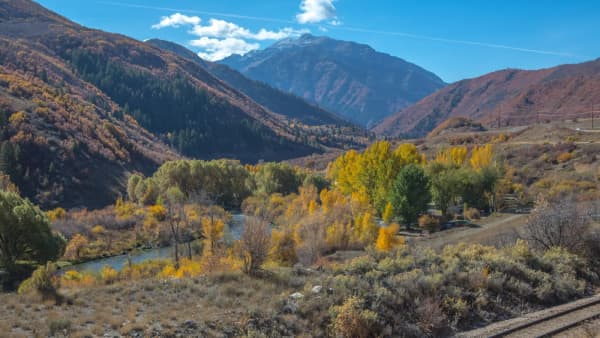
Autumn is the best answer for most people. The crowds thin after the school year restarts, the water settles, and from late September the canyon turns color that draws traffic from three counties. Our fall colors guide covers the timing, which moves year to year with elevation and weather.
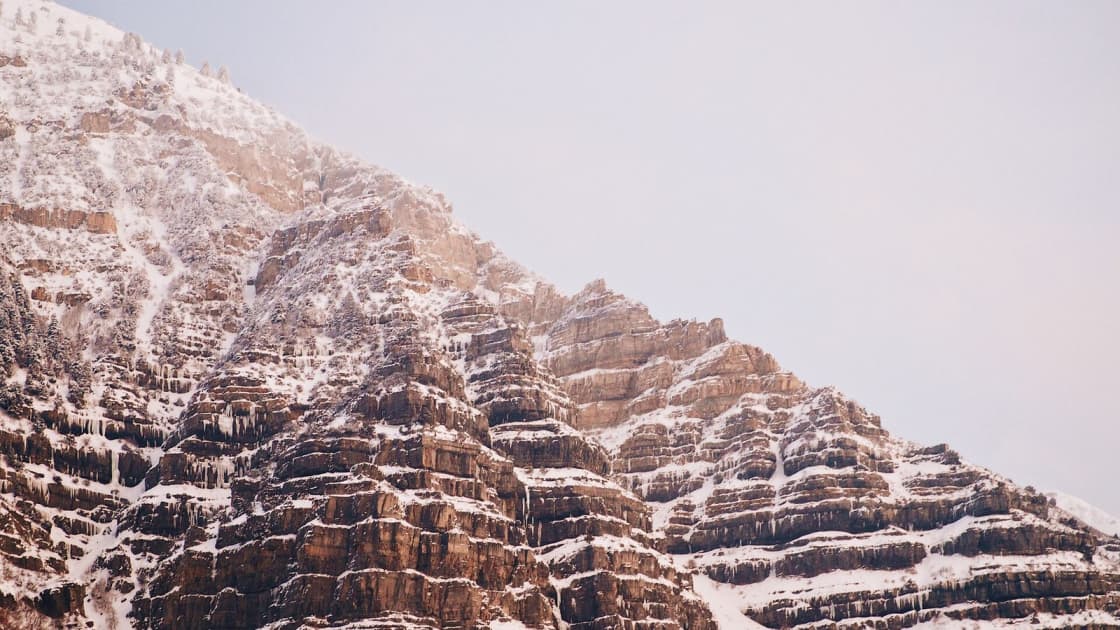
Winter is quiet, striking, and conditional. The parks do not close in the way a business closes, but access, snow and road conditions decide the day. The railroad's seasonal winter service is a genuine reason to come up in December.
The South Fork, which most people never turn up
At Vivian Park the South Fork of the Provo River comes down from the south to join the main stem, and the road up it is one of the least-used good drives in the county.
It is a narrower, quieter, more wooded corridor than the main canyon, and it climbs away from the highway noise within a minute of turning off. There are campgrounds up it, there is water the whole way, and in autumn it turns before the main canyon does because it sits higher and colder.
It is worth knowing about for a specific reason: on a July Saturday when Vivian Park itself is full and the main canyon is a queue, the South Fork is frequently not. Our camping near Provo guide covers the campgrounds up that side.
Canyon safety, briefly and seriously
Three hazards, all of them routine and all of them underestimated.
The river. It is snowmelt-fed, it is colder than it looks, and its flow varies enormously through the year and after storms. Cold water incapacitates faster than people expect, the current is stronger at higher flows than the surface suggests, and the riverbed is slick cobble. Children near moving water need an adult within arm's reach, not within sight.
The road. US-189 is a fast state highway through a narrow corridor with limited shoulder and a real crash history. The turnoffs to both parks arrive quickly. Slow down before you think you need to, and be careful pulling back out into traffic that is moving considerably faster than you are.
The weather. Canyon weather is not valley weather. Afternoon thunderstorms build fast in summer, the temperature drops sharply once the sun clears the west wall, and in winter the canyon holds snow and ice long after the valley floor is dry. Check conditions before driving up between roughly November and April.
None of this is a reason not to go. It is a reason to go prepared, which in a canyon this accessible is easy to forget precisely because it is so accessible.
Making a group day work
The reunion or ward activity at Vivian Park is a Utah Valley institution, and the ones that go well share a pattern.
Reserve early, and reserve bigger than you think. Groups grow between the planning and the day.
Send the grid coordinates, not directions. Everyone in this valley can navigate from an address, and half of them will be arriving separately.
Nominate someone to arrive first. Pavilion handovers are not always clean, and someone should be there at the start of your window.
Plan for no signal. Canyon coverage is patchy. Agree a meeting point and a time rather than relying on a group chat that may not deliver.
Bring more water than the arithmetic suggests. Elevation, dry air and sun do more than people expect.
Assign the rubbish. A group of forty generates more than the bins take on a busy Saturday, and packing it out is the difference between a park that stays good and one that does not.
Which one should you pick
Choose Nunn's if you are within half an hour of it, you have a small group, you want the river more than the facilities, and you are going on a whim.
Choose Vivian if there are more than about a dozen of you, if anyone needs a pavilion, if you are combining the trip with the railroad, or if tubing is the point of the day.
Choose a weekday, either way, if you possibly can. The canyon on a Tuesday afternoon in August is one of the best things about living here, and on a Saturday it is a car park with a view.
A short history of why there is anything here at all
Provo Canyon was infrastructure before it was recreation, and the parks sit on top of that history rather than beside it.
Water came first. The Provo River is the reason the valley below could be farmed at all, and the canyon is the corridor that delivers it. Diversion, storage and delivery works have shaped this drainage for well over a century, and the pattern of who owns what along the canyon floor still reflects those decisions.
Power came next, which is where Nunn's Park gets its name. Early hydroelectric development on the Provo River drew engineers and institutions into the canyon, and Lucien L. Nunn's work in that field is the reason a picnic ground carries a surname most visitors assume is a misspelling.
The railroad came for the same practical reasons and stayed for entirely different ones. What is now a scenic excursion line through the canyon began as transport infrastructure, and its survival as the Heber Valley Railroad is the reason Vivian Park has a station.
Recreation is the newest layer and in some ways the most fragile. The canyon absorbs enormous visitor pressure from a county that has grown fast and keeps growing, on a corridor that cannot be widened without taking something else away. That tension is visible in the parking, in the traffic, and in the periodic arguments about what should be built up here — our explainer on the Vesper Amphitheater proposal covers the current one.
Knowing that sequence changes the walk. The canyon is not wilderness with picnic tables in it. It is a working corridor that has been continuously used for a hundred and fifty years, and the recreation is the most recent thing about it.
Related Guides
-
The Provo River Parkway — the trail that connects both parks to the valley
-
Tubing and Rafting the Provo River — the float itself, and when not to do it
-
The Heber Valley Railroad — the train that stops at Vivian Park
-
Fishing Near Provo — the canyon stretch and the regulations
-
Camping Near Provo — the canyon campgrounds, for when a day is not enough
-
Bridal Veil Falls — the canyon's other unmissable stop
-
Fall in Provo — timing the canyon's best fortnight
-
Big Springs Park and the South Fork: Provo Canyon's Quiet Side
Frequently Asked Questions
What is the difference between Vivian Park and Nunn's Park?
Which one is the tubing takeout?
Do I need a reservation?
Is there a fee?
Can I get to Vivian Park without driving?
Are dogs allowed?
What is the parking situation?
When is the best time to go?
Sources
The facts in this guide were checked against these sources. Hours, fees and rules change, so confirm anything time-sensitive with the source before you go. How we make Provo.com.
- Parks and Trails - Public Works, Utah County. Checked October 12, 2026.
- Helpful Links | Provo, UT, Provo City. Checked October 12, 2026.
- Provo River Parkway: Vivian Park to Provo River Resort, AllTrails. Checked October 12, 2026.