
Easter in Utah Valley is two holidays stacked on one weekend. The Saturday is loud: every city in the county runs an egg hunt at a park in the morning, the museums and the trampoline parks are full by noon, the restaurants have a wait by six. The Sunday is the quietest day of the year — quieter than Christmas, quieter than the Sunday of general conference — because the valley's Sunday-closing habit and its religious majority combine to empty the roads and the stores in a way that newcomers find eerie the first time. A family from out of state expects Easter brunch at a restaurant and an afternoon at a garden; it gets a closed sign and an empty freeway, and then, if it has the patience to notice, a genuinely lovely day.
This guide explains how Easter works here: the Saturday egg-hunt circuit, the years when the holiday lands on or beside general conference (2027 is not one of them: Easter is March 28, conference is April 3–4), what is actually open on the Sunday, where the sunrise services are, what the temple grounds are like, how the weather gamble on a late-March hunt plays out, and a plan for a family with small children. It is the evergreen home for the holiday; the site's General Conference weekend guide covers the conference side in depth, and the restaurants-open-on-Sunday guide is the working list for the meal. Dates below are verified for 2027; the city egg hunts are announced each March and their parks change, so the city calendar is the source for those.
The Calendar Problem: Easter and Conference
The Church of Jesus Christ of Latter-day Saints holds its April general conference on the first weekend of April every year: two days of broadcast sessions that replace local worship for the whole valley that Sunday. Easter, meanwhile, moves between March 22 and April 25. Some years they coincide; most they do not; and the difference decides what Easter looks like here.
When they do not coincide — as in 2027, when Easter is March 28 and conference is April 3–4 — Easter Sunday is a normal Sunday of local worship for the Latter-day Saint majority, and the wards make an occasion of it: an Easter program of hymns and talks, often a ward choir, the children's classes with a Resurrection lesson. It is one of the two Sundays a year (Christmas is the other) when the meetinghouses are noticeably fuller. The family day follows the meetings.
When they do coincide, the valley's Easter changes shape. There are no local meetings; the family watches four two-hour sessions of conference from the couch on Saturday and Sunday; the egg hunts get compressed into Saturday morning before the 10 a.m. session; and the Sunday afternoon between sessions is the Easter dinner. The Church's leaders use the Easter sessions to preach on the Resurrection, and for many families the conference is the Easter observance. The rest of the valley — the non-LDS congregations, the newcomers, the students — proceeds normally, on a weekend when even the usual Sunday traffic has vanished.
Check the two dates together each spring. The pattern for the next few years: 2027 Easter March 28, conference April 3–4 (no collision); after that it depends on the moon.
The Saturday: The Egg-Hunt Circuit
The public Easter egg hunt is a city recreation department's spring ritual in Utah County, and nearly every city runs one on the Saturday before Easter.
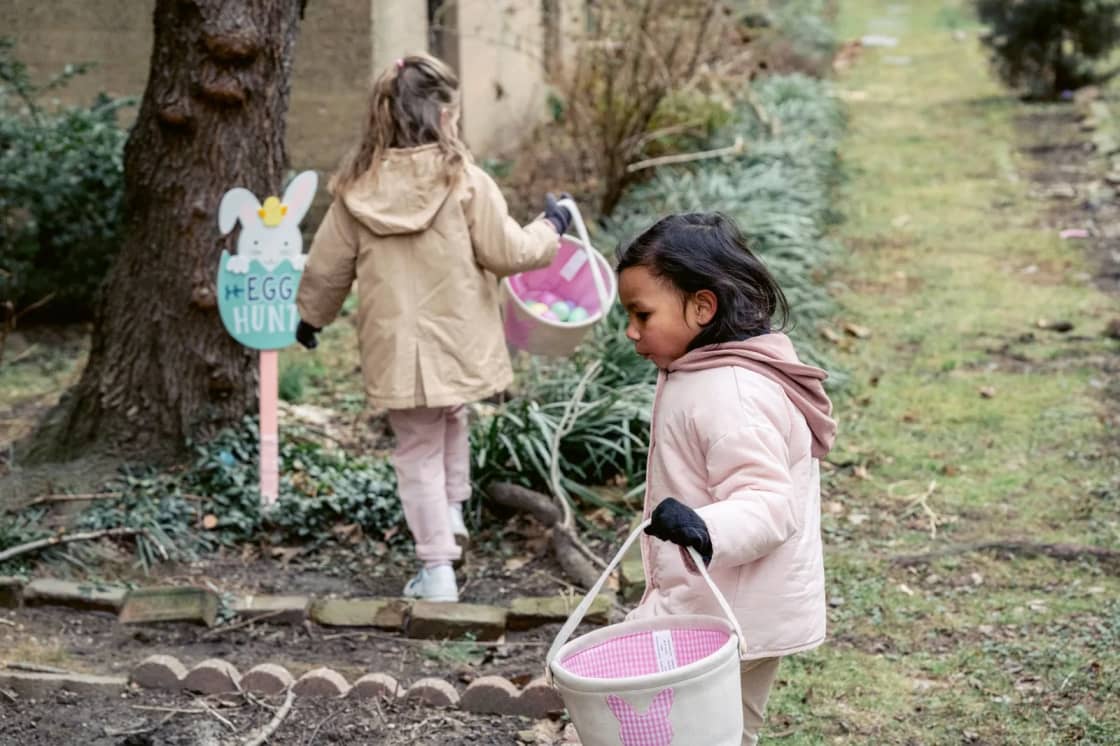
How they work. A big park — Provo has used its larger parks, Orem its city-center parks, Lehi, American Fork, Spanish Fork and the west-side cities their sports complexes — is scattered with thousands of plastic eggs the evening before, roped off by age group: toddlers and under, three-to-five, six-to-eight, nine-to-twelve. Families line up at the rope; a costumed bunny appears; at the whistle the children run, and the hunt is over in about ninety seconds. Some cities attach a pancake breakfast, a bounce house or a photo line; some hide a few golden eggs that redeem for a prize. It is free, it is chaotic, and it is over by 10:30.
The rules that catch newcomers. Arrive twenty minutes early; the parking fills and the rope goes up on time. Bring a basket the child can hold and run with. Stay behind the rope in the age group's area — the volunteers enforce it, because a nine-year-old in the toddler field is a problem. Expect a small child to get three eggs, not thirty, and to be perfectly happy. And check the city's social feeds the morning of: the hunts go on in drizzle and are canceled or moved in snow, and late March produces both.
Beyond the cities. The Latter-day Saint wards run their own hunts on the Saturday too, at the meetinghouse or a member's yard, open to the neighborhood in the same way the fall trunk-or-treats are. Thanksgiving Point has run paid and member egg hunts at the farm and gardens; the trampoline parks run indoor hunts that are weather-proof and ticketed; some shopping centers and the university-adjacent businesses run one for the children of students. The paid hunts are smaller and calmer, and for a two-year-old they are the better version.
Dates. The hunts are on the Saturday before Easter — March 27, 2027 — and are announced on the cities' calendars in early-to-mid March, rarely earlier. The park sometimes changes year to year. This page describes the pattern; the city page is the source for the current one.
The Saturday Afternoon: Spring Venues and the Weather Gamble
After the hunt, the afternoon belongs to whatever the weather allows.
In a warm year: the Provo River Trail and the canyon, the playgrounds, Utah Lake's shore at the state park, and the first patio lunches of the year on Center Street. Late March in a good year is in the 60s.
In a cold year, which March is about as often: the Butterfly Biosphere and the dinosaur museums in Lehi, the Bean Museum on BYU's campus (free), the rec centers' open swim, the trampoline parks. The valley's indoor-play inventory is deep, and Easter Saturday is one of the days it was built for.
The Tulip Festival question. Thanksgiving Point's Ashton Gardens open for their Tulip Festival in early-to-mid April most years (the 2026 festival ran April 6 to May 16). A late Easter can land inside it and make Easter Saturday the best garden day of the spring; a March Easter like 2027's will usually be a week or two before the gates open. Check the festival's dates against Easter each year; our Tulip Festival guide explains the tickets and the bloom timing.
Saturday dinner. Eat out on Saturday, because Sunday will be closed. The valley's restaurants know it, and Easter Saturday evening is one of the year's busiest; book, or go early.
The Sunday: What Is Actually Open
This is the section newcomers need most, and it is short because the list is short.
Open, with holiday hours: most of the national chain grocery stores (Smith's, Walmart, Harmons) — check the day's hours, which are often shortened; gas stations; pharmacies; the movie theaters, usually opening early afternoon; the national chain restaurants that open on Sundays in Utah County, which is a shorter list than elsewhere, with brunch reservations gone weeks ahead; hotels' restaurants.
Closed: nearly all locally owned restaurants, which close every Sunday here regardless of the holiday; the local grocers and markets; most retail, including the shopping centers' locally owned tenants; the museums at Thanksgiving Point and BYU (closed every Sunday); the rec centers (closed every Sunday); the trampoline parks and most entertainment venues; the state liquor stores (closed every Sunday by law); the temples (closed on Sundays as a rule). The restaurants-open-on-Sunday guide is the working list for the meal, and it is the same list on Easter as any other Sunday, minus a few that close for the holiday.
The practical result: Easter dinner in Utah Valley is a home meal for the overwhelming majority, and a family that wants it otherwise needs a reservation at one of the few brunch-serving chains by mid-March. The grocery run happens Saturday. And the roads on Easter Sunday, with both the Sunday-closing habit and the holiday at work, are the emptiest of the year — the freeway at noon looks like 5 a.m.
Sunday Morning: The Services
The sunrise service — an outdoor gathering at dawn on Easter morning — is a tradition of the valley's Protestant and Catholic congregations, and a small one, because those congregations are a minority here. Several churches in Provo and Orem hold one, some at a park or on a foothill overlook, some in a church garden, and all welcome visitors; the times are on each church's own page in the weeks before. The Catholic parishes hold Easter Vigil on Saturday night and Masses through Sunday morning. The evangelical and mainline churches hold their largest services of the year.
The Latter-day Saint wards hold their normal Sunday meetings at their normal hour — each ward has an assigned block between 9 a.m. and early afternoon — with an Easter program. Visitors are welcome and will be greeted; the dress is church clothes; the meeting is about seventy minutes with hymns, a sacrament service and two or three talks. For a newcomer curious about the valley's majority faith, Easter Sunday is the most accessible meeting of the year, because the subject is one every Christian tradition shares. Our conference guide explains how to find a ward's meeting time.
Sunday Afternoon: The Temple Grounds
The single most Utah Valley thing about Easter is the temple lawns on Sunday afternoon. The temples themselves are closed on Sundays, and closed to anyone without a recommend at all times, but the grounds are open to everyone, and on Easter afternoon they fill with families in spring dresses and pastel ties, posing on the lawns with the flowers behind them.
The Provo City Center Temple's grounds at Center Street and University Avenue — the rebuilt tabernacle, the gardens, the fountain — are the valley's most photographed spring setting. The Orem, Lindon, Saratoga Springs and Payson temples and the Provo Utah Temple site on the east bench have the same afternoon. Visitors are welcome to walk the grounds quietly; photography is fine; the flowers, planted for exactly this week, are at their best. It is free, it is open, and it is the valley's Easter parade.
The Weather, Honestly
Late March in Utah Valley: average highs in the low-to-mid 50s, lows near freezing, and about a one-in-three chance of precipitation on any given day, some of it snow. An Easter in late April is milder and greener. The city hunts run in light rain and are moved or canceled in snow, with the notice on the city's social feeds the morning of. The practical rules for an outdoor Saturday with a small child: dress for 40 degrees and mud, bring a full change of clothes, have the indoor plan ready, and do not put the good Easter outfit on until Sunday.
A Plan for a Family With Small Children
Saturday. The city egg hunt at 9 or 10 — arrive early, rope by age group, done by 10:30. A second, calmer hunt at a ward or a paid venue for a toddler who found the city one overwhelming. Lunch out. The afternoon at whatever the weather allows: the canyon trail or the museums. An early dinner out, booked. Egg dyeing at home in the evening.
Sunday. Church, for the families that go — the sunrise service, the parish Mass, the ward's Easter program. A home-cooked Easter meal, because that is what is open. The temple grounds in the afternoon for the photographs, or a walk on the empty roads. The basket hunt at home in the morning, which in this valley happens before church for a reason: the meeting is at ten.
The Easter-on-conference years. Saturday morning's hunt before the 10 a.m. session; the afternoon session on the couch; Sunday's sessions with the Easter meal between them; the temple grounds after the last one. The eggs are dyed on Friday.
The Easter Economy: Baskets, Dresses and the Saturday Rush
Two smaller things about the weekend that a family will notice.
The first is the shopping, which happens on Saturday and is intense. The valley's family size and its Sunday-closing habit compress the whole country's Easter retail into one day: the grocery stores on Easter Saturday morning are as busy as the day before Thanksgiving, the candy aisles are stripped by noon, and the children's-clothing racks at the big-box stores are picked over a week out. The habit of a new Easter outfit — a dress for the girls, a tie for the boys, matching where the family can manage it — is stronger here than almost anywhere, and it explains the temple lawns on Sunday. A family that wants a specific basket or a specific dress buys it in the second week of March.
The second is the Easter egg itself, which in this valley is often a real one. Egg-dyeing on Saturday evening is a household ritual, the grocery stores sell out of white eggs and food coloring, and the hunt at home on Sunday morning is as likely to involve dyed hard-boiled eggs hidden in the yard as plastic ones. The city hunts are plastic (and the eggs are meant to be returned to the bins at the exit, which the volunteers will ask for); the home hunts are whatever the family's tradition is. The mule deer that wander the east-bench neighborhoods have been known to find the yard eggs first.
For the Student Who Stayed in Provo
Both campuses are in session over Easter — BYU has no spring break, and UVU's week is usually a week or two before — so the valley's tens of thousands of students spend Easter in town, many of them far from family for the first time. The wards that serve the student apartments make an occasion of Easter Sunday; the campus-adjacent congregations of every tradition hold services aimed at students; and the tradition of a "Friendsgiving"-style Easter dinner in a student apartment is as real here as anywhere. The student's practical notes: the on-campus dining that is open on Sundays is the option for a meal out; the grocery run is Saturday; the temple grounds and the canyon are free; and the spring-break guide explains why the long weekend everyone else has is not on the calendar here.
What Newcomers Get Wrong
They plan Easter brunch at a restaurant on Sunday and discover in the week before that the local places are closed and the chains are booked. Book in March or cook.
They go to the city egg hunt at the posted time and find the parking full and the rope up. Twenty minutes early.
They bring a nine-year-old to a hunt with age groups and let her run with the toddlers. The volunteers will stop her, kindly.
They assume the museums and rec centers are open on Easter Sunday because it is a holiday. They are closed because it is a Sunday.
And they miss the temple grounds, which are the best free hour of the weekend.
The Short Version
Easter in Utah Valley is a loud Saturday and a silent Sunday. The cities run free egg hunts on the Saturday morning — March 27 in 2027 — announced in early March, over in ninety seconds, weather permitting. The afternoon is the canyon in a warm year and the museums in a cold one; the dinner out is Saturday's, because Sunday's restaurants are mostly closed. Easter Sunday, March 28, 2027, is a normal worship Sunday with an Easter program in the wards and sunrise services at the other churches; the following weekend, April 3–4, is general conference, and in the years the two collide the holiday becomes a conference weekend with eggs. The chains and the grocery stores open with holiday hours; almost everything local closes; the roads are empty; and the temple grounds on Sunday afternoon are the valley's Easter parade.
Related Guides
- General Conference Weekend in Utah Valley
- Restaurants Open on Sunday in Provo
- The Tulip Festival at Thanksgiving Point
- Thanksgiving Point: The Complete Visitor Guide
- Trampoline Parks & Indoor Play Places in Utah Valley
- Trunk-or-Treats and Little-Kid Halloween in Utah Valley
- Valentine's Day in Utah Valley
- Provo Canyon: The Complete Guide
Frequently Asked Questions
When is Easter in 2027, and does it fall on General Conference?
Where are the public Easter egg hunts?
What is open on Easter Sunday in Provo?
Is there a sunrise service?
What do families do on the Saturday?
What is the weather like for an outdoor hunt?
How does Easter differ here from the rest of the country?
Are the temple grounds open to visitors on Easter?