
Almost every page that publishes Provo's population publishes a number and stops. That is the least useful part of the answer.
Provo has roughly 115,000 residents. (That count, and every other figure on this page, comes from the American Community Survey — one of thirteen publishers in our guide to Provo data sources.) It also has a median age of 23.6, a measured poverty rate above 23%, a median household income below the state figure, and a population that is flat to slightly declining inside the fastest-growing county in Utah. Read those five facts without context and you would conclude Provo is a struggling city emptying out. Read them with context and you get something close to the opposite.
The context is that a single institution distorts every one of those numbers, and almost nobody who publishes them says so. This page is an attempt to publish the numbers and the distortion.
On sourcing. Every figure below is attributed to a source and a vintage in the text, because demographic data goes stale and different Census products disagree with each other by design. Where the sources conflict, we say so rather than picking. This page is re-verified and re-stamped when the underlying data updates, not on a schedule.
Advertisement
The headline number, and why it has a range
The 2020 Decennial Census counted 115,162 people in Provo. That is the most authoritative single figure available, because the decennial census is a count rather than a survey.
More recent American Community Survey five-year estimates put the city at roughly 114,766. The two vintages before it landed slightly lower, near 114,300 to 114,400. The Utah Population Committee, chaired and staffed by the University of Utah's Kem C. Gardner Policy Institute, produces annual subcounty estimates that show Provo essentially flat with a small decline.
So: about 115,000. The gap between the published figures is a few hundred to a few thousand people — smaller than the error bars on a survey estimate and smaller than the seasonal swing when a university empties out for the summer. Anyone quoting Provo's population to the nearest person is quoting a false precision.
Provo is the fourth most populous city in Utah and the county seat of Utah County.
The age number is the one that explains everything else
Provo's median age is approximately 23.6 years, per recent American Community Survey estimates. For comparison, Utah's statewide median is about 32 — already the youngest state in the country — and the national median sits closer to 39.
Then there is the figure that does the real work. According to ACS 2019–2023 five-year estimates, the single largest age group in Provo is 20 to 24 years old, at roughly 37,165 people — about 32.5% of the entire city. Not 32.5% of adults. Of everyone, including infants and retirees.
There is no ordinary American city with that shape. Provo's age pyramid is a spike.
Once you know that, the rest of the statistics stop being mysterious:
- Median household income of about $64,171 looks low for a metro with Provo's job market — until you remember that a large fraction of Provo households are students sharing an apartment.
- The measured poverty rate of roughly 23% is well above the national figure. Census data shows the largest demographic groups below the poverty line in Provo are women aged 18–24, then men aged 18–24, then women aged 25–34. That is a description of students, not of a distressed local economy. It does not mean real hardship is absent in Provo — it plainly is not — but the headline rate is measuring something different from what it measures in most cities.
- Household size and composition run unusually high and unusually non-family, for the same reason.
The practical version: if you are comparing Provo to another city on a spreadsheet, you are probably comparing a university student body to a workforce. Our cost of living in Provo guide handles the same problem from the household-budget side, and Provo vs Orem is the comparison most people are making.
The university, in numbers
Brigham Young University enrolled 35,873 students in the 2024–25 academic year — 32,952 undergraduate and 2,921 graduate — and roughly 82% of its undergraduates live off campus.
BYU is not the only school in town: Rocky Mountain University of Health Professions and Provo College also enroll students in Provo, so the city's total enrollment runs above BYU's alone.
An important honesty note on the arithmetic: you cannot simply divide total enrollment by 115,000 and declare that a third of Provo is students. The Census counts college students at their term-time address, so most on- and off-campus students in Provo do count as residents — but a meaningful share of enrolled students live in Orem, Springville or further out and are counted there. The two figures overlap heavily and imperfectly. What can be said cleanly is the ACS age band: roughly a third of Provo's counted population is between 20 and 24.
If the university itself is what brought you here, our BYU guide is the front door, and the UVU student guide covers the other side of the valley.
The growth question, which most sources get backwards
Here is the fact that separates Provo from every other Utah city people compare it to.
Utah's population reached an estimated 3,551,150 as of July 1, 2025, according to the Utah Population Committee, having added 44,351 residents in a year — a growth rate of 1.3%, down from 1.5% the year before. Utah County added more people than any other county in the state — 15,914, roughly 36% of all statewide growth — and has led the state in absolute growth for years running.
And Provo lost people.
The Committee's subcounty estimates for mid-2024 to mid-2025 put Provo at approximately −498 residents, among the largest numeric declines in Utah. Orem was the largest, at −943. Meanwhile Saratoga Springs added 4,682 people (8.4%, the highest growth rate in the state) and Eagle Mountain added 4,169 (6.8%) — the two of them now hold more than 125,000 people between them. Lehi ranked fifth statewide for net growth, adding 2,386.
This is not a story about Provo failing. It is a story about geography and land.
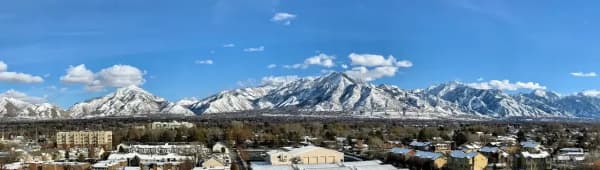
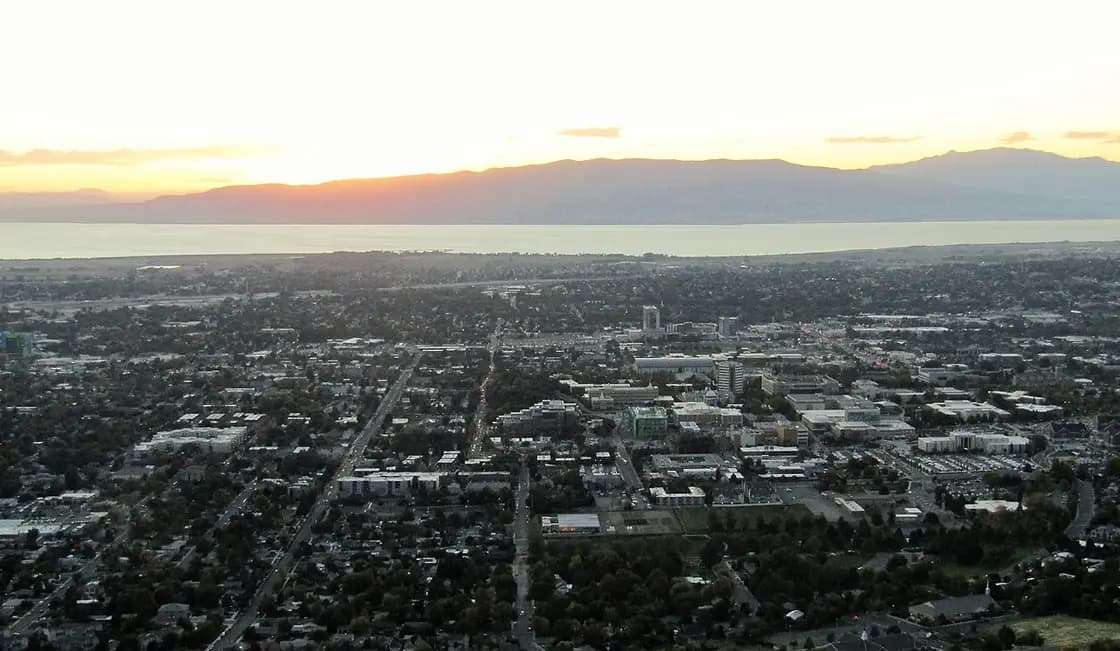
Provo is boxed in. Utah Lake forms the western edge. The Wasatch Range walls off the east. Orem sits directly north and Springville directly south. There is no annexable open land — the city built out decades ago, and what remains is infill and redevelopment. The valley's greenfield sits north and west, which is exactly where Saratoga Springs, Eagle Mountain and Lehi are.
Add a population where a third of residents turn over on an academic cycle, and small year-to-year declines are what you would expect. Provo's story from here is density and redevelopment rather than sprawl — which is precisely what the downtown build-out of the last decade has been. Our downtown Provo neighborhood guide is where that change is most visible, and the Provo neighborhoods guide covers how differently the city reads block to block.
For where the growth went, the north-county guides are the ones to read: living in Lehi, living in Eagle Mountain and living in Saratoga Springs.
What the numbers do not tell you
Three things worth stating plainly.
Provo is not the whole metro. The Provo–Orem–Lehi metropolitan area has been among the fastest-growing metros in the country by percentage. Utah County as a whole is on a trajectory that state projections have approaching Salt Lake County's population within a few decades. If you are evaluating "the Provo area" as a place to live or do business, the county figure is the relevant one, not the city figure.
The city empties and refills. Provo in July and Provo in September are measurably different places — traffic, restaurant waits, apartment availability, congregation sizes. No annual statistic captures that, and it is one of the first things newcomers notice.
We do not publish home price figures on this site, and that is deliberate. Utah is a non-disclosure state: individual property sale prices are not public record, so published "median home price" numbers for a Utah city are estimates built from partial data. We have seen three sources give three medians for the same Utah County city in the same year with a spread of well over $100,000. Population and age come from the Census Bureau and are auditable. Sale prices here are not, so we cover housing in durable terms instead — see the housing sections of living in Provo and buying a home in Provo.
Quick reference
| Measure | Figure | Source and vintage |
|---|---|---|
| Population | ~115,000 (115,162 counted) | U.S. Census Bureau, 2020 Decennial Census |
| Population, recent estimate | ~114,766 | U.S. Census Bureau, American Community Survey 5-year estimates |
| Rank in Utah | 4th most populous city | U.S. Census Bureau |
| Median age | ~23.6 years | ACS 5-year estimates |
| Largest age group | 20–24, ~37,165 people (~32.5%) | ACS 2019–2023 5-year estimates |
| Median household income | ~$64,171 | ACS 5-year estimates |
| Poverty rate | ~23% | ACS 5-year estimates |
| Year-over-year change | approx. −498 residents | Utah Population Committee, mid-2024 to mid-2025 |
| Utah County annual growth | +15,914 (most of any Utah county) | Utah Population Committee, mid-2024 to mid-2025 |
| BYU enrollment | 35,873 (2024–25) | Institutional enrollment data, 2024–25 |
| County | Utah County (county seat) | — |
Figures are rounded where the underlying estimate carries a margin of error. Where two Census products disagree, both are shown rather than averaged.
How the count is made, and the two rules that shape every number above
The figures above have a range and an odd age profile for reasons that are usually described as quirks. They are not quirks. They are the predictable output of two Census Bureau rules, and once you know both, most of the strange numbers about Provo stop being strange.
Rule one: usual residence. The Census counts people where they live and sleep most of the time. Under the 2020 residence criteria, a college student living away from a parent's home while attending school in the United States is counted at the on-campus or off-campus residence where they live and sleep most of the time, not at the parents' address. A student living at a parent's home while attending college is counted at the parents' home.
Applied to Provo, that means the city's population includes tens of thousands of people whose driver's licenses, voter registrations, permanent addresses and families are somewhere else entirely. That is not an error in the count and it is not double-counting. It is the rule working correctly, and it has been the rule, in substance, since the first census in 1790.
Rule two: group quarters. The Bureau classifies everyone not living in a house, apartment, mobile home or rented rooms as living in group quarters, defined as a place where people live or stay in a group living arrangement owned or managed by an organization that provides housing or services. There are two kinds: institutional, which covers correctional facilities, nursing homes and mental hospitals, and non-institutional, which covers college dormitories, military barracks, group homes, missions and shelters.
Student housing is enumerated through a separate Group Quarters operation, and the category reaches considerably further than dormitories. It also covers university-recognized fraternity and sorority houses and off-campus housing designed specifically for students — including privately owned apartment complexes where students hold individual leases. In a city where a large share of the housing near campus is built and leased on exactly that model, this is not a marginal category.
Why that matters for reading any statistic about Provo. Household-based measures are computed over the household population only, and people in group quarters are not in households. So median household size, household income, family composition and housing tenure all describe the part of Provo that is not student group housing. They are correct figures. They are simply answering a narrower question than the phrase "the average Provo household" suggests.
The poverty figure deserves its own warning. Poverty estimates derived from the American Community Survey exclude people living in institutional group quarters and in non-institutional college dormitories and military barracks — but students living off campus are inside the poverty universe. Their measured income is a semester's part-time earnings; their actual economic position frequently involves family support, savings, or loans that the measure does not see. Provo's poverty rate is therefore high, real as a measurement, and close to meaningless as a description of material hardship in the city. It should never be compared directly against the rate for a city without a large university.
Two smaller mechanics worth carrying. The ACS has sampled group quarters only since 2006, so comparisons that reach back further are not comparing the same universe. And the ACS includes anyone residing at an address for at least two months, which is a lower bar than intuition suggests in a town organized around semesters.
Finally, every ACS number carries a margin of error, and the smaller the geography or the subgroup, the wider it gets. A tract-level or single-year estimate for a small population can have a margin wide enough that two neighborhoods which look different on paper are statistically indistinguishable. The published estimate is the middle of a range, not a measurement.
And three different federal products will give you three different numbers for the same year, which is the mechanical reason the headline above carries a range rather than a figure. The decennial census is a full enumeration conducted once every ten years. The Population Estimates Program publishes an annual estimate that rolls the last census forward using births, deaths and migration. The American Community Survey is a rolling sample published as one-year and five-year estimates, where a five-year figure is an average across a window rather than a snapshot of any single year in it. None of the three is wrong and none is a correction of the others. They are separate instruments answering slightly different questions, and a source that cites one without saying which has told you less than it appears to.
If you are reading this because you are thinking of moving
The demographic picture is useful for that decision, but it is not the whole of it. A city with a median age of 23 feels a specific way — energetic, transient, cheap in some respects and stretched in others, and organized around an academic calendar whether or not you attend the university.
Whether that suits you is a different question from what the Census says. Living in Provo is the long-form answer, is Provo safe covers the question people ask second, and Provo for families covers the group the raw statistics serve worst — because a city whose median age is 23 still has schools, parks and neighborhoods that have nothing to do with students at all. The group the statistics serve second-worst is retirees, and retiring in Utah Valley treats that case directly, including why most people considering it end up looking at the surrounding cities rather than Provo itself.
Related Guides
- Provo vs Salt Lake City: Where Should You Live in Utah? (2026)
- Provo Development Tracker — the approved and pending projects behind the growth, by neighborhood
Frequently Asked Questions
What is the population of Provo, Utah?
Is Provo the biggest city in Utah?
What is the median age in Provo, Utah?
Is Provo growing or shrinking?
Why is Provo's poverty rate so high?
How many BYU students live in Provo?
Are BYU and UVU students counted in Provo's population?
Why is Provo's poverty rate so high?
Sources
The facts in this guide were checked against these sources. Hours, fees and rules change, so confirm anything time-sensitive with the source before you go. How we make Provo.com.
- 2020 Decennial Census Redistricting Data (PL 94-171), Table P1, U.S. Census Bureau. Checked October 12, 2026.
- ACS 5-year estimates 2020-2024, Tables B01003, B01002, B19013, B01001, B17001, U.S. Census Bureau. Checked October 12, 2026.
- ACS 5-year Subject Table S1701 (Poverty Status), U.S. Census Bureau. Checked October 12, 2026.
- Common Data Set 2024-2025, Brigham Young University. Checked October 12, 2026.
- Utah's population reaches 3.55 million as growth continues slowing trend, KUTV. Checked October 12, 2026.
- These were Utah's fastest-growing cities in 2025, according to the University of Utah, KSL.com. Checked October 12, 2026.