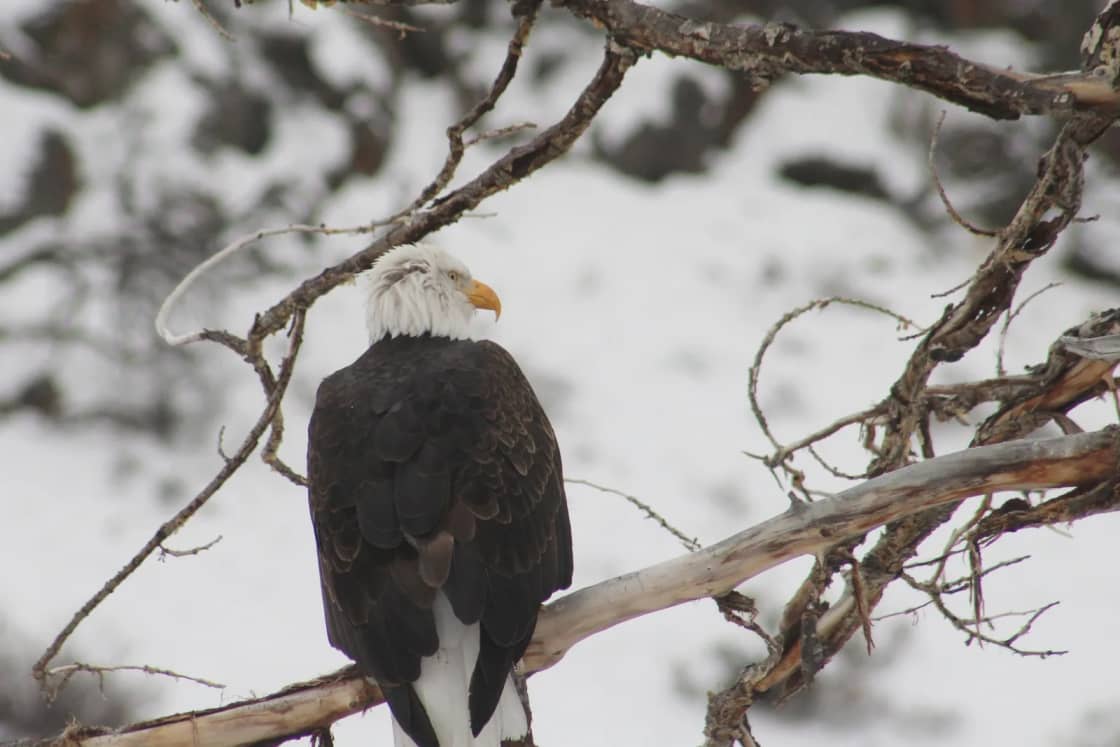
Every winter, bald eagles move into Utah from colder country to the north, following open water and food. The Utah Division of Wildlife Resources (DWR) says hundreds of them are in the state by the time February arrives, and it calls February the best time of year to see them. Many settle near rivers, reservoirs, marshes and fish hatcheries, and some of the most reliable spots are within an hour or so of Provo.
This guide is built on DWR's own list of viewing sites, published on a January 2026 flyer and repeated in coverage by KSL, the Deseret News, TownLift and the Daily Herald. It covers the Utah County spots first, then the day trips worth making from Provo, how to watch without disturbing the birds, what the newer wildlife management area permit rule means for eagle watchers, and what to check before you go.
All details below were checked against the sources named on Nov. 20, 2026. Wildlife is not on a schedule, and road conditions, gate hours and access rules change, so treat this as a starting point and confirm before you drive.
Quick facts
| Spot | From Provo (approx.) | Who names it |
|---|---|---|
| Utah Lake State Park and Provo River Delta | 5 miles, about 11 to 12 minutes | DWR flyer; KSL |
| Lincoln Beach and Lincoln Beach Road | South end of Utah Lake | TownLift, from DWR |
| Lower Provo River near SR-32 (Deer Creek and Jordanelle) | Deer Creek area about 16 miles, about 27 minutes | KSL; TownLift |
| Fountain Green and West Side Road to Wales | About 56 miles, a little over an hour | DWR flyer; Daily Herald |
| San Pitch River near Mount Pleasant | About 57 miles, about 75 minutes | KSL; Daily Herald |
| Eccles Wildlife Education Center, Farmington Bay | About 62 miles, about 75 minutes | DWR flyer |
| Weber River near Croydon, below Echo Reservoir | About 74 miles, about an hour and a half | DWR flyer |
| Willard Bay Reservoir | About 93 miles, about an hour and 45 minutes | DWR flyer |
| Peak season | February (late January through February) | DWR; Daily Herald |
| Cost to look | Free from public roads; park and permit rules vary by site | See sections below |
Drive distances and times are from OpenStreetMap routing (OSRM) between downtown Provo (Center Street and University Avenue) and approximate points at each site, without traffic or winter weather. They are rough, and snow can stretch them a lot.
Why eagles come to Utah in winter
Bald eagles live in parts of Utah all year, but winter is when most people see them. The Daily Herald's January 2026 report summarized the pattern: eagles move south in the cold months to find open water and reliable food, and rivers, reservoirs and fish hatcheries make good winter habitat. TownLift's report on DWR's list described hundreds of birds coming to the state for food and milder weather than they would find farther north.
DWR's flyer says bald eagles often eat fish but will also take other birds, small mammals and reptiles, scavenge roadkill and steal prey from other animals. That range explains the mix of sites below. Some are fish-rich waters like Utah Lake and Willard Bay. Some are farm valleys like Sanpete, where eagles perch in leafless trees, on utility poles and on fence posts. And some are marshes full of waterfowl, like Farmington Bay.
Eagles also gather to roost. DWR describes a "convocation" of bald eagles that often roosts in one large cottonwood south of Fountain Green, and two Cedar City roosts where they are regularly seen. Roost trees are why DWR's directions are so specific: a single cottonwood can hold several birds while the trees around it sit empty.
Utah County spots
Utah Lake State Park and the Provo River Delta
DWR's flyer lists Utah Lake State Park as a popular eagle-viewing spot, and the KSL and Deseret News versions of DWR's 2026 list describe eagles being found near Utah Lake State Park and the Provo River Delta on the west end of Provo. This is the closest DWR-named site to downtown, about 5 miles and 11 minutes by OSRM routing, straight west on Center Street.
Utah Lake State Park is at 4398 W. Center St. Utah State Parks lists winter hours (Nov. 1 through March 31) of 6 a.m. to 8 p.m. and a day-use fee of $20 per vehicle. The park phone is (801) 375-0731. The park's page does not say which buildings and restrooms stay open in winter, so call if that matters to your group.
The Provo River Delta, the restored wetland where the lower Provo River meets the lake, sits just north of the state park. TownLift's January 2026 report on DWR's viewing list said a nesting pair of bald eagles at the delta could be seen from its observation tower. A nest is a place to be especially careful: watch from the tower or the trail, not from closer.
Two things to know about the delta in winter:
- It is partly a hunting area. The Provo River Delta project's FAQ says DWR manages the delta partly as a waterfowl management area open to fishing and waterfowl hunting, with hunting limited to signed areas and several no-shooting zones. Waterfowl hunts can overlap eagle season, so check DWR's current waterfowl guidebook for dates, wear something visible and stay on the trail.
- Different agencies run different pieces. The project lists DWR's Central Region office, (801) 491-5678, for the waterfowl management area, and Utah County Public Works, (801) 851-8600, as a contact on its page. Our Provo River Delta birding guide covers the tower, the Skipper Bay Trailhead and who manages what.
Because Utah County is one of the four counties where DWR's new wildlife management area access rule already applies (more on that below), adults stepping onto the DWR-managed portion of the delta may need the free digital access permit or a fishing or hunting license. If you are not sure whose ground you are on, getting the free permit before you go removes the question.
Lincoln Beach and Lincoln Beach Road
TownLift's report on DWR's 2026 list named Utah Lake "especially Utah Lake State Park, Lincoln Beach, and Lincoln Beach Road" as central Utah viewing areas. Lincoln Beach is a Utah County park on the lake's far south end, at the northern tip of West Mountain. It is a quieter, more open shoreline than the state park, which can mean a long, clear look across the water and the bare trees. Our Lincoln Beach guide covers the road in and what is there. The same roadside rule applies here as anywhere: pull fully off the road before you stop to look.
The lower Provo River between Deer Creek and Jordanelle
DWR's list includes Deer Creek and Jordanelle reservoirs, off U.S. 189 in Wasatch County, and TownLift's report singled out the lower Provo River near State Route 32 as a particular spot. That stretch is a short drive past the top of Provo Canyon. OSRM puts the Deer Creek dam area about 16 miles and 27 minutes from downtown Provo, and the Jordanelle end is farther.
Strictly speaking this is Wasatch County, not Utah County, but for Provo residents it is the easiest mountain-valley eagle drive on DWR's list. U.S. 189 through Provo Canyon is a busy highway with limited shoulders, so do your looking from established pull-offs, parking areas and state park lots, not from the travel lanes. Our Deer Creek and Jordanelle guide covers the parks and access points, and our Provo Canyon in winter guide covers the canyon drive itself.
Day trips from Provo
Fountain Green, West Side Road and Wales Reservoir (Sanpete County)
This is the site DWR has pointed people to for years. The flyer says that about 3.7 miles south of the Fountain Green State Fish Hatchery, "a convocation of bald eagles often roosts in a large cottonwood tree." It adds that eagles can be spotted in leafless trees, on utility poles and on fence posts around the Sanpete Valley, and that Wales Reservoir is another popular spot.
The Daily Herald's January 2026 report gave more detail: the roost is along West Side Road south of Fountain Green, there is a pull-off for safe viewing, and eagles are often seen farther south toward Wales and Wales Reservoir, especially on colder mornings.
From Provo, the usual approach is south on I-15 to Nephi, then east on State Route 132 toward Fountain Green. OSRM puts the hatchery area about 56 miles and a little over an hour from downtown Provo. The roads through Sanpete are two-lane and rural, with farm traffic, so the pull-off matters. Our Sanpete County guide has more on the towns and where to eat on the way.
San Pitch River near Mount Pleasant
Also in Sanpete County, DWR's list includes the San Pitch River by the trees near 8250 East and 20500 North outside Mount Pleasant. The Daily Herald described tall cottonwoods with dead snags along the river there. OSRM puts Mount Pleasant about 57 miles and 75 minutes from Provo, by way of U.S. 6 through Spanish Fork Canyon and U.S. 89 south. It pairs easily with Fountain Green in a loop: drive down one side of the valley and back up the other.
Farmington Bay and the Eccles Wildlife Education Center (Davis County)
DWR's flyer says visitors to the George S. and Dolores Doré Eccles Wildlife Education Center can often see bald eagles that have moved into the nearby Farmington Bay Waterfowl Management Area. The center is at 1157 S. Waterfowl Way (about 1700 W. Glovers Lane) in Farmington, about 62 miles and 75 minutes from Provo by OSRM routing.
DWR's visitor page lists the building's hours as Tuesday through Saturday, 11 a.m. to 4 p.m., closed Sunday, Monday and holidays. The entry gate opens at 7 a.m. and closes at 5 p.m., and the 1.6-mile nature trail loop is open during daylight hours every day, with walk-in access next to the gate when it is closed. Dogs must be leashed, and bicycles, horses, hunting and fishing are not allowed on the center's trails. The flyer says the center is free.
In past Februaries, DWR has run Bald Eagle Month activities here. TownLift's report on the 2026 program listed guided bird walks, kids' activities and live bald eagle presentations at Farmington Bay. Those were 2026 dates; check DWR for anything planned in 2027.
The rest of Farmington Bay is a wildlife management area in Davis County, where the new access rule applies. KSL's report on DWR's list noted that parts of the area require a license to enter. DWR's WMA page says people visiting or taking part in a program at a DWR education center inside a WMA are exempt, so a visit to the Eccles center itself is covered. If you plan to walk or drive the WMA dikes beyond the center, get the free permit. Our Layton, Kaysville and Farmington guide covers the rest of the area.
Weber River near Croydon and Echo Reservoir
DWR's flyer lists trees along the Weber River near Croydon and just below Echo Reservoir in Morgan and Summit counties. OSRM puts Croydon about 74 miles and an hour and a half from Provo. This is a good choice if you are already headed toward Park City or I-84.
Willard Bay and Salt Creek
The flyer lists Willard Bay Reservoir, west of Willard, where eagles are often seen in trees near the water, about 93 miles from Provo. Farther north, it names Compton's Knoll at the Salt Creek Waterfowl Management Area west of Corinne, with an important limit: you view from the Compton's Knoll area on the south side of the WMA, and DWR says the rest of that WMA is closed to visitors. If you are going that far north, our Bear River Migratory Bird Refuge guide covers a nearby refuge where bald eagles are part of the December-to-March raptor season.
Scofield and Huntington state parks
KSL's version of DWR's list includes Scofield State Park near Helper and Huntington State Park in Emery County, and TownLift reported that both have consistent eagle populations. OSRM puts Scofield about 61 miles and 80 minutes from Provo, by way of U.S. 6 through Spanish Fork Canyon, and Huntington about 95 miles and two hours. Utah State Parks lists Huntington's winter hours as 8 a.m. to 5 p.m. with Thanksgiving and Christmas closures; its phone is (435) 687-2491. Check each park's fee page before you go, since we did not confirm current fees for either. Our Scofield Reservoir guide covers that drive, and note that Scofield sits high, so winter roads there can be rough.
Farther afield
DWR's list also includes:
- Fish Springs National Wildlife Refuge, near the Tooele-Juab county line. The U.S. Fish and Wildlife Service calls it one of the most isolated refuges in the lower 48. It is open sunrise to sunset and free, but it has no services, the refuge currently lists restrooms and drinking water as unavailable, cell phones generally do not work, and most routes involve long stretches of gravel. FWS warns that snow drifts have stranded travelers and advises a spare tire, warm clothing, sleeping bags in cold weather, and plenty of water. Plan it as a full, careful day, not a whim.
- Ouray National Wildlife Refuge, in Randlett in the Uinta Basin, about three hours from Provo.
- Midview Reservoir, northeast of Bridgeland, where TownLift reported eagles often hunt waterfowl on the ice.
- Recapture Reservoir, between Monticello and Blanding, and the Colorado River north of Moab, if you are already on a southeastern Utah trip. See our Moab from Provo guide.
- Cedar City. DWR's flyer calls it the place to see eagles in southwestern Utah, at two roosts: Rush Lake Ranch, at 9600 N. Minersville Highway (State Route 130) about 12 miles north of town, and a group of cottonwoods west of 3900 West and 2700 North. It is about three and a half hours from Provo, so it works best as part of a longer southern Utah trip. Our Utah national parks ranking can help you build one.
DWR viewing events, and what is known for 2027
DWR has a long habit of hosting free bald eagle viewing events in winter, typically in February, which it has promoted as Bald Eagle Month. At past events, biologists have set up spotting scopes and answered questions.
The most recent one on record: in January 2026, DWR hosted a free viewing event outside Cedar City on a Friday from 3 to 6 p.m., according to KSL and TownLift. Registration through Eventbrite was encouraged but not required, and DWR handed out collectible Bald Eagle Month pins while supplies lasted. In February 2026, TownLift reported, the Eccles Wildlife Education Center ran its own Bald Eagle Month activities.
For 2027, nothing has been announced yet. As of Nov. 20, 2026, DWR's news page had no posts about 2027 bald eagle events. Its most recent items were from mid-November and covered other topics. DWR's events page still carries a "Bald Eagle month" placeholder, but no dates. Past announcements have come out in early January, so check the DWR news page and the wildlife events calendar at wildlife.utah.gov after the holidays. We will not guess at dates or places until DWR posts them.
If you go to a DWR event, expect to stand outside in the cold for a while. TownLift's coverage of the 2026 event recommended warm clothing and binoculars or a spotting scope.
Etiquette: how DWR asks people to watch
DWR's guidance is short and practical, and it comes up in nearly every report on eagle viewing:
- Don't stop in the road. DWR's flyer says not to drive distracted while looking for eagles, and not to stop in the middle of the road when you see one. Pull completely off the road before viewing. "Your safety, and the safety of other motorists, comes first," the flyer says.
- Stay public. Watch only from public roads and public property, and do not trespass on private land. This matters most in places like Sanpete County and the Weber River, where many roost trees are on or beside private farms and ranches.
- Don't walk toward eagles. The Daily Herald's summary of DWR's advice says never approach eagles on foot. Use binoculars or a spotting scope so you can see them without pushing them off a perch.
- Give nests extra room. If you are watching the nesting pair reported at the Provo River Delta, stay on the tower and the trail.
A few more points follow from the same idea. Eagles burn energy every time they flush in cold weather, and a bird pushed off a roost tree at dusk has to find another one. Keep car doors closed and voices low at roosts, don't use drones near birds, and if an eagle starts watching you or shifting on its perch, you are close enough. To report someone harassing or harming wildlife, DWR's line for reporting a poacher or wildlife crime is 800-662-3337, or text 847411.
Who this is for, and who should skip it
Good fit: families with kids who can handle a short wait in the car, new birders, photographers with a long lens, and anyone looking for a reason to get outside in February. The Utah Lake and Provo River Delta sites cost little in time, and the Fountain Green trip makes an easy half day with a stop in a Sanpete town.
Think twice: people who want a guaranteed sighting. Eagles move with weather, ice and food, and a cottonwood full of birds one week can be empty the next. Expect some empty trees.
Skip the remote sites if: you don't have a reliable vehicle with good tires, you are not comfortable on gravel or snowy rural roads, or you can't carry winter supplies. Fish Springs and the Uinta Basin sites are a long way from help. Stay with the Utah County, Wasatch County and Farmington options instead.
When to go
Month. February is DWR's pick, and late January through February is the Daily Herald's. December and early January can still produce eagles, but numbers are typically lower.
Time of day. None of the DWR material checked for this guide gives a best hour for eagles. As a general wildlife rule, the U.S. Fish and Wildlife Service says early morning and late afternoon are the best times for viewing and photos at Fish Springs, and the Daily Herald noted eagles toward Wales are often seen on colder mornings. For sunrise or sunset, check the weather.gov forecast for your destination, not for Provo.
Weather. The Daily Herald's report ties winter eagle movements to open water and food, so during a hard freeze, look where water is still open. Cold snaps also make rural roads slick, which is a reason to check conditions before a long drive.
Costs
Watching eagles from a public road is free. Costs come from where you park:
- Utah Lake State Park: $20 per vehicle for day use, per Utah State Parks.
- Eccles Wildlife Education Center: free, per DWR's flyer.
- Wildlife management areas in Davis, Salt Lake, Utah and Weber counties: a free digital access permit or a Utah fishing, hunting or combination license for anyone 18 or older (see below). Our fishing and hunting license guide covers what each license costs.
- Fish Springs National Wildlife Refuge: free, per FWS.
- Scofield and Huntington state parks: day-use fees apply; check Utah State Parks' fee pages for current rates.
The WMA access permit, explained for eagle watchers
This is the change most likely to catch people out this winter. DWR's wildlife management areas page says that since July 1, 2026, under H.B. 30, anyone 18 or older must have either a free digital access permit or a Utah hunting, fishing or combination license to enter a WMA in Davis, Salt Lake, Utah or Weber counties. DWR says the rule applies to all activities on a WMA, including wildlife watching and photography, not only hunting and fishing.
The details, from the same page:
- How to get it: watch DWR's educational video and complete the materials about WMAs, then show proof of completion. DWR links to the permit form from its WMA page.
- Cost and length: free, valid for 365 days.
- Exemptions: people under 18, people driving a highway through a WMA, and people visiting or taking part in a program at a DWR education center located inside a WMA, among others.
- What's next: on July 1, 2027, the requirement expands to more counties, and on July 1, 2028, to all WMAs statewide. That means the Sanpete, Uinta Basin and other rural WMAs are not yet covered this winter, but they will be soon.
The practical advice: if you plan to watch eagles anywhere near Farmington Bay or the Provo River Delta, get the free permit before you go and keep it on your phone.
What to bring
- Binoculars, at a minimum. A spotting scope is better at roosts, where you are watching from a roadside pull-off.
- A camera with a long lens, if you want photos. Shoot from the car or a pull-off.
- Warm layers, a hat and gloves. Waiting at a roost means standing still in the cold, and lakeshores are often windy.
- A full tank of gas for Sanpete, the Uinta Basin and the west desert.
- Your WMA permit or license for Davis, Salt Lake, Utah and Weber county WMAs.
- For Fish Springs and other remote sites: FWS's list includes a spare tire, a patch kit or air compressor, warm clothing and sleeping bags, and 2 liters to a gallon of water per person per day.
- A field guide or bird app, to sort young bald eagles from golden eagles. DWR says bald eagles don't develop the white head and tail until about 4 to 5 years old.
Safety and road conditions
Most eagle trips from Provo happen on rural two-lane roads in winter, and the biggest risk is the drive, not the birds. DWR's own guidance puts traffic safety first: no distracted driving, no stopping in the road, pull fully off before you look.
A few more practical points:
- Canyon routes. U.S. 189 through Provo Canyon, U.S. 6 through Spanish Fork Canyon and roads around Scofield can be snowpacked. See our guide to Utah winter driving and the traction law.
- Gravel and the west desert. FWS says single-car rollovers are the leading cause of vehicle injuries and deaths in the west desert, and it advises slowing to about 30 mph when passing oncoming vehicles on gravel to cut down on thrown rocks. It also says not to rely on GPS alone for Fish Springs.
- Ice. Stay off frozen lakes and reservoirs unless you know the ice is safe. The birds are perfectly visible from shore.
- Hunters. Waterfowl hunting is allowed in signed areas of some marshes, including parts of the Provo River Delta, and seasons can overlap eagle season. Wear something bright and stay on marked trails.
What to check before you go
- DWR news and events calendar at wildlife.utah.gov, for 2027 viewing events and any changes to recommended sites.
- Road conditions, through UDOT's traffic site or app. Our road conditions guide explains where to look.
- The forecast for your destination on weather.gov.
- Park hours and fees on the Utah State Parks page for Utah Lake, Scofield or Huntington.
- Eccles Wildlife Education Center hours on DWR's visitor page, since building hours and gate hours differ.
- Your WMA permit, if you will set foot on a WMA in Davis, Salt Lake, Utah or Weber counties.
- Fish Springs refuge alerts on the FWS page, if you are going that far.
A simple plan from Provo
For a first eagle outing, start close. Drive west on Center Street to Utah Lake State Park or the Provo River Delta on a February morning, scan the shoreline trees and the water, and climb the delta's observation tower if conditions allow. If you see nothing, you have lost half an hour.
For a longer day, head south to Nephi and east to Fountain Green early enough to reach the West Side Road roost in the morning, continue south toward Wales Reservoir, then loop through the Sanpete Valley to Mount Pleasant and the San Pitch River before returning north on U.S. 89 and through Spanish Fork Canyon on U.S. 6. Keep an eye on fence posts and utility poles along the way, which DWR says eagles use all over the valley.
For more winter ideas, see our list of things to do in Utah in winter and the Utah Lake guide.
Sources
Details in this guide come from the Utah Division of Wildlife Resources' January 2026 bald eagle viewing flyer, DWR's wildlife management area and Eccles Wildlife Education Center pages, and DWR's news page; Utah State Parks' pages for Utah Lake and Huntington state parks; the U.S. Fish and Wildlife Service page for Fish Springs National Wildlife Refuge; the Provo River Delta Restoration Project's FAQ; and reporting by KSL (Jan. 6, 2026), the Deseret News (Jan. 7, 2026), TownLift (Jan. 6, 2026) and the Daily Herald (Jan. 28, 2026). Drive times are from OpenStreetMap routing (OSRM). All were checked Nov. 20, 2026.
Related Guides
- Utah National Parks From Provo, Ranked
- Birdwatching at Utah Lake and the Provo River Delta
- Bear River Migratory Bird Refuge From Provo
- Things to Do in Sanpete County
- Deer Creek and Jordanelle Reservoirs
- Antelope Island From Provo
Frequently Asked Questions
When is the best time to see bald eagles in Utah?
Where can I see bald eagles near Provo?
Does DWR hold bald eagle viewing events, and are 2027 dates set?
Do I need a permit to watch eagles at Farmington Bay or other wildlife management areas?
Is the Fountain Green eagle roost worth the drive from Provo?
What should I bring to watch bald eagles?
How should I behave around bald eagles?
How do I tell a bald eagle from other big raptors?
Sources
The facts in this guide were checked against these sources. Hours, fees and rules change, so confirm anything time-sensitive with the source before you go. How we make Provo.com.
- Bald eagle viewing in Utah (Bald Eagle Month flyer, January 2026), Utah Division of Wildlife Resources. Checked November 20, 2026.
- Wildlife management areas: access requirements, Utah Division of Wildlife Resources. Checked November 20, 2026.
- Visit the Eccles Wildlife Education Center, Utah Division of Wildlife Resources. Checked November 20, 2026.
- Utah Wildlife News, Utah Division of Wildlife Resources. Checked November 20, 2026.
- Utah Lake State Park, Utah State Parks. Checked November 20, 2026.
- Huntington State Park, Utah State Parks. Checked November 20, 2026.
- Fish Springs National Wildlife Refuge, U.S. Fish and Wildlife Service. Checked November 20, 2026.
- Provo River Delta Restoration Project FAQs, Provo River Delta Restoration Project. Checked November 20, 2026.
- Where to watch bald eagles in Utah in celebration of America 250, KSL.com. Checked November 20, 2026.
- Where to watch bald eagles in Utah in celebration of America 250, Deseret News. Checked November 20, 2026.
- Peak bald eagle viewing season begins in Utah, TownLift. Checked November 20, 2026.
- Winter brings bald eagles to Sanpete County, Daily Herald. Checked November 20, 2026.