New this season in Pleasant Grove
Coming up
- Utah Flower Market — Wednesdays at Grove Station — Wednesdays, public hour 11 AM - noon
- Dear Evan Hansen at The Ruth — Feb 8 – Mar 20, 2027
- The 39 Steps at The Ruth — Feb 22 – Apr 24, 2027
- Utah Flower Market 2027 season — Wednesdays, public hour 11 AM - noon
- Shrek the Musical at The Ruth — Apr 19 – May 22, 2027
- The 25th Annual Putnam County Spelling Bee at The Ruth — May 17 – Jul 24, 2027
Everything dated across the valley sits on the events calendar, and openings and closings are tracked at openings and closings. Neither is a scrape: an entry appears on the tracker only when this site has already published the reporting behind it.

More on Pleasant Grove: every guide we have published there, in one place.
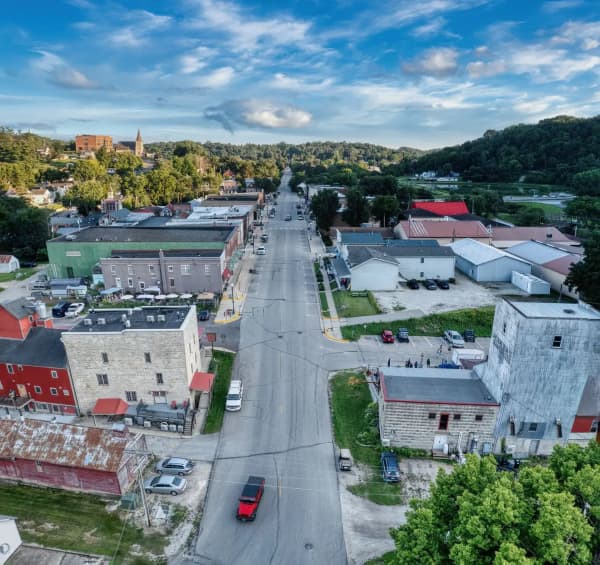
Pleasant Grove is one of the older cities in Utah Valley and one of the least likely to be described as up-and-coming, which is meant here as a compliment. It is largely built out, tree-lined and settled — the nickname is Utah's City of Trees — and it sits with its back directly against Mount Timpanogos, which gives it two canyons inside the city limits and the best everyday view of the mountain in the valley.
Its two biggest draws are a festival that has run for more than a century and a quarter-acre American flag hung across a canyon wall. Neither is what most visitors expect, and neither shows up on the standard Utah Valley itinerary.
Here is what to do with a day here.
Strawberry Days
Strawberry Days is the reason most people outside the city know Pleasant Grove's name. It runs in June, usually the third week, and it is a community festival first and a tourist event a distant second — which is exactly what makes it worth attending.
The modern week is built around a PRCA rodeo, a grand parade, a carnival, a car show and cruise, an art show, a Miss Strawberry Days competition, sports tournaments, a pie-eating contest, concerts, and the strawberries and cream that gave the festival its name and that people do queue for.
The first celebration is the interesting part. Contemporary accounts describe a public program held in the street, sponsored by the Old Wasatch Club — a business group that functioned as an early chamber of commerce. Bleachers were put up in a pasture, and what spectators watched was a pony parade and a horse-pulling contest. Out-of-town visitors arrived on the Orem Interurban, the electric railway that ran the length of the valley. Provo businesses closed for the day, and Provo sent its band up to play alongside Pleasant Grove's. Strawberries and cream were served, and the dancing ran into the night.
The name was not decorative. Strawberries were a real local crop — one account puts roughly 250 acres under strawberries in the early 1920s — and the festival was deliberately timed to land at the end of the harvest. Large-scale commercial strawberry farming in Pleasant Grove is long gone. The festival kept the name anyway, which is the usual way these things go in Utah Valley: Payson's Golden Onion Days and American Fork's Steel Days are both named after industries that have left.
About the "oldest festival in Utah" claim
You will see Strawberry Days described as Utah's oldest continuous community celebration. That claim is contested, and it is worth understanding why rather than picking a side.
The disagreement is not really about dates — it is about categories. Newspaper accounts and the festival's own tradition put the first celebration in 1921 and call it Utah's oldest continuous city celebration. Encyclopedia-style sources put the first festival in June 1922 and call it Utah's second-oldest community harvest festival. Those two statements can both be true at once, because they are counting different things: one is measuring unbroken civic celebrations, the other is measuring harvest festivals specifically. Utah's state tourism office splits the difference and calls it "one of Utah's oldest," while making a narrower and better-supported claim about the rodeo being the longest continually running in the state.
There is also an arithmetic tell. A 1989 newspaper account billed that year's festival as the 68th. An unbroken run beginning in 1921 would have made 1989 the 69th. That is a one-year gap somewhere — the same shape as the edition-count gap in Payson's Golden Onion Days, where the arithmetic also comes up one short of the founding year.
Why "continuous" is doing the heavy lifting: American Fork, one city north, has a summer celebration with roots reaching back to the 1860s — older than Strawberry Days by any measure — but its own published history records that the city held no celebration at all in 1964 or 1965. Continuity, not age, is what the Pleasant Grove claim rests on. That is a real distinction and a defensible one; it is simply not the same claim as "oldest."
This site used to state the superlative flatly. It does not any more.
Follow the Flag, Grove Creek Canyon
The other thing Pleasant Grove does that nowhere else does: every Fourth of July, a giant American flag is unfurled across the mouth of Grove Creek Canyon, where it hangs against the Wasatch for roughly a week.
The scale is the point. The flag runs about 150 feet by 78 feet — more than a quarter-acre of fabric, about 400 pounds — strung across the canyon mouth. It is visible from a long way out across the north end of the valley, which means you do not have to hike at all to see it. A drive up the hill will do.
Standing under it is a different experience from seeing it, though, and the walk is short: a few minutes from the parking area, on maintained dirt, with state flags lining the path. There are restrooms at the trailhead. It is family- and dog-friendly.
The "By the Dawn's Early Light" unfurling ceremony takes place the morning of July 4 at the Grove Creek Canyon trailhead, at the top of Grove Creek Drive. The flag then stays up for roughly the following week and a half, so the ceremony is not your only window. The nonprofit behind it has also built its own traditions around the flag — a Flag Walk in late June, when hundreds of people carry the folded flag uphill from the city cemetery to the trailhead, plus music at the flag site and a trail run later in the month.
Full details are in our Follow the Flag event guide. Confirm the current year's schedule before planning around a specific morning.
The Grid
Pleasant Grove holds one of the most unusual indoor venues in the county: a multi-level kart track with a corkscrew that descends three stories. Our guide to The Grid covers what is there and how to plan a visit.
Battle Creek Falls
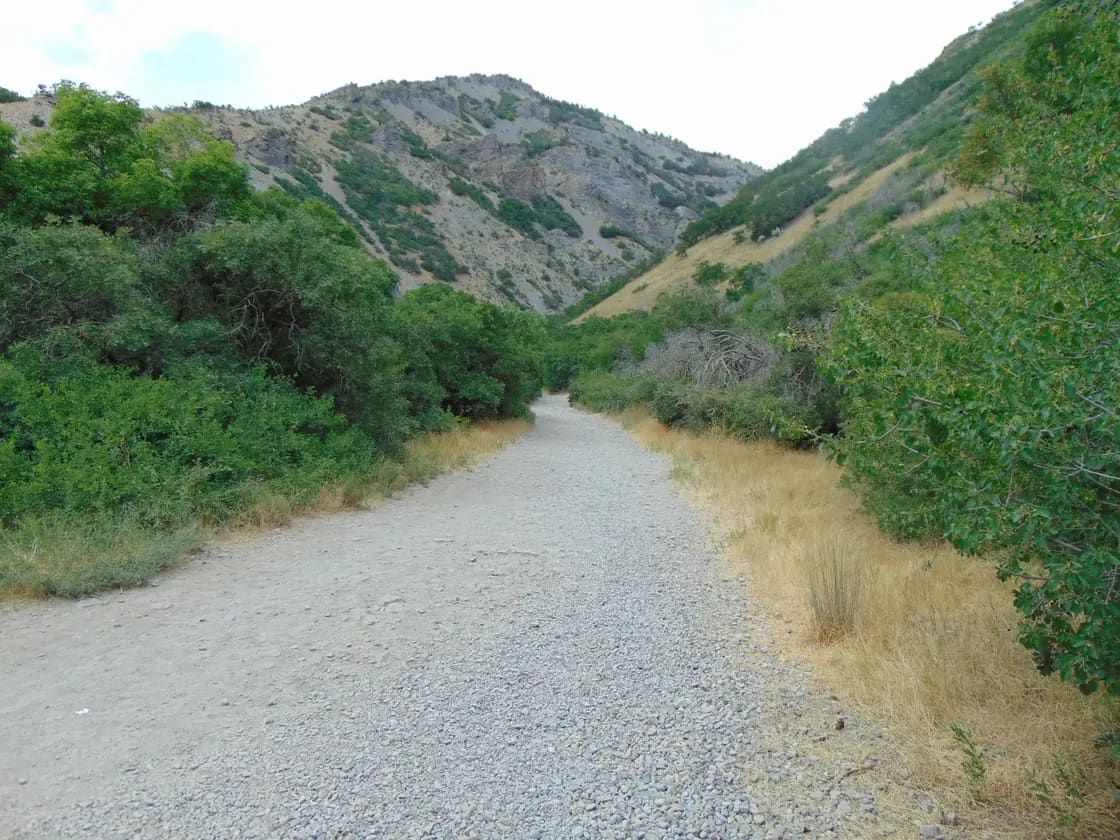
The best hike in town starts at the eastern edge of it. Battle Creek Falls is among the most accessible waterfall hikes in the valley — a short out-and-back on a wide gravel start, ending at a roughly fifty-foot falls you can walk right up to. There is no fee and no permit, which is not universal locally: Stewart Falls sits behind a Forest Service recreation fee from the Aspen Grove side, and Timpanogos Cave requires a paid tour ticket.
That accessibility is also the trail's main problem. On a July Saturday the parking area behaves like a shopping center car park in December. Go early, or go on a weekday.
A naming trap worth knowing about. The Battle Creek trailhead is at Pleasant Grove's Kiwanis Park, at the mouth of Battle Creek Canyon. Provo also has a Kiwanis Park, on the other side of the valley — it is the finish line for the Freedom Run every July 4. They are two different parks in two different cities with the same name, and a navigation app given only "Kiwanis Park" can reasonably send you to the wrong one. Search the canyon or the trail, not the park name.
Pleasant Grove has been rebuilding the Battle Creek trailhead parking area through 2026, so the approach and capacity may differ from whatever an older blog post described. Pull it up before you leave.
At the mouth of the canyon there is a monument and plaque marking the 1849 event that gave the creek — and originally the town — its name. Our Battle Creek Falls guide covers that history properly, including why sources disagree on the death toll and on whether to call it a battle, a skirmish or a massacre. It is not tidy, and this site does not tidy it.
The G, and the canyon most visitors miss
Above town, the large "G" on the mountainside is a Pleasant Grove landmark visible across the north end of the valley — the initial of the local high school, maintained as a community fixture. Hiking up to it is a standard local outing: short, steep and more workout than stroll, with a wide payoff over Utah Valley at the top.
Pleasant Grove has two canyons, and almost every visitor only uses one. Battle Creek is the famous one. Grove Creek Canyon, immediately north, carries the other main trail out of the city and is where the flag hangs. It climbs harder and faster than Battle Creek does and it is quieter for it, and the two connect on the bench above town, so a loop is possible for anyone willing to work for it. Take water; the exposure on the Grove Creek side is real in summer.
Both canyons feed into the wider Mount Timpanogos trail network. Timpanogos itself is a serious all-day summit and not a casual outing — the standard approaches start elsewhere, and we cover them in the Mount Timpanogos hike guide.
The starship simulator nobody tells you about
The most unusual thing in Pleasant Grove is bolted onto the side of an elementary school.
The Christa McAuliffe Space Center sits on the campus of Central Elementary, and it is not a school science lab with ambitions. It runs six starship simulators — full bridge sets with crew stations, where groups take roles as captain, engineer, scientist and the rest and fly a scripted mission with a live flight director improvising against them. Missions run two and a half to five hours, and the center sets a minimum age of 10. The building also holds a planetarium, with public shows on most Monday, Wednesday, Friday and Saturday evenings.
It began in 1990 as one teacher's classroom experiment. Victor Williamson, then teaching at Central Elementary, built the first simulator — Voyager — through grants, donations and volunteer labor, and it opened on November 8, 1990. It grew from there into today's six-ship fleet at 95 North 400 East.
The part visitors miss: it is not schools-only. The center runs public simulator flights and planetarium shows on select weekday evenings and Saturdays, bookable by the group — birthday parties, family reunions, team events, and, genuinely, date nights. Reservations open up to 90 days out and the ships book up, so this is a plan-ahead activity rather than a drop-in one. Check the current schedule and reserve before you drive.
It has also gone by the Christa McAuliffe Space Education Center, so older listings and directions may use either name. It is the same place, named for the teacher chosen for NASA's Teacher in Space project who died aboard Challenger in 1986.
When the weather is wrong
Pleasant Grove has a denser cluster of indoor commercial entertainment than a city this size normally supports, most of it near the I-15 side of town.
The Grid is the anchor: indoor go-kart racing on a multi-level track with elevation changes and banked turns, plus a large arcade. Enthusiast write-ups make big claims about the track's length relative to other American circuits; treat those as marketing until you see the operator say it. The karts are the reason to go regardless. There is also axe throwing and at least one escape-room operator in town, and the space center above is the best bad-weather option in the city if you can get a booking.
One correction, because half the activity lists still get this wrong: Evermore Park is closed. The immersive fantasy park was in Pleasant Grove, not Orem — a common misattribution — and it has shut permanently. It still appears near the top of current "things to do in Pleasant Grove" round-ups, some of them written this year. If a page is recommending Evermore to you today, that page has not been checked recently, and you should discount whatever else it says about the city.
Parks, and one with a tech-company backstory
For a city of its size, Pleasant Grove's park system does a lot of work. Discovery Park, on the north end near 100 East, is the one families name first — it splits its playgrounds by age, with a separate structure for under-fives, and it is built for the kind of afternoon where nobody has planned anything. It sits alongside Manila Park, which carries the sports fields and a walking path, and some sources describe the two as one complex rather than neighbors; the science-themed portion is credited to Novell, the Orem software company that shows up throughout Utah Valley's tech history. It is a small, odd, local detail: a playground funded by a company that once fought Microsoft.
Anderson Park on the east side is the other one worth knowing, and it hosts city events through the summer.
Main Street and the older core
Pleasant Grove's historic Main Street anchors a small downtown of local shops and restaurants. It is a district rather than a destination, but it reflects the city's actual character far better than the commercial strips out on the arterials do.
The building most worth ten minutes is the Pleasant Grove Tithing Office at 7 South 300 East — a one-story brick building constructed around 1908 and listed on the National Register of Historic Places in 1985. It was listed as one of 28 well-preserved tithing buildings in Utah, buildings that functioned as the collection and redistribution points of a nineteenth-century economy that ran substantially on goods rather than cash: a family's tithe might arrive as grain, eggs or livestock, and the tithing office is where it was received and stored. Almost nothing else in the north valley makes that economy as legible.
Eating here
Pleasant Grove and Lindon share one commercial corridor and, for practical purposes, one restaurant scene — State Street forms much of the boundary between them, and several restaurants sit close enough to it that even their own listings sometimes disagree about which city they are in. We cover both together in the Pleasant Grove and Lindon restaurant guide.
One local fact that gets missed: Chubby's Cafe started here, at 336 South Main Street. It has since grown into a chain of a dozen locations across Utah, from Vineyard and Orem down to St. George and out to Tooele — but the original is a Pleasant Grove restaurant, and the beer-battered fries are the reason people who moved away still stop on the way through.
The old-fashioned end of town is Purple Turtle, a diner locals have been going to for decades for burgers and fish and chips — and, in June, for strawberry shakes, which is the one week of the year when ordering one feels like participating in something.
Pleasant Grove also holds a genuine curiosity for Utah County: Clear Water Distilling, which describes itself as the first distillery in the county, operates on 700 South. In a county where the drinking culture is covered mainly by explaining what is not available, an operating distillery is a real outlier. Our Utah Valley nightlife guide covers the wider picture, including the state alcohol rules that catch visitors out.
Sunday is the constraint, as it is across most of the north valley. A meaningful share of the independent kitchens here close outright, and several close Mondays too.
The city's other name
Pleasant Grove was settled on September 13, 1850, by eight founding families, and incorporated by the territorial legislature on January 19, 1855. For its first years it was called Battle Creek, after the 1849 event at the canyon mouth. The settlers wanted something less grim, and renamed the town after the small grove of trees where they had settled, near what is now Locust Avenue and 200 South.
It is a small thing, but it is the same pattern as its neighbor: American Fork spent eight years incorporated as Lake City before changing back. Two adjacent Utah County cities, both of which are not using the name they started with.
doTERRA is headquartered here, and its campus is one of the most visible corporate presences in north Utah County. It is not a visitor attraction, but it is a landmark and a large part of the local economy.
What's minutes away
Pleasant Grove's position is half its value. Within about fifteen minutes you can reach Thanksgiving Point in Lehi, American Fork Canyon and Timpanogos Cave, the Alpine Loop in season, and the shopping and dining in Orem and American Fork.
Provo is roughly 15 to 20 minutes south on I-15 in normal traffic — longer at commute times, when the corridor between here and Orem is one of the slower stretches in the county.
If you only have three hours
Three hours in Pleasant Grove is a choice between a canyon and a kart track, and both are defensible.
If you want the canyon: Battle Creek Falls is the obvious call — a short out-and-back on a wide gravel start, ending at a roughly fifty-foot waterfall you can walk right up to, with no fee and no permit. That is not universal locally; Stewart Falls sits behind a Forest Service recreation fee from the Aspen Grove side. The catch is parking. On a July Saturday the lot behaves like a shopping center car park in December. Go early or go on a weekday, and note that the city has been rebuilding the trailhead parking area through 2026, so the approach may not match an older blog post.
The naming trap that ruins the trip: the Battle Creek trailhead is at Pleasant Grove's Kiwanis Park. Provo also has a Kiwanis Park, on the other side of the valley. Give a navigation app only "Kiwanis Park" and it can reasonably send you twenty-five minutes wrong. Search the canyon or the trail, not the park name.
If you want the indoor option: The Grid is a multi-level indoor kart track with a corkscrew that descends three stories, plus a large arcade. It fills three hours without difficulty.
If you are here in early July, neither is the answer. The giant flag across the mouth of Grove Creek Canyon — roughly 150 feet by 78 feet, more than a quarter-acre of fabric — is up for about a week and a half from July 4, and it is visible from a long way out across the north valley. You do not have to hike to see it; a drive up the hill will do. Standing under it is a short walk from the parking area on maintained dirt, with restrooms at the trailhead. The Follow the Flag guide has the schedule.
Pleasant Grove with kids
This city punches well above its size for children, and the reason is one attraction almost nobody outside the county knows about.
The Christa McAuliffe Space Center is bolted onto the side of an elementary school and it is not a school science lab. It runs six starship simulators — full bridge sets where a group takes roles as captain, engineer and scientist and flies a scripted mission against a live flight director — plus a planetarium. Missions run two and a half to five hours, for ages 10 and up.
The part visitors miss is that it is not schools-only. Public simulator flights and planetarium shows run on select weekday evenings and Saturdays, bookable by the group. Reservations open up to 90 days out and the ships book up, so this is a plan-ahead activity rather than a drop-in one. It has also gone by the Christa McAuliffe Space Education Center, so older listings use either name.
Battle Creek Falls is the right size for children — short, wide underfoot at the start, free, and the waterfall is a real payoff rather than a viewpoint. Discovery Park is the park families name first: it splits its playgrounds by age, with a separate structure for under-fives, and it sits alongside Manila Park and its sports fields. The science-themed portion is credited to Novell, which makes it a playground funded by a company that once fought Microsoft — see Utah Valley's tech history. The destination playgrounds guide covers the county's best.
One correction, because half the activity lists still get it wrong: Evermore Park is closed. The immersive fantasy park was in Pleasant Grove — not Orem, a common misattribution — and it has shut permanently. If a page is recommending it to you today, discount whatever else it says about the city.
Pleasant Grove on a Sunday
Pleasant Grove's Sunday splits cleanly: the outdoors is fully available and the indoor cluster largely is not.
The canyons do not observe Sundays. Battle Creek Falls, Grove Creek Canyon and the hike up to the G are all open, free and ungated. A Sunday is one of the better days for Battle Creek precisely because of the parking problem — the crush is a Saturday phenomenon more than a Sunday one, though in high summer neither day is quiet. Grove Creek is the quieter canyon in any case: it climbs harder and faster than Battle Creek and is emptier for it, and the two connect on the bench above town if you are willing to work for the loop. Take water; the exposure on the Grove Creek side is real.
The space center is the one to check. Its public flights run on select weekday evenings and Saturdays, which means Sunday is not part of the public schedule — do not build a Sunday around it.
The flag, in season, has no hours at all. It hangs across the canyon mouth for roughly a week and a half from July 4, day and night.
The Tithing Office at 7 South 300 East is a street-visible historic building rather than a staffed attraction, so a Sunday walk down Main Street works fine. For food, Pleasant Grove and Lindon share one corridor and effectively one restaurant scene — the joint guide gives the current picture, and the valley-wide Sunday guide covers the county.
Pleasant Grove in winter
Pleasant Grove is the best-equipped city in Utah Valley for a bad day, and it is not close. It carries a denser cluster of indoor commercial entertainment than a city this size normally supports, most of it near the I-15 side of town.
The Grid is the anchor — indoor karting on a multi-level track with elevation changes and banked turns, plus a large arcade. Enthusiast write-ups make big claims about the track's length against other American circuits; treat those as marketing until the operator says it. The karts are the reason to go regardless. There is also axe throwing and at least one escape-room operator in town.
The space center is the best bad-weather option in the city if you can get a booking — six simulators and a planetarium dome, entirely indoors, and a two-and-a-half-hour mission is a whole winter afternoon. The 90-day reservation window means winter plans should be made in autumn.
Outdoors, the canyons change character. Battle Creek and Grove Creek are lower-elevation trails than the Alpine Loop side of the valley, so they stay walkable longer into the season than the high routes do — but they also ice, and the Grove Creek grade is steep enough that traction matters more than it looks. The flag is a summer fixture, not a winter one; the unfurling is July 4 and it comes down after about a week and a half.
For the rest of the season, the rec centers guide compares the county's indoor facilities, the indoor activities guide covers cold-day options valley-wide, the winter activities guide covers the season, and the Christmas lights guide maps the display circuit.
Six places in Pleasant Grove, in one list
Everything below is a place you can go in Pleasant Grove. Six is a short list and it is the honest number, not a placeholder. Two of the six point at the Follow the Flag guide, because the flag and the canyon it hangs across are covered there as one thing rather than as separate pages.
The Christa McAuliffe Space Center, the Tithing Office on 300 East, the G, Manila and Anderson Parks and the city's restaurants are all here too. Evermore Park is absent because it has closed permanently. Kiwanis Park is left out because Provo has one too and the two are easy to mix up. Hours and prices are left out on purpose, because both change.
Make a day of it
A summer morning. Battle Creek Falls early, before the lot fills. Breakfast or an early lunch on the Pleasant Grove and Lindon corridor. Discovery Park in the afternoon if there are children, or the G if there are not.
The Fourth of July. The morning flag ceremony in Grove Creek Canyon, then the rest of the day anywhere in the valley. This is the strongest single-morning case for driving to Pleasant Grove specifically.
Strawberry Days week in June. Pick the parade morning or a rodeo night; the two feel like different festivals. Do not try to do the whole week unless you live here.
Autumn. The canyons hold color later than the valley floor, and the Alpine Loop up the road is one of the best leaf drives in the state — see our fall guide for timing.
Thinking about living here?
If a visit has you wondering about the housing market, the schools and what it is like day to day, our complete guide to living in Pleasant Grove covers all of it, including the Timpanogos School District split that takes effect in 2027 and puts Pleasant Grove in a new district alongside Orem, Lindon and Vineyard.
Related Guides
- Things to Do in Lindon, Utah: A Local's Guide (2026)
- Things to Do in Springville, Utah (2026)
- Utah Valley Hike Finder — filter every trail by difficulty, length, season, dogs and fees
Frequently Asked Questions
What is Pleasant Grove, Utah known for?
Is Strawberry Days really the oldest festival in Utah?
When is Strawberry Days in Pleasant Grove?
What is the giant flag in Pleasant Grove?
How hard is the Battle Creek Falls hike?
What is the G above Pleasant Grove?
Does Pleasant Grove have anything historic to see?
How far is Pleasant Grove from Provo?
Sources
The facts in this guide were checked against these sources. Hours, fees and rules change, so confirm anything time-sensitive with the source before you go. How we make Provo.com.
- Pleasant Grove City: History, Pleasant Grove City. Checked October 12, 2026.
- Annual Heritage Festival, Pleasant Grove City. Checked October 12, 2026.
- Community Events, Pleasant Grove City. Checked October 12, 2026.
- Pleasant Grove Tithing Office, Utah State Historical Society structure/site form (NRHP), National Park Service (NPGallery). Checked October 12, 2026.
- FAQ: The New School District Boundaries, Utah County. Checked October 12, 2026.
- Pleasant Grove City Council meeting notice (Evermore Park liquor consent), Utah Public Notice Website. Checked October 12, 2026.
- Follow the Flag: FAQ's, Follow the Flag. Checked October 12, 2026.
- Follow the Flag (home, flight list), Follow the Flag. Checked October 12, 2026.
- Christa McAuliffe Space Center (Alpine School District): Simulators, Christa McAuliffe Space Center (Alpine School District). Checked October 12, 2026.
- Christa McAuliffe Space Center (Alpine School District): About, Christa McAuliffe Space Center (Alpine School District). Checked October 12, 2026.
- Christa McAuliffe Space Center (Alpine School District): Planetarium, Christa McAuliffe Space Center (Alpine School District). Checked October 12, 2026.
- The Grid. Checked October 12, 2026.
- Chubby's Cafe locations, Chubby's Cafe. Checked October 12, 2026.
- Clear Water Distilling: About, Clear Water Distilling. Checked October 12, 2026.